
Why Lighting for Microgreens Makes or Breaks Your Harvest
Lighting for microgreens is one of the most important factors in growing healthy, flavorful, nutrient-dense crops indoors. Get it right, and you’ll have vibrant, thick stems and rich color. Get it wrong, and you’ll end up with pale, leggy plants that lack both flavor and nutrition.
Here’s a quick summary of what microgreens need from their lights:
| Factor | Recommended Range |
|---|---|
| Light type | Full-spectrum LED (shop lights or T5/T8 strips) |
| Color temperature | 4,000K – 6,500K (daylight spectrum) |
| Daily light hours | 12-18 hours (17 on / 7 off is a common sweet spot) |
| Light distance from canopy | 6-12 inches (15-30 cm) |
| Minimum intensity | 20 watts per tray / 100-120 µmol/m²/s PPFD |
| Optimal PPFD | 200-400 µmol/m²/s |
| When to start lighting | After 3-5 days of darkness (post-germination) |
Microgreens are surprisingly flexible when it comes to lighting. You don’t need expensive, specialized grow lights to get great results. In fact, affordable LED shop lights in the daylight spectrum often outperform pricier alternatives for home growers.
But there’s more to it than just flipping a switch. How long, how far, and what kind of light you use all affect your yield, nutrition, and flavor in measurable ways. For example, research shows that a 16-hour photoperiod can increase antioxidant capacity by 25% and boost beneficial compounds like betalains by nearly 50% compared to a 12-hour schedule.
This guide walks you through everything – from choosing the right bulb to setting up your rack – so you can grow with confidence from day one.
Choosing the Best Lighting for Microgreens
When we first start exploring lighting for microgreens, the sheer number of options can feel overwhelming. Do you need a high-end purple “blurple” light, or will a standard light from the hardware store do?
Based on our testing and extensive research, the most effective and budget-friendly choice for almost every grower is the LED shop light. Specifically, T5 or T8 LED strips are the industry standard for a reason. They offer a slim profile that fits perfectly under shelving units, produce very little heat, and provide the uniform coverage needed for 10×20 trays.
While specialized LED grow panels (like the Spider Farmer SF1000 (100W)) offer incredible power and are great for larger plants or professional setups, they can sometimes be “overkill” for simple microgreens. On the other hand, traditional T5 fluorescent lights are becoming obsolete; they consume more electricity, run hotter, and lose their effectiveness much faster than LEDs.
Science actually supports the move toward simple white LEDs. One comprehensive study on kale microgreens found that those grown under white LEDs had significantly higher levels of all major carotenoids compared to those grown under specialized red or blue LEDs. This is great news for your wallet because it means you don’t need to spend a fortune on “specialty” spectrums to get superior nutrition.
To help you decide, we’ve put together a guide on choosing the right lighting for growing microgreens that breaks down these options further.
| Light Type | Energy Efficiency | Heat Output | Best Use Case |
|---|---|---|---|
| LED Shop Lights (T5/T8) | High | Very Low | Standard shelving, home & commercial |
| T5 Fluorescent | Medium | Moderate | Budget starts (if already owned) |
| LED Grow Panels | High | Moderate | High-intensity crops, large open areas |
Technical Specifications: Spectrum, Intensity, and Distance
To maximize the “Return on Investment” (ROI) of your grow, you need to understand the technical side of light. We don’t just want green plants; we want dense, flavorful greens that look as good as they taste.
Optimal Spectrum for Lighting for Microgreens
The “color” of your light is measured in Kelvin (K). For microgreens, we want to mimic the bright, midday sun. This is why we recommend lights in the 5500K-6500K range, often labeled as “Daylight.”
Why does this matter?
- Blue Wavelengths (400-500nm): These are crucial for keeping plants short and dense. Without enough blue light, microgreens “stretch” toward the source, becoming thin and weak.
- Red Wavelengths (600-700nm): These encourage biomass and leaf expansion.
- Full Spectrum (White): By using a full-spectrum white light, you ensure the plants get a balanced diet of wavelengths. This balance is what drives the production of chlorophyll and carotenoids (like lutein and beta-carotene).
If you’re looking for a starting point, check out these affordable grow lights for microgreens that hit that 6500K sweet spot perfectly.
Positioning and Intensity of Lighting for Microgreens
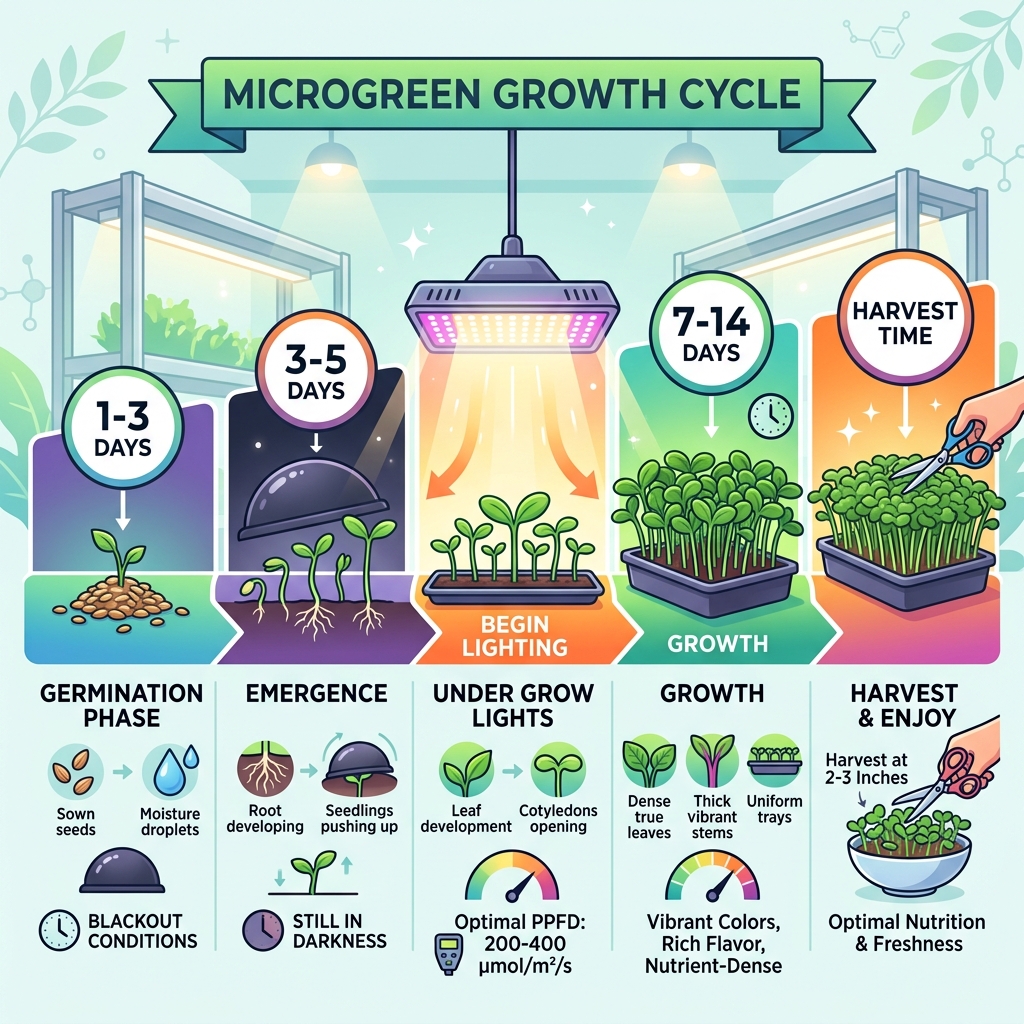
Intensity is often measured in PPFD (Photosynthetic Photon Flux Density), which tells us how many “light particles” are actually hitting your plants. For healthy microgreens, we aim for:
- Minimum: 100-120 µmol/m²/s
- Optimal: 200-400 µmol/m²/s
If you don’t have a PAR meter to measure PPFD, don’t worry! A good rule of thumb is to ensure you have at least 20 watts per 10×20 tray or roughly 2,000 lumens per shelf.
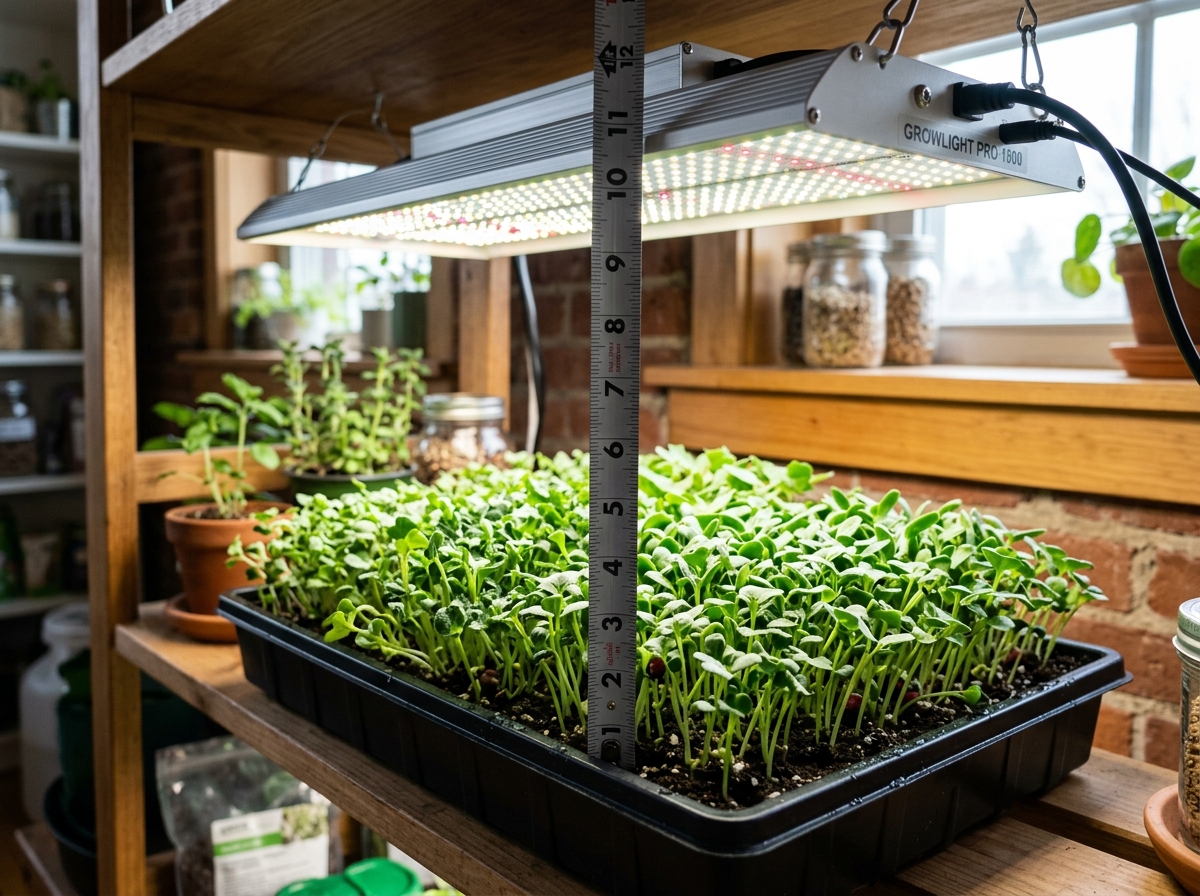
The distance between your light and the plant canopy is the most common variable growers adjust. Generally, 6-12 inches (15-30 cm) is the magic range.
- Too close (under 6 inches): You risk “bleaching” the leaves or causing heat stress, even with LEDs.
- Too far (over 12 inches): The light intensity drops off significantly, leading to “leggy” growth where stems are long, pale, and prone to falling over.
For more on getting your rack setup right, see our guide on the best indoor grow lights for microgreens.
Managing the Photoperiod and Growth Stages
Just like us, plants have a circadian rhythm. They need a “work” period (light) to photosynthesize and a “rest” period (dark) to process that energy.
Finding the “Sweet Spot” Schedule
We’ve found that while microgreens can grow on a 12/12 schedule (12 hours on, 12 hours off), they truly thrive with a bit more overtime.
- 16/8 Schedule: A very popular choice that balances growth with energy costs.
- 18/6 Schedule: Great for faster growth and maximum nutrient density.
- 17/7 Schedule: Our “Goldilocks” recommendation. 17 hours of light provides ample energy for the plants to develop deep colors and spicy flavors without significantly increasing your power bill.
Consistency is key! Using a simple electric timer to automate this process ensures your plants never miss a “sunrise.” For a deeper dive into how these schedules affect your plants, read our article on led grow lights for microgreens.
From Germination to Light Exposure
One of the most common questions beginners ask is: “When do I turn the lights on?”
Microgreens actually start their journey in the dark. This is called the blackout phase. During this time (usually 3-5 days), we keep the seeds covered, often with a weighted tray on top. This mimics being underground and encourages the seeds to develop strong roots and push upward.
You should expose your microgreens to light when:
- They have germinated and are roughly 2-3cm (about an inch) tall.
- They are starting to shed their seed hulls.
- They look slightly yellow (this is normal—they’ll turn green within hours of hitting the light!).
Moving them to light too early can result in shorter yields, while waiting too long can make them overly leggy and yellow. We’ve detailed this transition in enlightening indoor microgreens: a guide to lighting.
Cost Analysis and Energy Efficiency for Growers
At FinanceOrbitX, we love talking about efficiency. Growing your own food should be a savvy financial move, not a drain on your bank account.
The good news? LED setups are incredibly cheap to run. Let’s look at the numbers: If you use three 20-watt LED shop lights (60W total) on a single shelf for 17 hours a day, and your electricity rate is $0.12/kWh, your monthly cost is approximately $3.67 per shelf.
To maximize your efficiency:
- Daisy-chain your lights: Many LED strips allow you to plug them into one another, meaning you only need one outlet for an entire grow rack.
- Use Reflective Surfaces: Surrounding your rack with Mylar or even simple white foam board can increase light uniformity by 10-30% without adding a single watt of power.
- Clean Your Bulbs: Dust can reduce light output by over 20%. A quick wipe once a month keeps your “assets” performing at their peak.
For more tips on keeping your grow-op lean and green, check out enlightening indoor microgreens: a guide to lighting 2.
Troubleshooting Common Lighting Mistakes
Even with the best intentions, things can go sideways. Here is how to spot—and fix—common lighting issues:
1. Leggy, Stretched Stems
- The Symptom: Your microgreens are tall, thin, and falling over.
- The Cause: Not enough light intensity or lights are too far away.
- The Fix: Lower your lights to the 6-8 inch range or add an extra light strip to the shelf.
2. Pale or Yellow Leaves
- The Symptom: Plants look washed out even after several days under lights.
- The Cause: Incorrect spectrum (too much red, not enough blue) or insufficient duration.
- The Fix: Ensure you are using “Daylight” (5500K-6500K) bulbs and running them for at least 12-16 hours.
3. Light Bleaching or Crispy Edges
- The Symptom: The tops of the leaves look white or burnt.
- The Cause: Lights are too close or too powerful for the specific variety.
- The Fix: Raise the lights by 2-3 inches.
4. Uneven Growth
- The Symptom: Plants in the center of the tray are tall, while the edges are short.
- The Cause: Poor light distribution.
- The Fix: Ensure you have multiple light strips per shelf (we recommend three 20-watt LED shop lights in the 5500-6500K range per shelf). You can also rotate your trays 180 degrees halfway through the grow cycle.
Frequently Asked Questions about Microgreen Lighting
Can I use regular LED shop lights instead of specialized grow lights?
Yes, absolutely! In fact, many experienced growers prefer them. Standard LED shop lights in the 5500K-6500K range provide the exact daylight spectrum microgreens need. They are often cheaper, more readily available, and produce excellent results for both fast-growers (like radish) and slow-growers (like basil).
How many hours of light do microgreens need daily for optimal flavor?
While they can survive on 6-8 hours, 12-18 hours is the range for optimal flavor. Longer light cycles (like 17 hours) help develop the secondary metabolites that give microgreens their intense spicy, nutty, or sweet flavor profiles.
When is the best time to move microgreens from the dark to the light?
Move them once they have germinated and reached about 2-3cm in height. This usually happens between day 3 and day 5, depending on the variety and room temperature. If they look a little “squashed” from the weighted tray, don’t worry—they will straighten up and turn green almost immediately once the lights come on.
Conclusion
Mastering lighting for microgreens is the single best way to ensure a high “yield on investment” for your indoor garden. By choosing efficient LED shop lights, maintaining a consistent 17-hour photoperiod, and keeping your canopy 6-12 inches from the source, you’re setting yourself up for professional-grade success.
At FinanceOrbitX, we believe that sustainable gardening should be accessible, logical, and scalable. Whether you’re growing a single tray on a counter or a full multi-tier rack in your garage, the right light is the key to unlocking the full nutritional potential of these tiny superfoods.
Ready to take the next step? Start your indoor gardening journey here and discover how easy it is to grow fresh, vibrant greens right in your own home.
