
Why Watering Frequency Makes or Breaks Your Microgreens
How often to water microgreens depends on their growth stage, but here’s a quick answer to get you started:
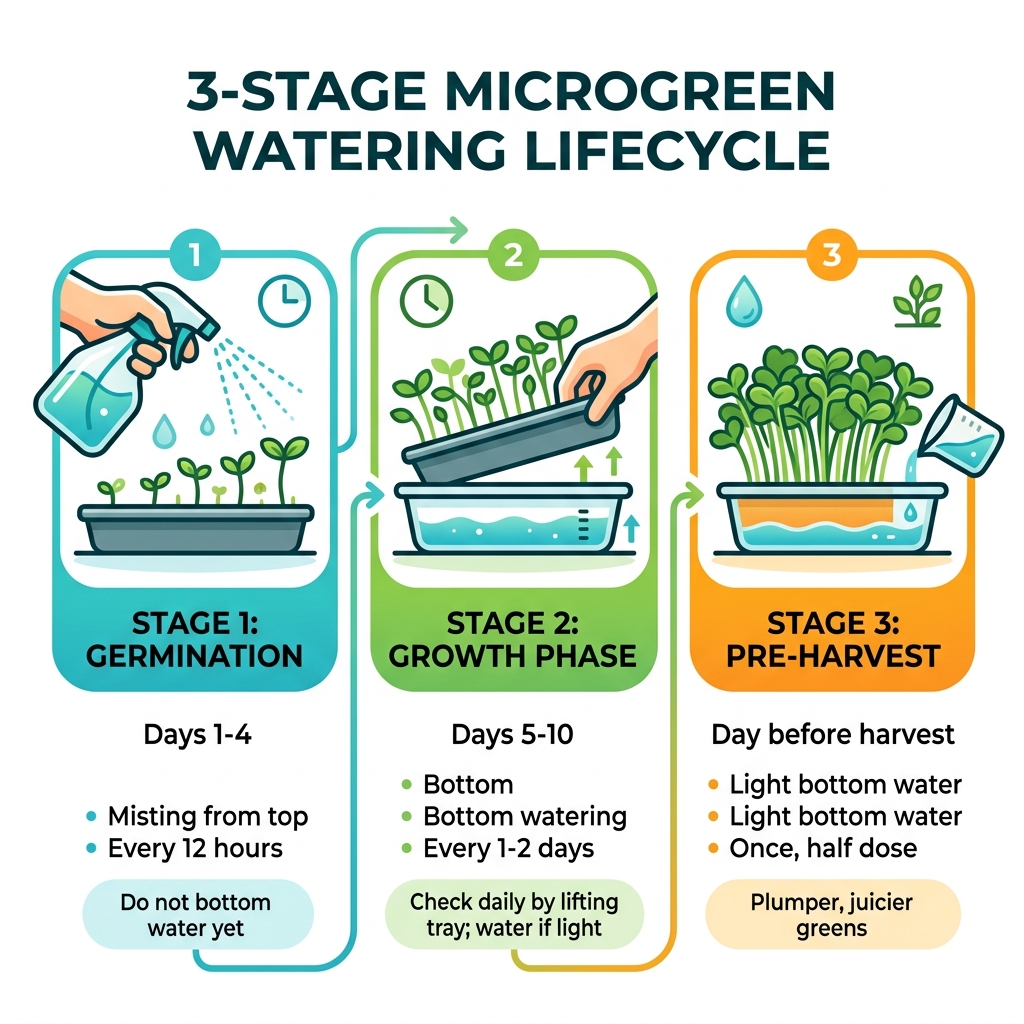
| Growth Stage | Watering Method | Frequency |
|---|---|---|
| Germination (Days 1-4) | Misting from top | Every 12 hours |
| Growth phase (Days 5-10) | Bottom watering | Every 1-2 days |
| Pre-harvest (Day before harvest) | Light bottom water | Once, half dose |
- Germination: Mist lightly every 12 hours. Do not bottom water yet.
- Growth phase: Bottom water with 1-2 cups depending on tray size. Check daily by lifting the tray — if it feels light, water it.
- Pre-harvest: Give a half-dose of water the morning before harvest for plumper, juicier greens.
Watering microgreens sounds simple. But it’s one of the most common places beginners go wrong.
Too much water and you get mold, root rot, and slimy stems. Too little and your greens wilt within hours. The tricky part? Both problems can look similar at first glance.
Here’s the thing most guides don’t tell you upfront: there is no single fixed watering schedule that works for everyone. Your tray size, growing medium, room temperature, and the variety you’re growing all change how often your microgreens need water.
The good news is that once you understand the basic stages and learn to read your trays, watering becomes almost second nature. And as one widely-shared principle among experienced growers puts it — it’s better to underwater than overwater, because microgreens can recover from a dry spell far more easily than from soggy roots.
This guide will walk you through exactly what to do at each stage, how much water to use, and how to spot problems early before they ruin your crop.
How Often to Water Microgreens Based on Growth Stage
At FinanceOrbitX, we believe that mastering the “cash flow” of your garden—the water—is the ultimate investment in a high-yield harvest. Just like a financial portfolio, your microgreens require different levels of attention as they mature. You wouldn’t manage a retirement fund the same way you manage a checking account, and you shouldn’t water a seed the same way you water a four-inch-tall pea shoot.
Understanding how often to water microgreens requires looking at the calendar. Here is a breakdown of the typical lifecycle:
| Phase | Duration | Primary Goal | Watering Frequency |
|---|---|---|---|
| Soaking | Day 0 | Rehydrate seed | Once (for large seeds like peas/sunflower) |
| Seeding | Day 1 | Initial moisture | Mist soil surface and seeds thoroughly |
| Blackout | Days 2-4 | Germination | Mist every 12 hours (if edges look dry) |
| Growth | Days 5-Harvest | Rapid biomass | Bottom water every 1-2 days (based on weight) |
| Pre-Harvest | 12-24h before | Shelf life | Half-dose 12-24 hours before cutting |
To dive deeper into the nuances of these phases, check out our secrets-for-healthy-microgreen-growth guide.
How often to water microgreens during the blackout phase?
The blackout phase is the “incubation” period for your seeds. During this time, they are usually covered by another tray or a humidity dome to keep them in total darkness. Because they are covered, evaporation is minimal.
We recommend a misting schedule of roughly every 12 hours. However, many expert growers find that if the growing medium was properly hydrated at the start, you might not need to add much water at all during the first 48 hours. The goal is to keep the environment humid so the seeds can germinate effectively.
Check the edges of your tray. If the soil or coir looks light brown and “arid,” give it a light spritz with a spray bottle. This moisture helps soften the seed hulls, making it easier for the tiny plants to shed them as they grow. Be careful not to over-mist; standing water on the surface during blackout is an open invitation for mold.
How often to water microgreens right before harvest?
Timing your final hydration is a pro-level move that impacts the quality of your greens. If you water right before you cut them, the leaves and stems will be wet, which leads to rapid rot in the refrigerator. If you don’t water at all, they might arrive at the kitchen table looking limp and sad.
The “sweet spot” is to water about 12 to 24 hours before harvest. Give them a half-dose (about 50% of your usual amount). This allows the plants to pull that moisture up into their cells, making them “plump” and crunchy, but gives the soil surface and the lower stems enough time to dry out. This balance ensures maximum shelf life and the best possible texture. For more on this, see our guide on the-right-way-to-water-your-microgreens.
Mastering the Methods: From Misting to Bottom Watering
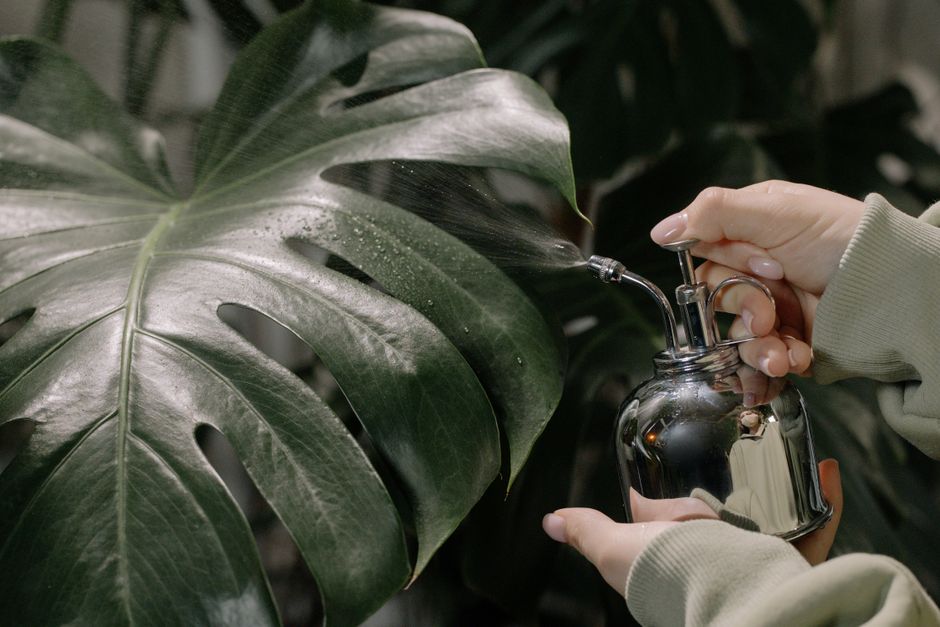
In microgreens, there are two main schools of thought: top-watering and bottom-watering. While top-watering (misting) is essential at the very beginning, California State University research on bottom watering benefits suggests that switching to bottom-watering as soon as possible is the best way to ensure healthy crops.
When and how to switch watering techniques
The transition happens when the “blackout” ends and the lights go on. At this stage, your microgreens have developed “root hairs” (which often look like white fuzz—don’t mistake them for mold!) and their first set of leaves, known as cotyledon leaves.
Once these roots have established themselves in the medium, they are ready to drink from the bottom. To do this effectively, you need a two-tray system:
- The Growing Tray: This tray has drainage holes in the bottom.
- The Reservoir Tray: This is a “no-hole” tray that sits underneath.
To bottom water, simply lift a corner of the growing tray and pour your water into the reservoir tray. We recommend the 20-minute soak rule: let the tray sit in the water for 20 minutes to allow the medium to wick up moisture through capillary action. After 20 minutes, if there is still standing water in the bottom tray, pour it out. This prevents the roots from “drowning” and helps you how-to-avoid-mold-in-your-microgreen-garden.
Determining the Right Amount for Your Tray Size
One of the biggest questions we get is: “Exactly how much water do I pour in?” While environmental factors play a role, you can use these baseline volumes for bottom-watering once your greens are in the growth phase:
- 1020 Tray (approx. 10″ x 20″): 2 cups (500 ml) per watering.
- 1010 Tray (approx. 10″ x 10″): 1 cup (250 ml) per watering.
- Home Tray (approx. 5″ x 7″): 1/2 cup (125 ml) or about 9 tablespoons.
The most reliable way to know how often to water microgreens is the “Lift and Feel” test.
- Immediately after your seeds germinate and you’ve given them their first real drink, lift the tray. Feel that weight? That is “full saturation.”
- Check the tray the next day. Lift it again. As the plants drink and water evaporates, the tray will become significantly lighter.
- When the tray feels light—almost like there’s nothing but dry soil in it—it’s time to water.
Using this dry weight baseline is far more accurate than following a rigid calendar.
Environmental Factors and Medium Impact
Your home isn’t a laboratory, and external factors will constantly shift your watering needs.
- Temperature: Microgreens are happiest in rooms around 68-75°F. If your grow room is hotter, evaporation happens faster, and your plants will “perspire” more, meaning you’ll need to water more frequently.
- Water Temperature: Always use room temperature water (around 70°F). Using ice-cold water straight from the tap can shock the sensitive root systems of these “baby” plants, slowing their growth.
- Humidity and Airflow: If you use fans to prevent mold (which we highly recommend!), the increased airflow will dry out your trays faster. If your humidity is above 60%, the trays will stay wet longer, increasing the risk of rot.
- Growing Medium:
- Coconut Coir: This is a favorite at FinanceOrbitX. It holds water beautifully but doesn’t get “muddy.” It changes color significantly (from dark brown to light tan) when dry, making it a great visual indicator.
- Peat Moss: Excellent water retention, but if it dries out completely, it becomes “hydrophobic” (repels water) and can be very hard to re-wet.
- Hydroponic Mats/Hemp: These have very little “reservoir” capacity. If you use mats, you may need to water twice a day because they dry out much faster than soil.
For a deeper dive into the setup, read the-ultimate-step-by-step-guide-to-growing-microgreens-without-killing-them.
Troubleshooting: Signs of Overwatering and Underwatering
Even the best “garden CFOs” make mistakes. The key is to catch them early.
Signs of Overwatering:
- The Smell: A musty, sour, or “swampy” smell is a dead giveaway.
- Slimy Roots: Healthy roots are vibrant white. If they are brown, translucent, or slimy, you have root rot.
- Yellowing Stems: If the base of the plants looks yellow or pale, they might be “drowning.”
- Mold: Visible white fuzz on the soil surface (not to be confused with root hairs). Use tools-to-prevent-mold-in-microgreens like fans and hydrogen peroxide sprays to manage this.
Signs of Underwatering:
- Wilting: This is the most obvious sign. The plants will lose their “turgor pressure” and flop over.
- Arid Medium: The soil pulls away from the edges of the tray.
- Light Tray: The tray feels like a feather when lifted.
The Recovery Plan: If you’ve overwatered, tip the tray to drain excess water immediately and increase airflow with a fan. Skip the next 1-2 watering sessions. If you’ve underwatered, don’t panic! Microgreens are surprisingly resilient. Give them a full dose of water, and they will usually “stand back up” within a few hours.
Frequently Asked Questions about Microgreen Hydration
What is the ideal pH for watering microgreens?
Most microgreens thrive in slightly acidic water with a pH between 5.5 and 6.5. If your tap water is very alkaline, you can add a small amount of lemon juice (about 2 teaspoons per gallon) to bring the pH down. While many greens grow fine with standard tap water, adjusting the pH can unlock nutrients in the soil and lead to faster growth.
Can microgreens recover if I miss a day of watering?
Yes, usually. Because they are harvested so young, they have a lot of vigor. If they are wilting but not yet “crispy,” a good bottom-watering will usually revive them. However, missing 2 or more days in a hot environment is often fatal. We recommend setting a daily phone reminder to check your trays.
Should I use a fixed schedule or water based on need?
Always water based on need. A fixed schedule doesn’t account for a rainy, humid day or a particularly dry, sunny afternoon. Use the “Lift and Feel” method as your primary guide.
Conclusion
At FinanceOrbitX, we want your first foray into horticulture to be as profitable and enjoyable as a well-timed market trade. Mastering how often to water microgreens is the single most important skill you can develop. By moving from top-misting to bottom-watering and learning to “read” the weight of your trays, you eliminate the guesswork that leads to crop failure.
Remember: observe your plants daily, keep your leaves dry, and when in doubt, it’s usually safer to wait a few hours than to add more water to an already damp tray. To ensure you’re on the right track, be sure to avoid-these-common-microgreen-growing-mistake and keep your garden growing strong!
