
Why Microgreens Harvesting Is the Most Important Step You’ll Take
Microgreens harvesting is the moment all your growing effort either pays off — or goes to waste.
Here’s a quick summary of what you need to know:
- When to harvest: Most microgreens are ready in 7–14 days after seeding, once the cotyledons are fully open and the first true leaves begin to appear
- How to cut: Use sharp, clean scissors or a harvest knife and slice just above the soil or mat line in one smooth motion
- When to cut: Harvest in the morning, when plants are most hydrated and crisp
- How to store: Keep unwashed microgreens in a breathable container at 35–40°F (1.5–4°C) — they can last up to 10–14 days this way
- Can they regrow? Most varieties are a one-time crop — start fresh after each harvest for best results
The harvest window for microgreens is surprisingly narrow. Cut too early and the flavor hasn’t fully developed. Wait too long and bitterness creeps in — or worse, the greens start to wilt and lose their nutritional punch.
Unlike herbs or lettuce that you can keep snipping over weeks, most microgreens are a single-use crop. That means the way you handle those final few minutes — the cut, the collection, the cooling — directly determines the quality of everything on your plate.
The good news? Once you understand the signals and the steps, harvesting becomes fast, satisfying, and even a little addictive.
This guide walks you through every part of the process, from spotting the right harvest window to storing your greens for maximum shelf life.
When to Harvest: Recognizing the Perfect Window
Timing is everything in small-scale farming. When we talk about microgreens harvesting, we are looking for a specific stage of development known as “juvenile vigor.” This is the point where the plant is packed with the maximum concentration of nutrients and flavor before it starts putting energy into becoming a mature vegetable.
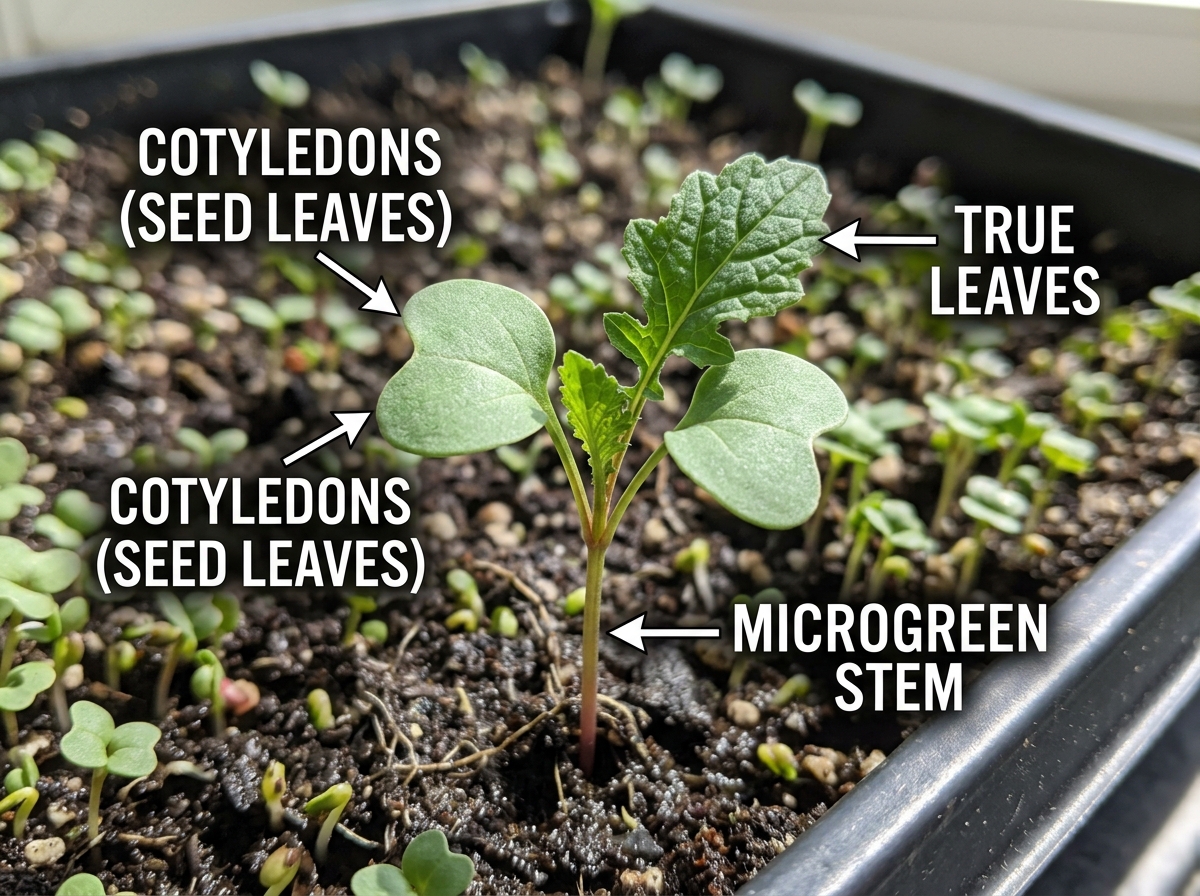
To hit this window, you need to understand two botanical terms: cotyledons and true leaves.
- Cotyledons: These are the very first “seed leaves” that emerge. They are thick, usually heart-shaped or rounded, and contain the initial energy store of the seed.
- True Leaves: These emerge after the cotyledons and look like miniature versions of the adult plant’s foliage (e.g., jagged like kale or feathery like cilantro).
For most varieties, the ideal time to harvest is when the cotyledons are fully expanded and the first set of true leaves is just beginning to peek out. This typically happens between 7 and 21 days after seeding, depending on your environment and the specific variety. If you wait too long, the stems can become woody, and the flavor may turn bitter.
We always recommend taste testing your crop daily starting around day seven. If it tastes sweet, spicy, or nutty (depending on the variety) and has a satisfying crunch, it’s ready. Following proper techniques for harvesting microgreens ensures you don’t miss this peak flavor profile.
The Morning Advantage in Microgreens Harvesting
If you want the absolute best quality, set your alarm clock. We’ve found that harvesting in the early morning offers a significant “turgidity” advantage. During the night, plants take a metabolic rest and fully hydrate. By sunrise, the cells are plump with water, making the stems exceptionally crisp.
Harvesting during the heat of the day or after the grow lights have been on for 12 hours can lead to “limp” greens. Morning-harvested microgreens not only have a better “snap” when you eat them, but they also boast a longer shelf life and better nutrient retention because they haven’t been stressed by heat or intense light. For more on managing your grow cycle, check out our microgreens-101-a-beginners-guide.
Variety-Specific Timing for Microgreens Harvesting
Not all greens grow at the same speed. While the 7–14 day window is standard, some “slow-pokes” require more patience.
- Fast Growers (7–10 days): Radish, broccoli, mustard, and arugula. Radish is often the “sprinter” of the group, sometimes ready in just 6 days.
- Medium Growers (10–14 days): Sunflower and pea shoots. These need a bit more time to develop their signature stem thickness and height.
- Slow Growers (14–25 days): Basil, amaranth, cilantro, and beets. These varieties have smaller seeds and take longer to establish their root systems.
Always consult variety-specific growth charts, but your home’s temperature and humidity will ultimately dictate the pace.
Essential Tools for Professional Microgreens Harvesting
You don’t need a massive budget to harvest like a pro, but you do need the right tools. Using dull kitchen scissors is a recipe for bruised stems and a shorter shelf life.
| Tool Type | Best For | Labor Time (per 1020 tray) | Pros/Cons |
|---|---|---|---|
| Sharp Scissors | Home use / Small batches | ~4 minutes | Precise cut; low cost; easy to sanitize. |
| Harvest Knife | Commercial / Chefs | ~2-3 minutes | Very fast; requires skill to avoid “sawing.” |
| Electric Clippers | Large-scale production | ~1.3 minutes | Fastest method; can cause jagged edges if not sharp. |
Before you start, ensure your tools are treated with food-safe disinfectants. Sanitation is critical because any bacteria on your blades can transfer to the cut stems, causing rapid rot in the fridge. We recommend a quick dip in a 5% vinegar solution or a food-grade hydrogen peroxide spray. If you’re just starting your setup, our beginners-guide-to-microgreens-garden-setup covers the must-have equipment in detail.
Precision Cutting Techniques
The goal of microgreens harvesting is a “clean cut.” A jagged or crushed stem leaks sugars and moisture, which invites mold.
- The Bunching Method: Gently grasp a small bunch of greens by the leaves with one hand (don’t squeeze!). With your other hand, use your scissors or knife to cut the stems about half an inch above the soil line.
- The Clear-Cut Method: For those using a harvest knife, you can sweep across the tray in one fluid motion.
- Avoiding Dirt and Hulls: Avoid cutting too close to the soil to prevent peat or coco coir from getting into your harvest. If you see seed hulls (like the black shells on sunflowers), give the tray a gentle “brush” with your hand before cutting to knock them loose.
For a deeper dive into the growing process that leads up to this moment, see the-ultimate-step-by-step-guide-to-growing-microgreens-without-killing-them.
Post-Harvest Handling: Rinsing, Drying, and Storage
Once the greens are cut, the clock starts ticking. The biggest enemy of a harvested microgreen is excess moisture.
If you are growing for home use, the best practice is to not wash the greens until right before you eat them. If you must wash them (for example, if you see soil on the leaves), you must dry them completely. A salad spinner is your best friend here. Place the greens in the spinner, spin gently, and then lay them out on a clean towel under a fan for 10–15 minutes until they are bone-dry to the touch.
Storage Specifications:
- Temperature: 35–40°F (1.5–4°C) is the “sweet spot.”
- Humidity: 90–95% (achieved by using a sealed but breathable container).
- Shelf Life: Properly handled greens can last 10–14 days in dark storage, compared to just 2–4 days if left on a kitchen counter.
Using breathable containers or clamshells with small vents prevents the “sauna effect” where condensation builds up and turns your greens into mush. For more storage tips, visit our ultimate-guide-to-growing-microgreens-at-home.
Maximizing Your Yield and Market Value
If you’re looking at microgreens as a “side hustle” or a way to save on your grocery bill, efficiency is key. On average, a standard 1020 tray should yield about 0.30 lb (136g) of greens.
To reach these numbers, focus on your seeding rates. We suggest 10–15 grams of seed per tray for varieties like broccoli or kale. For larger seeds like peas, you might go as high as 350 grams.
The profitability of microgreens is staggering. One metal baker’s rack with 5 levels can generate $500 per week if you sell trays to local restaurants or at farmers’ markets for $25 each. By mastering microgreens harvesting speed—reducing your time from 4 minutes to 1.3 minutes per tray—you significantly increase your hourly “wage” as a gardener. To learn how to incorporate these yields into your meals, check out how-to-eat-microgreens-daily.
The Regrowing Question
A common question we get at FinanceOrbitX is: “Can I get a second harvest?”
For 90% of microgreens, the answer is no. Most are “one-and-done” crops. Once you cut the stem below the lowest leaf, the plant has no way to photosynthesize and regrow.
- The Exception: Pea shoots. If you cut them about an inch above the soil, leaving at least one small leaf node, they will often regrow. However, the second harvest is usually tougher and less flavorful.
- The Risk: Regrowing increases the risk of soil-borne diseases like Pythium.
We recommend composting your spent soil or bamboo fiber mats and starting fresh. Bamboo mats are particularly great because they are 100% biodegradable and make for a very “clean” harvest with zero soil splash. If you’re looking for ways to use your first (and best) harvest, try our microgreens-recipes-for-beginners.
Frequently Asked Questions about Microgreen Harvesting
Should I wash microgreens before storing them in the fridge?
We strongly recommend unwashed storage. Microgreens are incredibly delicate; the mechanical action of washing and the lingering moisture can bruise the leaves and lead to rapid spoilage. If you grow them cleanly indoors on mats or carefully bottom-water your soil, they shouldn’t have dirt on them anyway. Simply rinse them in a bowl of cold water immediately before serving.
How do I harvest microgreens grown on hydroponic mats?
Harvesting from bamboo or hemp mats is actually easier than soil. Since there is no loose dirt, you can cut much closer to the “root mat” without worry. Use a sharp knife and slice horizontally across the mat. Once finished, the entire mat and root system can be tossed into your compost bin.
What are the most common harvesting mistakes to avoid?
- Dull Blades: This “chews” the stem rather than slicing it, leading to browning.
- Late Harvesting: Waiting for the plants to get “big” often results in bitter, tough greens.
- High Moisture: Harvesting right after watering means the leaves are wet, which is a death sentence for shelf life.
- Soil Contamination: Cutting too low and getting dirt in the container.
Conclusion
Mastering microgreens harvesting is the final bridge between being a “plant hobbyist” and a “precision horticulturist.” At FinanceOrbitX, we believe that gardening should be as efficient as it is rewarding. By following these professional standards—harvesting in the morning, using sanitized tools, and ensuring bone-dry storage—you ensure that every seed you sow reaches its full nutritional and financial potential.
Ready to expand your indoor farm? Explore more indoor gardening guides to keep your thumb green and your kitchen stocked all year round. Happy harvesting!
