
Stop Wasting Money on Expensive Grow Lights for Microgreens
Affordable microgreens growing lights don’t have to mean weak harvests or complicated setups. The best budget options for most home growers are simple LED shop lights — the kind you can pick up at any big box store for around $20 each.
Quick answer: Best affordable grow lights for microgreens
| Light Type | Cost | Best For |
|---|---|---|
| LED shop lights (4-ft, 5000-6500K) | ~$20 each | 1-4 trays on a rack |
| Compact desktop LED panels | $30-$70 | Small countertop setups |
| T5 LED strip lights | $50-$100 | Multi-shelf systems |
| Full-spectrum grow panels | $70-$150 | Larger dedicated spaces |
You don’t need to spend hundreds on a specialized grow light. Research and real-world tests both point to the same conclusion: standard daylight-spectrum LED shop lights outperform many pricier “grow lights” for leafy microgreens.
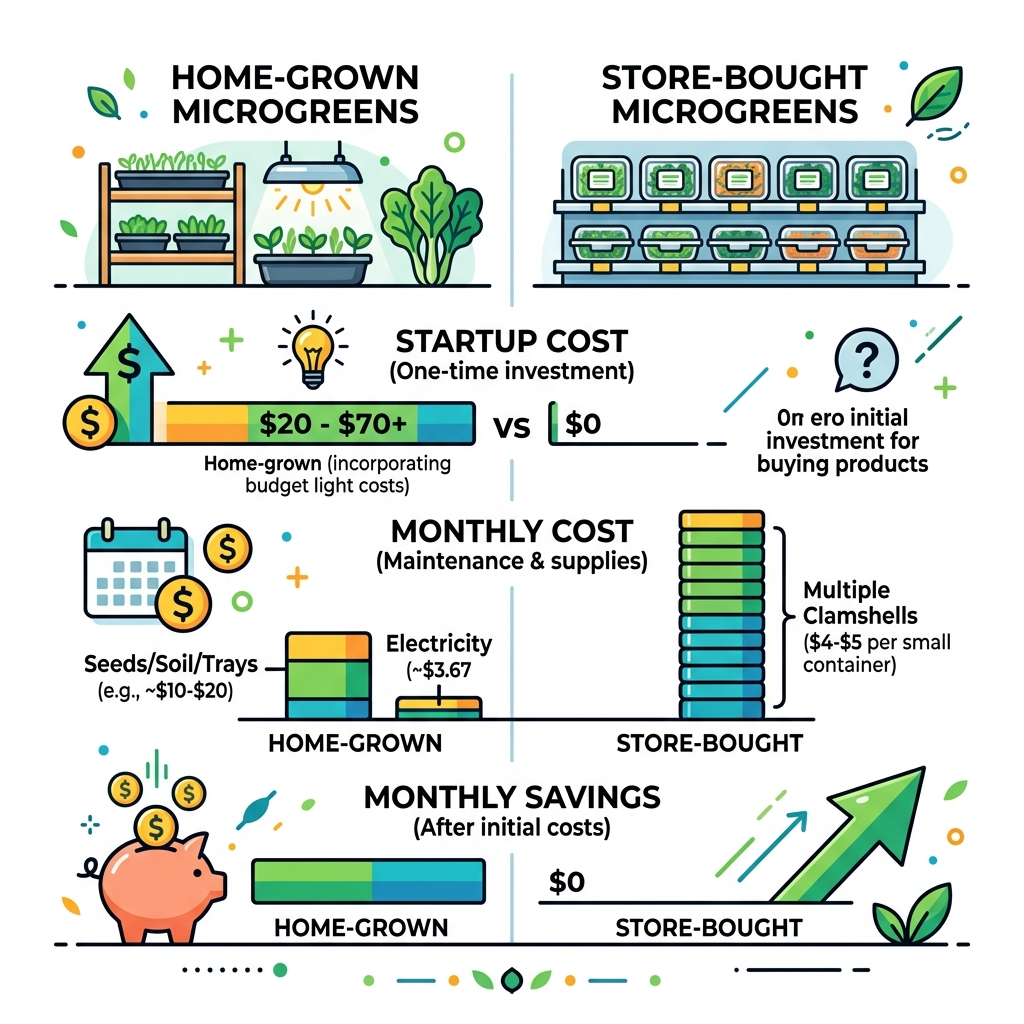
Here’s why that matters for your wallet. A typical 3-light shelf setup running 60 watts for 17 hours a day costs roughly $3.67 per month in electricity. That’s it. Meanwhile, a small clamshell of microgreens at the grocery store runs $4-5 — for a single serving.
The math is hard to argue with.
Whether you have a sunny apartment kitchen or a dark basement shelf, there’s a budget lighting setup that works. This guide breaks down exactly what to buy, what to skip, and how to set it all up without overspending.
Why LED Shop Lights are the Best Affordable Microgreens Growing Lights
When we first started exploring indoor gardening, we were bombarded with ads for “professional-grade” grow lights costing upwards of $300. As a company that loves a good ROI, we had to ask: do our tiny greens really need a NASA-level spectrum?
The short answer is no. For microgreens, which are harvested just 7 to 14 days after germination, the expensive features of high-end lights (like flowering spectrums or heavy-duty cooling fans) are overkill. This is where affordable microgreens growing lights in the form of standard LED shop lights shine.
The “Shop Light” Secret
Microgreens primarily need blue-heavy light to develop strong stems and vibrant leaves. Standard LED shop lights in the 5000K-6500K color temperature range mimic bright daylight. This specific range is the “sweet spot” for photosynthesis in young greens.
In fact, one comprehensive study on kale microgreens found that those grown under white LEDs had significantly higher levels of all major carotenoids compared to those grown under specialized red or blue LEDs. By using a “generic” white light, you aren’t just saving money—you might actually be growing more nutritious food.
Comparing the Options
If you are still on the fence about whether to go “pro” or “budget,” take a look at how these stack up:
| Feature | LED Shop Lights | Specialized Grow Lights |
|---|---|---|
| Price | $15 – $25 per fixture | $80 – $400+ |
| Lifespan | 50,000+ hours | 50,000+ hours |
| Ease of Setup | Plug-and-play | Often requires mounting kits |
| Spectrum | Fixed (Daylight) | Often adjustable (Red/Blue) |
| Microgreen Performance | Excellent | Marginal improvement for the cost |
For a deep dive into how to choose, check out our guide on choosing-the-right-lighting-for-growing-microgreens.
Standard LED Shop Lights: The Ultimate Affordable Microgreens Growing Lights
The “gold standard” for a budget-conscious grower is the 4-foot LED fixture. These are usually sold as T5 or T8 integrated strips. We recommend a setup that uses three 20-watt LED shop lights in the 5500-6500K range per shelf.
This configuration provides an even light distribution across two standard 1020 trays. Because these lights emit very little heat, you can keep them close to your plants without worrying about “leaf toast.” For those looking to start small, affordable-grow-lights-for-microgreens can be as simple as a single 2-foot strip tucked under a kitchen cabinet.
Compact Desktop LED Panels: Affordable Microgreens Growing Lights for Small Spaces
Not everyone has room for a 4-foot industrial rack in their living room. If you’re growing on a countertop, you need something sleeker. Compact LED panels or “grow stands” are fantastic affordable microgreens growing lights for apartment dwellers.
Models like the Amconsure LED Grow Lights offer a middle ground. They often feature attachment clips or small stands that make them highly portable. While they might not have the raw power of a full shop light, they are infinitely better than a dark corner.
Another great option is the Vego Garden Grow Lights Stand, which offers customized modes for different growth stages. These desktop units often include built-in timers, which is a massive win for those of us who tend to forget to flip the switch. You can find more of our top picks for small spaces at best-indoor-grow-lights-for-microgreens.
Optimizing Your Setup for Maximum Yield and Minimum Cost
Buying the right light is only half the battle. To get that high-value “grocery store” look for pennies on the dollar, you need to manage how those lights are used.

The 17-Hour Sweet Spot
Through our research and testing, we’ve found that microgreens thrive on a “long day” cycle. While 12 hours is the bare minimum, an optimal photoperiod is 17 hours on and 7 hours off.
Why 17 hours? It maximizes growth without stressing the plants. Research shows 16-hour photoperiod increases phenolic compounds by 32%, total betalains by 49%, and antioxidant capacity by 25%. By pushing it to 17, you ensure your greens are as nutrient-dense as possible before harvest.
Light Intensity and Placement
Microgreens need a light intensity of roughly 100–200 µmol/m²/s (this is a measure of “Photosynthetic Photon Flux Density” or PPFD). If that sounds like science-babble, don’t worry. In practical terms, it means your lights should be 6 to 12 inches above your trays.
- Too far away: Your microgreens will become “leggy”—tall, thin, and pale as they stretch toward the light.
- Too close: While LEDs are cool, they can still cause “light bleach” or drying if they are touching the leaves.
For a step-by-step walkthrough on setting this up, see our enlightening-indoor-microgreens-a-guide-to-lighting resource.
Energy Efficiency: The Real ROI
One of the best things about affordable microgreens growing lights using LED technology is the energy bill. A standard LED shop light uses about 20 watts. If you run three of them on a shelf, that’s 60 watts total. At an average utility rate of $0.12/kWh, running these lights for 17 hours a day costs just $3.67 per month.
Compare that to the $20+ you might spend on four tiny containers of microgreens at a high-end grocer, and your lighting system pays for itself in less than two months.
Common Mistakes to Avoid with Budget Lighting
Even with the best affordable microgreens growing lights, things can go sideways if you aren’t careful. We’ve made these mistakes so you don’t have to!
1. The “Leggy” Trap
The most common mistake beginners make is placing the lights too high. If your broccoli microgreens look like they’re trying to reach the moon, they aren’t getting enough light. Lower your fixtures. If you are using a grow rack and lighting setup here, use adjustable chains or S-hooks to bring the lights closer to the trays.
2. Inconsistent Timing
Plants love a routine. If you turn the lights on at 8 AM one day and noon the next, your yields will suffer. Use a cheap mechanical or digital timer. It’s a $10 investment that ensures your plants get exactly 17 hours of light every single day, even when you’re sleeping in.
3. Ignoring Airflow
While LED lights don’t get “hot” like old-school incandescent bulbs, they do generate some warmth. In a tight space or a multi-tier rack, this heat can build up, leading to mold issues. We recommend a small USB fan to keep air moving across the trays. This strengthens the stems and prevents the dreaded “damping off” (where your greens suddenly fall over and rot).
4. Falling for the “Purple” Hype
Many “affordable” grow lights on sites like Amazon feature a pink or purple (blurple) hue. While these can work, tests often show that LED shop lights produced greener, larger, healthier plants than cheap red/blue grow lights. Stick to full-spectrum white light (5000K-6500K) for the best results.
For more troubleshooting tips, check out our updated guide: enlightening-indoor-microgreens-a-guide-to-lighting-2.
Frequently Asked Questions about Microgreen Lighting
How many hours a day should microgreens get light?
Most microgreens need between 12 and 16 hours of light daily. However, for the fastest growth and highest nutrient content, we recommend a photoperiod of 17 hours on and 7 hours off.
Automating this with a timer is essential. Not only does it help the plants, but it also helps you manage your energy costs. To understand more about how these lights function, you can learn more about grow light basics here.
Can I just use a sunny window instead of buying lights?
You can, but it’s often frustrating. Natural sunlight is free, but it’s inconsistent. On cloudy days, your plants won’t get enough energy. Furthermore, plants in windows tend to lean toward the glass, requiring you to rotate the trays daily to prevent curved, weak stems.
If you really want to avoid buying lights, a southern-facing window is your best bet, but even then, your growth will be slower and less uniform than with a proven 3-light setup.
What is the ideal distance between the light and the tray?
For standard affordable microgreens growing lights like LED shop lights, aim for 6 to 12 inches.
If you notice your plants are stretching (legginess), move the light closer. If you see the leaves turning white or looking “burnt,” move them further away. Since microgreens grow quickly, you might find you need to raise the lights an inch or two mid-way through the growing cycle to maintain that ideal gap.
Are fluorescent lights (T5/T8) still a good option?
Fluorescent T5 and T8 bulbs used to be the industry standard, and they still work! However, they are becoming less “affordable” when you factor in the long-term costs.
- Energy: LEDs use about 40-50% less electricity than fluorescents.
- Heat: Fluorescents run hotter, which can dry out your trays faster.
- Lifespan: An LED lasts 50,000 hours, while a fluorescent bulb might only last 10,000 to 20,000 hours.
In our opinion, it’s better to spend $20 on an LED fixture now than to deal with the higher electricity bills and bulb replacements of a fluorescent system.
Conclusion
At FinanceOrbitX, we believe that gardening should be as good for your bank account as it is for your body. By opting for affordable microgreens growing lights like standard LED shop lights, you are cutting out the “marketing tax” often associated with indoor growing.
You don’t need a massive budget to start harvesting nutrient-dense greens in your own kitchen. Start with a simple shelf, a couple of $20 daylight-spectrum LEDs, and a basic timer. Within a week, you’ll be harvesting fresh broccoli, radish, or kale microgreens that are tastier and cheaper than anything you can find at the store.
Ready to build your own high-ROI garden? Explore our full range of microgreen supplies and join the ranks of home growers who are ditching the expensive grocery store clamshells for good!
