
The Tiny Crop With Surprisingly Big Profit Potential
How to start a microgreen business is simpler than most people expect — and the payoff can be real.
Here’s the short version:
- Set up a small growing space — a spare room, basement, or garage shelf works fine
- Buy basic equipment — trays, LED lights, seeds, and a growing medium
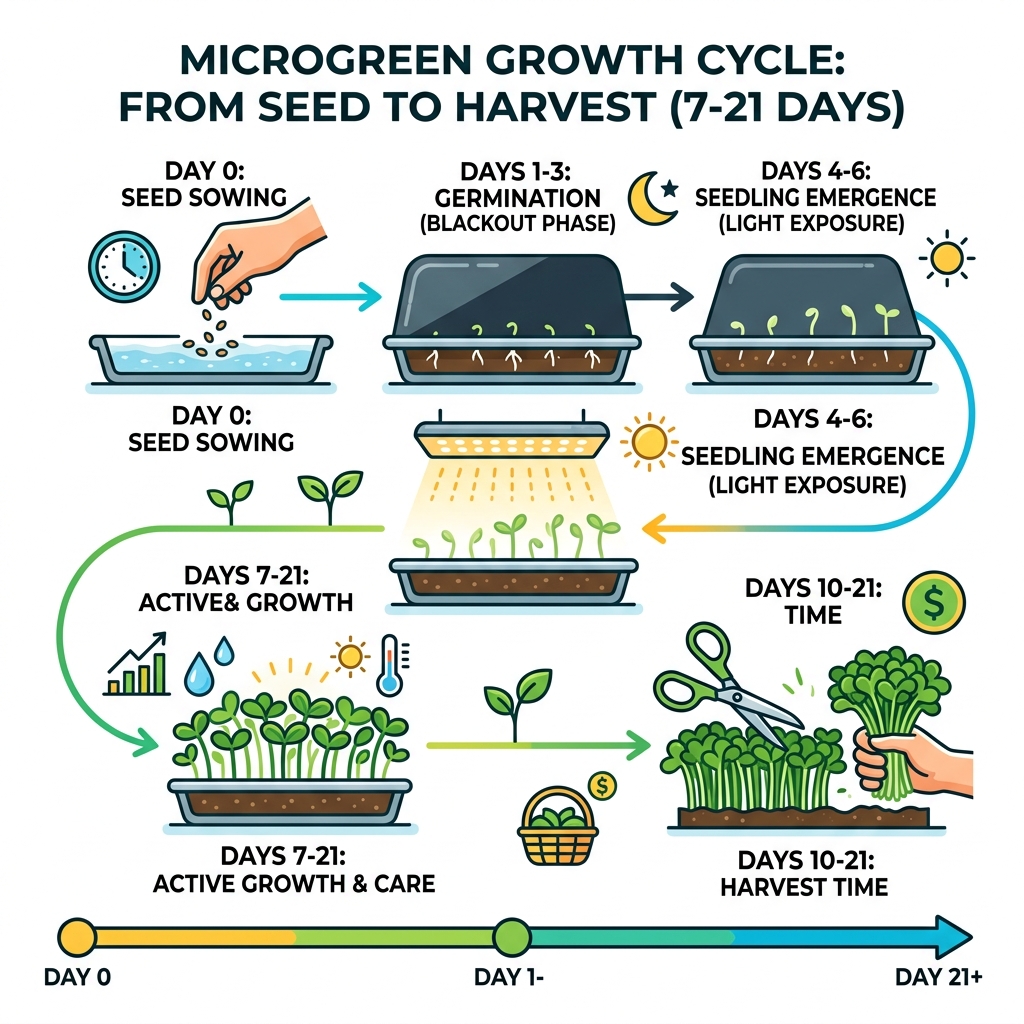
- Grow your first batch — most varieties are ready to harvest in 7-21 days
- Price and sell — target chefs, farmers markets, or direct subscribers at $25-$50 per pound
- Reinvest and scale — one 6-square-foot rack can generate around $500 per week
That’s the core loop. Everything else is details.
The global microgreens market was valued at $2.3 billion in 2020 and is growing at nearly 8% per year. Demand is rising fast — from health-conscious home cooks to Michelin-starred chefs who want fresh, local garnishes delivered weekly.
And the barrier to entry? Remarkably low. You can get started for as little as $500.
What makes this business model so attractive is the combination of a short growth cycle, minimal space requirements, and premium pricing. You’re not waiting months for a harvest. You’re turning seeds into sellable product in under three weeks — sometimes in under ten days.
This guide walks you through every step, from your first tray to your first paying customer.
How to start a microgreen business word roundup:
- Growing Microgreens Without Soil
- How to Grow Microgreens Step by Step
- Lettuce Microgreens Easy Start
Why the Microgreens Market is a High-Yield Opportunity
If you’re looking for a business that blends high profit margins with a “inventory” turnover, microgreens are the gold standard. The global microgreens market is projected to reach over $8 billion by 2032, fueled by a 10-12% annual growth rate. But why is everyone suddenly obsessed with these tiny leaves?
It comes down to “juvenile vigor.” Microgreens are harvested just after the first true leaves develop, meaning they are packed with up to 40 times the nutrient density of their mature counterparts. For example, broccoli microgreens are famous for high levels of sulforaphane, a compound studied for its health properties.
From a business perspective, the efficiency is unmatched. Unlike traditional farming, which requires acres of land and favorable weather, microgreens offer year-round production in a controlled indoor environment. You can grow them in a spare bedroom or a basement using vertical racks, maximizing every square inch of floor space.
For those just starting, our microgreens-101-a-beginners-guide/ covers the basic biological appeal that keeps health-conscious consumers coming back for more. In 2025, the demand for locally grown, organic, and nutrient-dense food isn’t just a trend; it’s a staple of the modern economy.
How to Start a Microgreen Business: From Setup to First Harvest
Transitioning from a hobbyist to a professional grower requires a shift in mindset. You aren’t just gardening; you’re managing a production line. A professional setup focuses on consistency, sanitation, and climate control.
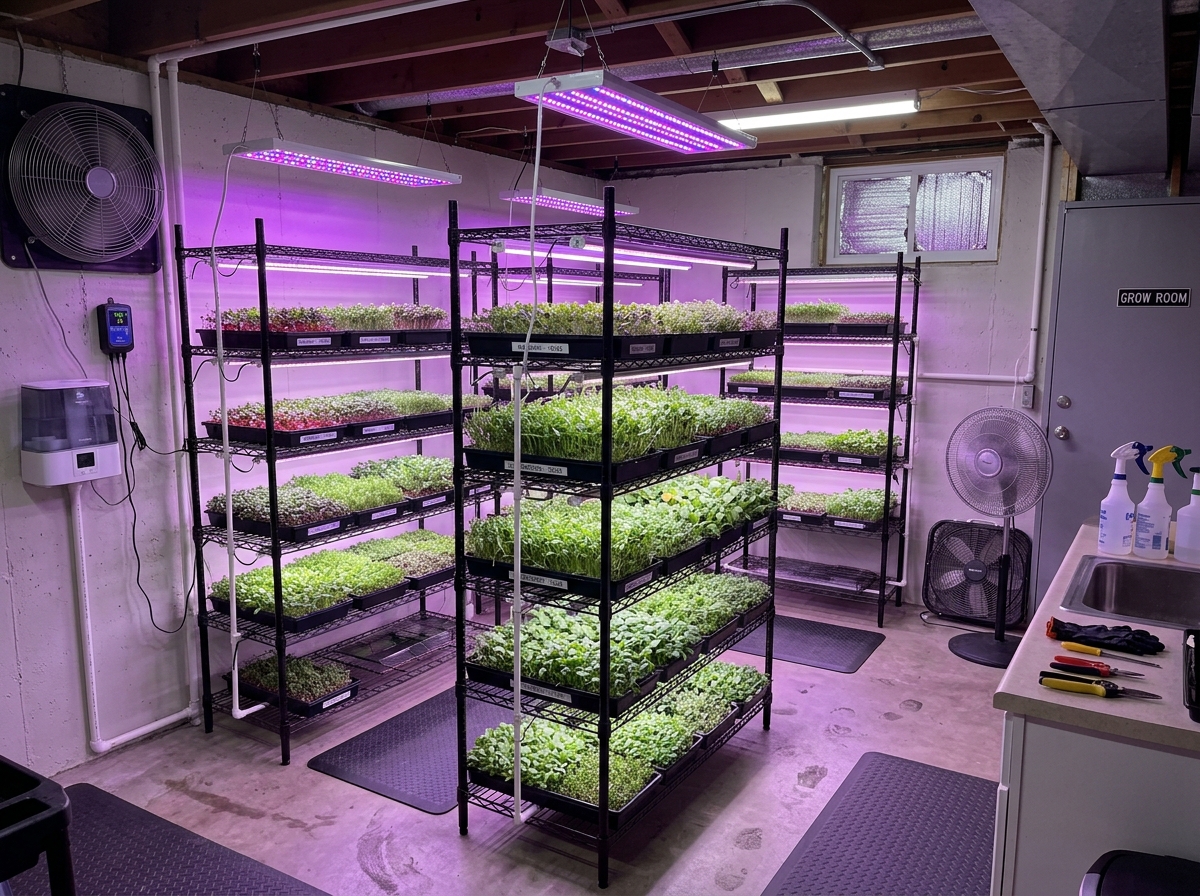
To maintain high yields, your grow room should ideally stay between 65-75°F with a relative humidity of 40-60%. If the air gets too stagnant or damp, you’ll face the grower’s worst nightmare: mold. We recommend using oscillating fans to keep air moving and prevent “damping off” (a condition where young seedlings collapse).
For a deeper dive into creating the perfect environment, check out our ultimate-guide-to-growing-microgreens-at-home/. Sanitation is your best friend. Cleaning your trays with a food-safe sanitizer after every harvest is non-negotiable if you want to avoid pathogens.
Essential Equipment for how to start a microgreen business
You don’t need a tractor, but you do need the right tools. Here is the “starter pack” for a professional-grade microgreen operation:
- 1020 Trays: These are the industry standard (10 inches by 20 inches). You’ll need “flats” with holes for drainage and “nesting” trays without holes for bottom watering. See our tray-reviews-the-best-for-indoor-microgreens/ for the most durable options.
- LED Grow Lights: You don’t need expensive high-intensity lights. Simple, full-spectrum LED shop lights work wonders for microgreens. We’ve rounded up the best affordable-grow-lights-for-microgreens/ to keep your overhead low.
- Growing Medium: Most pros use organic-soil-for-microgreens/ or coco coir. Some even prefer hydroponic mats for a cleaner harvest.
- Digital Scale: Essential for weighing out seeds to ensure even density across your trays.
- Ventilation: A few small clip-on fans for your racks.
- Misting Bottles and pH Meters: To keep your water quality and moisture levels in the “sweet spot.”
Step-by-Step: how to start a microgreen business workflow
Efficiency is the name of the game. To make how to start a microgreen business a profitable reality, you need a repeatable weekly rhythm.
- Seeding: Weigh your seeds based on the variety. For example, you might use 10g of broccoli seed per tray but 350g for pea shoots. Spread them evenly across pre-moistened soil.
- Blackout Period: Stack your trays on top of each other with an empty tray and a weight (like a brick) on top. This forces the roots deep into the soil and encourages the stems to grow strong and tall as they search for light.
- Lighting and Bottom Watering: Once the sprouts are about an inch tall, move them under the LEDs. Always water from the bottom (pouring water into the tray without holes) to keep the leaves dry and prevent rot.
- Harvesting: Use a very sharp knife or electric shears. Avoid scissors, as they can pinch and bruise the delicate stems.
- Cold Chain: Immediately move your harvested greens to a refrigerator. Keeping them at 33-40°F is critical for shelf life.
| Variety | Growth Time (Days) | Difficulty | Flavor Profile |
|---|---|---|---|
| Radish | 7 – 10 | Easy | Spicy, Peppery |
| Broccoli | 10 – 14 | Easy | Mild, Earthy |
| Pea Shoots | 12 – 16 | Medium | Sweet, Crunchy |
| Sunflower | 12 – 15 | Medium | Nutty, Robust |
For help with your planting calendar, our guide on scheduling-your-microgreen-growing-for-beginners/ will help you time your harvests so you always have fresh product for market day.
Pricing and Selling Your Tiny Crops for Maximum ROI
Growing the greens is only half the battle; the real “finance” in FinanceOrbitX comes from how you sell them. Microgreens typically sell for $25 to $50 per pound, depending on your location and target market.
Where to sell:
- Chefs and Restaurants: This is the bread and butter for many growers. Chefs love vibrant colors (like red radish or amaranth) for garnishing high-end dishes. Approach them during their “off-hours” (usually 2:00 PM to 4:00 PM), bring a sample kit, and offer a “cash on delivery” arrangement.
- Farmers Markets: Great for building a brand and getting direct feedback. Offer samples! Once people taste the “pop” of a fresh sunflower shoot, they’re often hooked.
- Subscription Models: This is the most stable revenue stream. Customers pay a monthly fee for a weekly “bounty box” delivered to their door. It’s the ultimate way to ensure your trays are sold before you even plant the seeds.
- Grocery Stores: Higher volume but lower margins. They typically want at least a 30% gross margin for themselves.
To see how others have made the leap, read how-these-microgreen-newbies-turned-tiny-sprouts-into-big-business/. The key is to find your Unique Selling Proposition (USP)—maybe you offer a “Spicy Salad Mix” that no one else in town grows.
Scaling Your Side Hustle and Navigating Legal Requirements
As you move from one rack to ten, you’ll need to treat your operation like a “real” company. This means drafting a solid business plan. Tools like AgPlan can help you map out your financial projections and risk management strategies.
Legal and Safety:
- FDA Produce Safety Rule: While microgreens have fewer regulations than sprouts, you still need to follow basic food safety protocols, including water testing and sanitation records.
- Insurance: We highly recommend looking into FLIP (Food Liability Insurance Program) or similar small-farm insurance. A $1 million general liability policy is standard for selling to grocery stores.
- Permits: Check your local zoning laws. Many areas allow “cottage food” production, but selling to restaurants often requires a commercial food handler’s permit or a retail food license.
Scaling also means better tracking. You can’t manage what you don’t measure. Using the-best-software-to-track-your-microgreen-growth-and-yields/ will help you understand which varieties are your “cash cows” and which are just taking up space.
Frequently Asked Questions about Microgreen Farming
How much space do I need to earn $500 per week?
Surprisingly little! A single 5-tier metal baker’s rack (occupying about 6 square feet of floor space) can hold 20 trays. If you sell those trays for $25 each (either as whole trays or processed into clamshells), you hit $500 per week.
Do I need a greenhouse to start a microgreen business?
Nope. In fact, most modern microgreen businesses are strictly indoor operations. Basements, garages, and spare rooms are actually better than greenhouses because you have total control over the light, temperature, and humidity, which allows for consistent year-round production.
What are the most profitable microgreen varieties for beginners?
Radish, broccoli, and pea shoots are the “big three.” They are fast-growing, hardy, and have high germination rates. Radish is particularly great for beginners because it can be harvested in as little as 7 days, giving you a very fast feedback loop. For a list of high-yield options, see our top-high-yield-microgreens-varieties-to-boost-your-production/.
Conclusion
At FinanceOrbitX, we believe that how to start a microgreen business is one of the most accessible paths to agricultural entrepreneurship today. It’s a rare opportunity where you can start with a few hundred dollars and scale to a full-time income within a single year.
By focusing on high-quality seeds, strict sanitation, and building solid relationships with your local culinary community, you can turn a small corner of your home into a high-yield “green” investment. Whether you’re looking for a side hustle to pay the bills or a new career in sustainable agriculture, the microgreen market is ripe for the picking.
Ready to dig deeper into home-grown profits? More info about indoor gardening is just a click away. Happy growing!
