
Why Understanding Your Microgreens Tray Cost Breakdown Can Make or Break Your Harvest Budget
The microgreens tray cost breakdown typically looks like this for a standard 10×20 tray:
| Cost Component | Typical Range |
|---|---|
| Seeds | $0.30 – $6.00 |
| Growing medium (coco coir or soil) | $0.75 – $2.50 |
| Packaging (clamshell/bag) | $0.25 – $0.50 |
| Electricity (allocated per tray) | $0.25 – $0.60 |
| Labor (allocated per tray) | $1.00 – $3.00 |
| Fixed overhead (lights, shelving, rent) | $3.00 – $8.00 |
| Total estimated cost per tray | $5.55 – $20.60+ |
Note: Costs vary widely based on your setup size, variety, and whether you’re growing at home or at commercial scale.
Growing microgreens sounds simple. Plant seeds, water them, harvest in two weeks, and sell. But a lot of first-time growers are surprised when they realize they’re barely breaking even — or worse, losing money on every tray.
The problem usually isn’t the growing. It’s the math.
One experienced grower found that radish microgreens cost $23 per tray to produce at a run of 25 trays. That means you need to sell each tray for at least $32.53 just to hit a 30% profit margin. Many beginners charge far less — simply because they never sat down to calculate what each tray actually costs them.
Whether you want to grow microgreens for your own kitchen or turn it into a side income, knowing your numbers is the first step. This guide walks you through every cost involved — from seeds and soil to electricity and packaging — so you can grow smarter, not just greener.
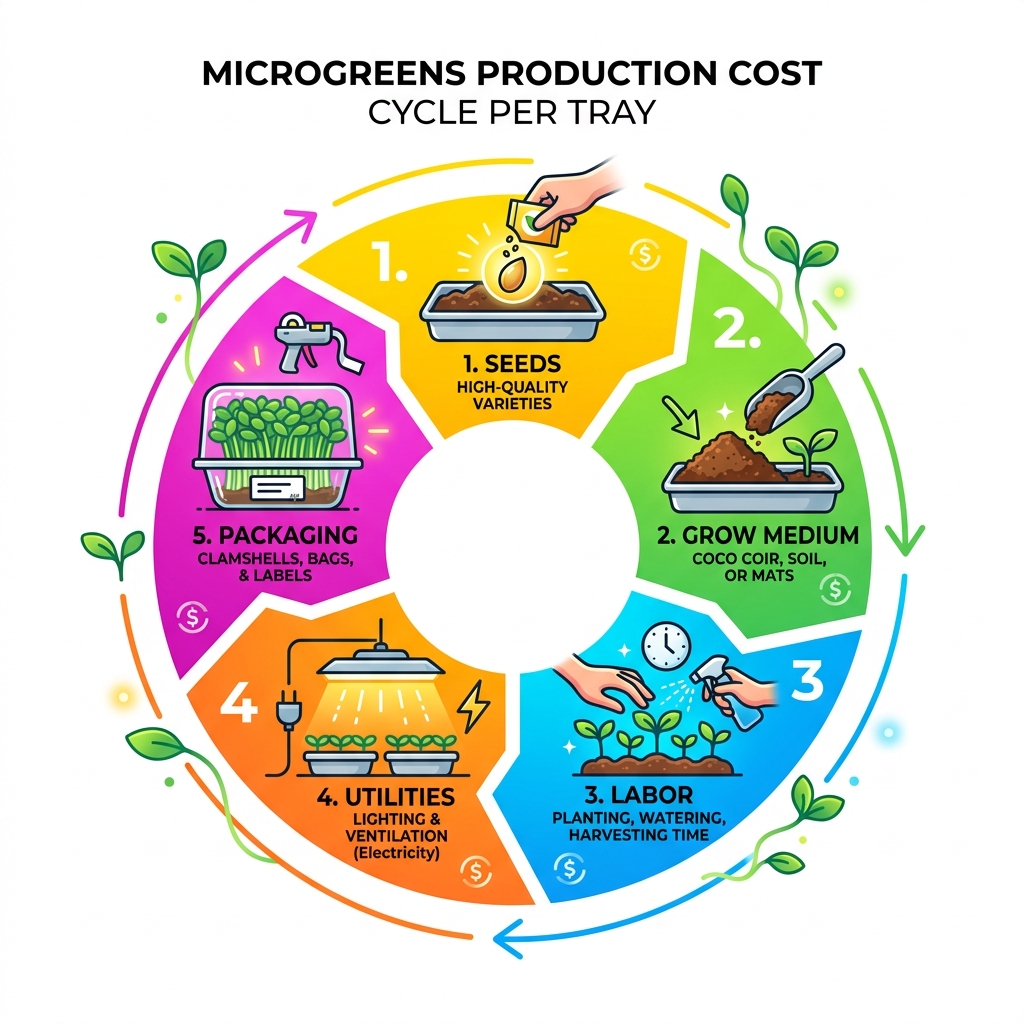
The Anatomy of a Microgreens Tray Cost Breakdown
When we dive into the microgreens tray cost breakdown, we have to look at two distinct categories: variable costs and fixed costs. Variable costs are the “use-it-and-lose-it” items—things like seeds and soil that you buy for every single tray. Fixed costs are your infrastructure—the lights, the racks, and the fans that keep running regardless of whether you have one tray or twenty.
To understand the Return on Investment (ROI) of your indoor garden, we need to treat each tray like a tiny business unit. For a commercial grower producing 50 trays a month, the costs might break down to roughly $8 in variable inputs and $15 in fixed overhead, totaling $23 for a variety like radish. If you’re growing at home, your overhead is much lower, but your input costs per tray might be higher because you aren’t buying in bulk.
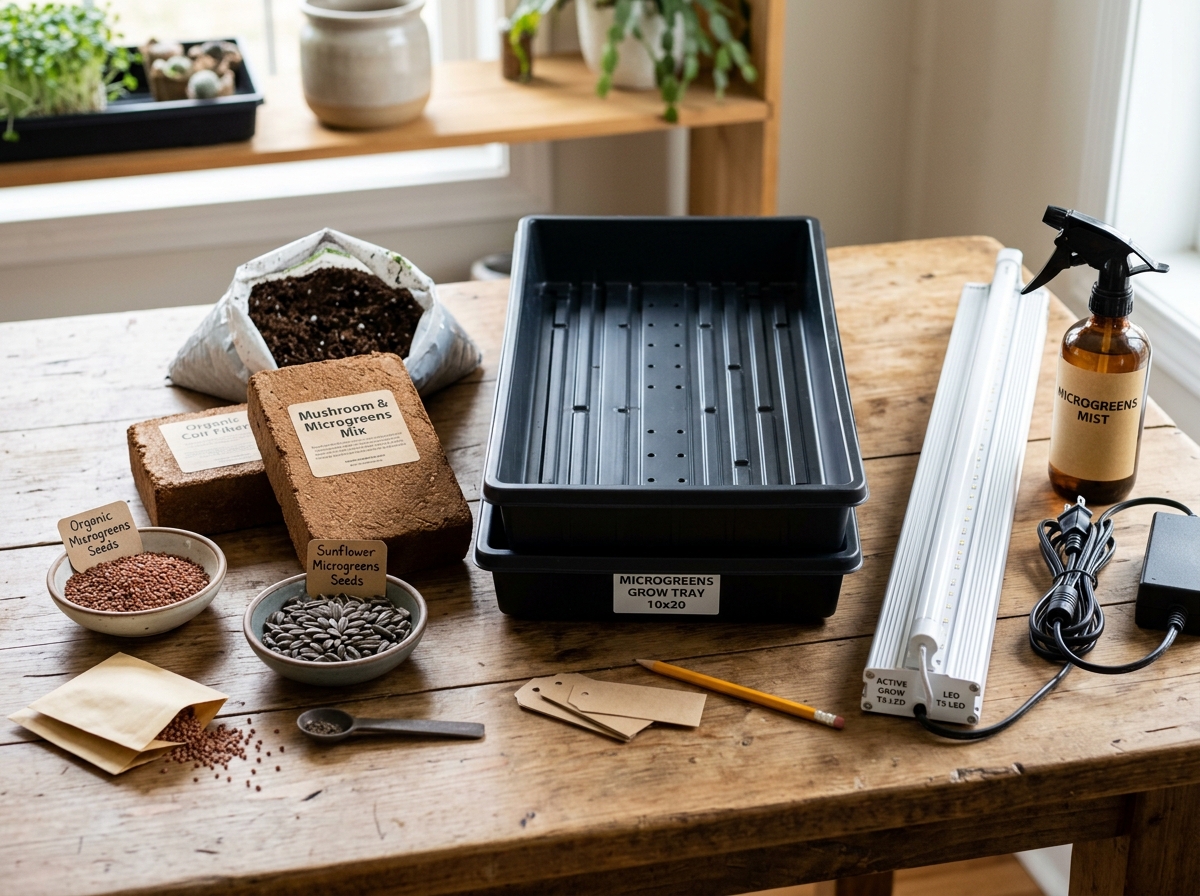
| Variety | Seed Cost | Medium Cost | Total Variable Cost | Typical Yield |
|---|---|---|---|---|
| Radish | $0.30 | $1.25 | $1.55 | 10–14 oz |
| Sunflower | $1.10 | $1.25 | $2.35 | 12–16 oz |
| Pea Shoots | $1.06 | $1.25 | $2.31 | 12–18 oz |
| Nasturtium | $6.00 | $1.25 | $7.25 | 4–6 oz |
Seed Costs in a Microgreens Tray Cost Breakdown
Seeds are often your most significant recurring expense. The price varies wildly depending on the variety. For example, radish seeds are incredibly affordable, costing as little as $0.30 per tray. On the flip side, specialty items like nasturtium can run you $6.00 per tray just for the seeds!
When calculating your microgreens tray cost breakdown, seeding density is the “secret sauce.” If you sow too thinly, your yield drops, and your cost per ounce skyrockets. If you sow too densely, you risk mold and wasted seeds. Most successful growers aim for a balance that maximizes the “canopy” of the tray. It’s also vital to consider germination rates; buying high-quality, sprouting-grade seeds ensures that 85-95% of what you sow actually turns into a harvestable plant. For more on setting your final prices based on these seed inputs, check out this Microgreens Pricing: A Beginner’s Guide for What to Charge.
Growing Mediums and the Microgreens Tray Cost Breakdown
What your greens grow in matters for both your plants and your wallet.
- Coco Coir: A popular choice for its cleanliness and water retention. A 5lb brick usually costs around $1.00 to $1.50 per tray and can yield 7-10 trays.
- Potting Soil/Seed Starting Mix: Often preferred by home growers for its nutrient profile, costing between $1.50 and $2.50 per tray.
- Reusable Mats: Silicone or hemp mats are gaining traction. While silicone mats have a higher upfront cost (around $5.50 each), they can last for over 100 cycles, bringing the cost per tray down to a measly $0.05.
Choosing the right foundation is a critical step in choosing the best containers for your microgreens to ensure drainage and root health are optimized.
Variable Costs: From Seeds to Packaging
Once the greens are grown, the costs don’t stop. If you are selling your produce, packaging becomes a major player in your microgreens tray cost breakdown. Even if you’re just growing for yourself, you’ll need a way to store them to maintain freshness.
Packaging and Distribution Expenses
If you’re selling at a farmers’ market or to local chefs, your packaging needs to be professional. A standard 24oz clamshell typically costs about $0.26. Add in a professional label ($0.05 – $0.10) and the cost of the bag or box, and you’re looking at nearly $0.50 per unit before you’ve even factored in your time.
Distribution is another “hidden” variable. If you’re driving to a market, fuel and booth fees must be accounted for. We recommend allocating these weekly overhead costs across the total number of trays you produce. If you spend $20 on gas and $30 on a market fee to sell 50 trays, that’s an extra $1.00 per tray you need to track. For those just starting out, finding the best containers for nurturing indoor microgreens can help reduce waste by keeping the product fresh longer.
Yield Expectations and Harvest Math
To know if your costs are worth it, you have to measure your yield. A standard 10×20 tray usually yields between 8 and 12 ounces of greens, though peas and sunflowers can go as high as 16-20 ounces.
If a tray of radish costs you $23 to produce (including labor and overhead) and yields 12 ounces, your cost is $1.91 per ounce. If you sell those ounces for $3.00 each, you’re in the green! To maximize this, many growers use Heavy Duty Shallow Trays for Microgreens which allow for easier harvesting and better airflow. Success in this business often comes down to “succession planting”—sowing new trays every few days so you have a consistent harvest and don’t have “dead time” on your expensive racks. You can see how different trays impact these results in our tray reviews: the best for indoor microgreens.
Fixed Costs and Overhead: The Hidden Expenses
This is where many hobbyists-turned-pro get tripped up. Fixed costs are the expenses that stay the same whether you grow one tray or a hundred.
Labor and Utility Calculations
Your time isn’t free. Even if you aren’t paying yourself a salary yet, you should factor in labor at a fair hourly rate (e.g., $15-$20/hr). It typically takes about 15–30 minutes of total labor per tray—covering everything from soil preparation and seeding to watering and harvesting.
Utilities are surprisingly manageable but must be tracked. A full rack of 24 trays with LED lights and fans typically uses about $0.60 to $0.90 of electricity per day. Over a month, that’s roughly $22-$27. Using a kilowatt counter can help you get an exact read on your specific setup. For a deeper dive into the home-scale version of these numbers, see How Much Does It Cost to Grow Microgreens at Home?.
Equipment Depreciation and Maintenance
Your equipment won’t last forever. A professional grow rack might cost $500 to $700 to build. If that rack lasts 5 years, it “costs” you about $10 a month in depreciation. Fans might need replacing every two years, and trays—unless you buy the heavy-duty versions—often crack and need replacing annually.
Sanitation is another ongoing cost. You’ll need white vinegar, hydrogen peroxide, or food-safe sanitizers to keep your trays and environment mold-free. We’ve found that best trays for hydroponic microgreens often require slightly different sanitation protocols than soil-based setups. Always keep a stock of seed sprouting trays for microgreens ready to swap in so your production line never stops.
Profitability and Pricing Across Sales Channels
Where you sell your greens determines how much you can charge.
- Farmers Markets: You can often get the highest price here ($4–$6 per 2oz clamshell), but the labor and travel costs are high.
- Chefs/Restaurants: They buy in bulk and provide consistent weekly income, but they usually expect a lower “wholesale” price (around $20–$35 per tray).
- Grocery Stores: These offer the highest volume but the lowest margins, often taking 30–40% of the retail price as their cut.
Targeting a gross margin of 75% or higher across your entire menu is a healthy goal. This gives you enough “buffer” to cover your operating expenses and still walk away with a 30% net profit. Choosing the best containers for indoor gardening can help you present a premium product that justifies these higher margins.
Target Margins for Sustainable Growth
We recommend using a “cost-plus” pricing model. Start with your microgreens tray cost breakdown (the absolute floor), add your desired profit margin, and then check that against the market. If your cost is $23 and you want a 30% margin, your price is $32.53. If the local market only pays $25, you need to find a way to lower your production costs or switch to a more profitable variety.
Market psychology also plays a role. It’s often easier to sell a 2oz container for a clean $5.00 than for $4.87. Rounding up slightly can significantly boost your bottom line without deterring customers. For hydroponic enthusiasts, finding the top hydroponic trays for microgreens can often lower medium costs, helping hit those target margins faster.
Strategies to Reduce Your Production Costs
Want to keep more of your “green”? Here are our favorite ways to trim the fat:
- Bulk Purchasing: Buying 1lb of seed might cost $15, but buying 25lbs could drop the price per pound by 40%.
- Reusable Supplies: Switch from disposable mats or one-time-use plastics to silicone mats and heavy-duty trays.
- Energy Efficiency: Use LED shop lights (5000-6500K) instead of expensive “specialty” grow lights. They use 50-60% less electricity than old-school fluorescents.
- Bottom Watering: This reduces water waste and, more importantly, prevents mold, which can destroy an entire tray’s worth of profit in a day.
You can learn more about eco-friendly and cost-effective tray options in our guide to ditch the plastic with these beginner microgreens growing trays.
Frequently Asked Questions about Microgreens Costs
What is the average total cost to produce one 10×20 tray?
For a commercial setup, the average total cost (including labor, utilities, and overhead) is typically between $15 and $23. For a home grower using repurposed containers and natural light, the cash outlay can be as low as $2.00 to $5.00 per tray, though yields may be lower.
How do home setup costs differ from commercial operations?
Home growers often have a lower “cost floor” because they don’t count rent or electricity as a business expense. However, commercial growers benefit from “economies of scale”—buying seeds and soil in bulk and using efficient vertical racks that produce more greens per square foot.
Which microgreen varieties offer the highest profit margins?
Radish, pea shoots, and sunflowers are the “bread and butter” of most farms because they have low seed costs and high yields. Specialty items like basil or sorrel can be priced much higher but take longer to grow and require more attention.
Conclusion
At FinanceOrbitX, we believe that gardening is one of the best investments you can make—not just for your health, but for your financial literacy. Understanding the microgreens tray cost breakdown teaches you the fundamentals of business: COGS, overhead, margins, and ROI.
Whether you’re looking to save $140 a year on your grocery bill or build a $5,000-a-month side hustle, the key is to start small, track every penny, and scale only when your math proves it works. Ready to plant your first tray? Start your indoor gardening journey today and see how easy it is to grow your own “green.”
