
Why Microgreens Lighting Makes or Breaks Your Harvest
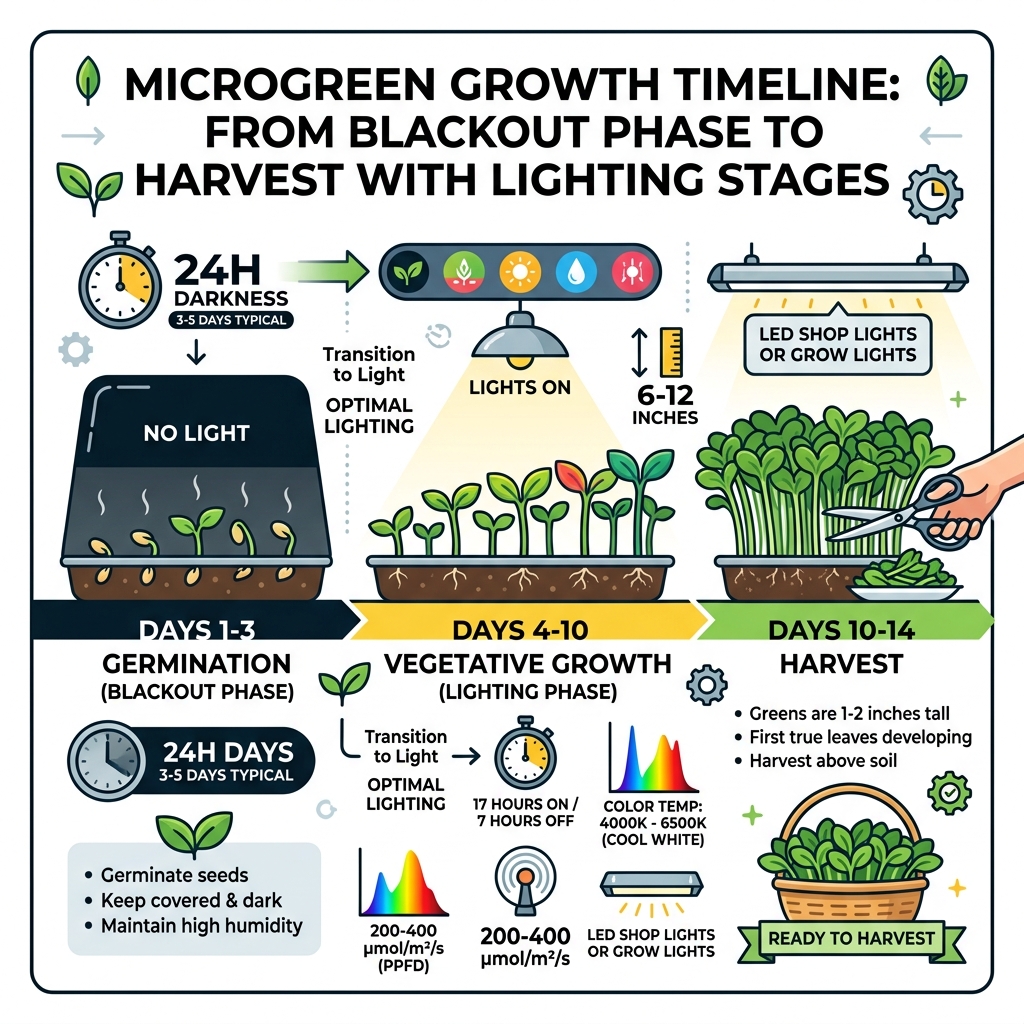
Microgreens lighting is one of the most important factors in growing healthy, flavorful, and nutrient-dense microgreens indoors. Get it right, and you’ll have vibrant, stocky greens ready to harvest in as little as 10-14 days. Get it wrong, and you’ll end up with pale, leggy plants that disappoint.
Here’s a quick summary of what you need to know:
| Factor | Recommendation |
|---|---|
| Light duration | 12-16 hours per day (17 on / 7 off is a tested sweet spot) |
| Color temperature | 4,000K – 6,500K (cool white or daylight) |
| Light intensity (PPFD) | 200-400 µmol/m²/s |
| Distance from canopy | 6-12 inches above plants |
| Minimum wattage | 20W per tray |
| Germination phase | Darkness for first 3-5 days |
The good news? You don’t need expensive specialty grow lights to get great results. Many home growers do just fine with affordable LED shop lights from a hardware store.
But there’s more to it than just flipping a switch. Light spectrum, intensity, duration, and placement all affect not just how fast your microgreens grow — but also their taste, color, and nutritional value.
Research shows, for example, that a 16-hour photoperiod can increase antioxidant capacity by 25% and phenolic compounds by 32% compared to a 12-hour schedule. That’s a meaningful difference from a simple timer adjustment.
This guide walks you through everything — from the blackout germination phase to harvest — so you can set up your lighting with confidence.
Understanding Microgreens Lighting Requirements
When we talk about microgreens lighting, the first thing we need to understand is that more light isn’t always better, and “always on” isn’t the goal. Plants, much like us, have a biological clock. To grow the best possible crop, we need to mimic the natural rhythm of the sun while providing the specific “fuel” microgreens need at each stage of their short life.
The Germination and Blackout Phase
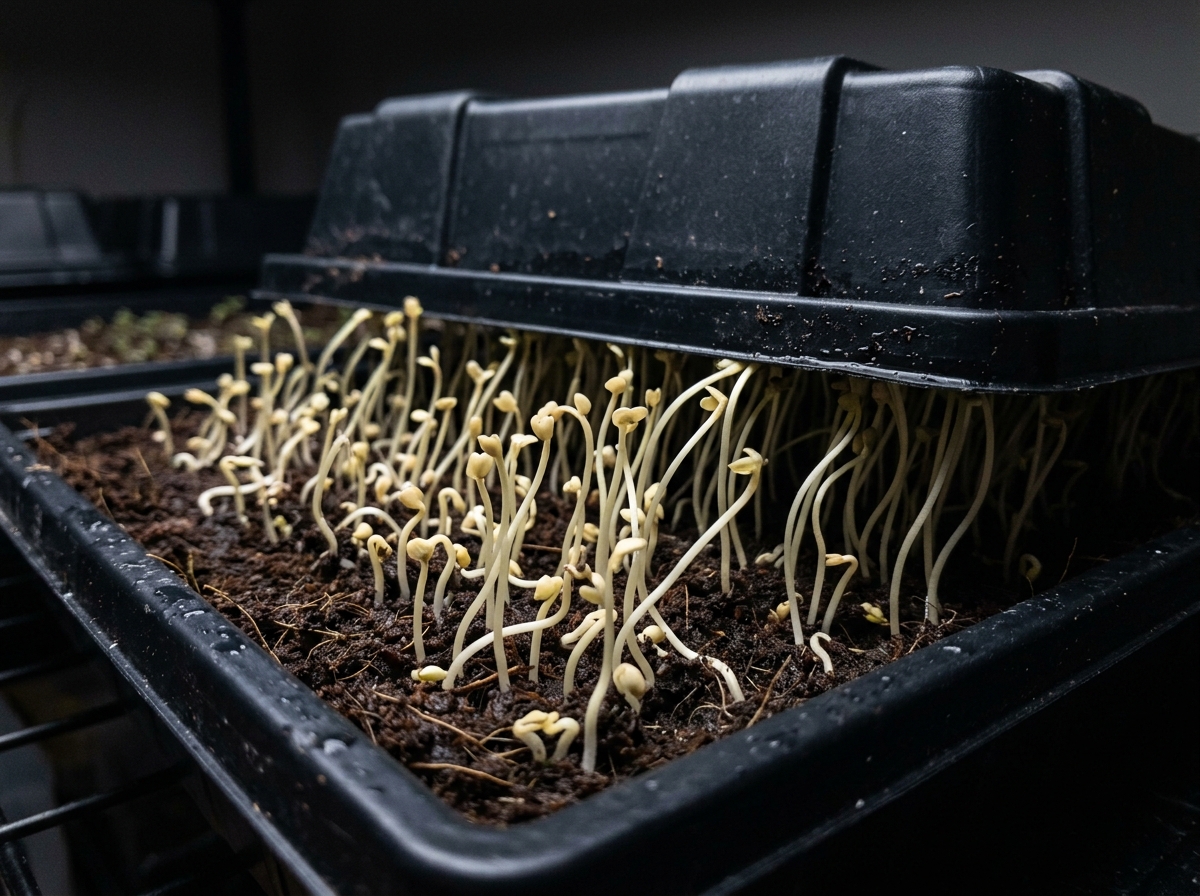
Believe it or not, the most important part of your microgreens lighting strategy starts with no light at all. For the first 3 to 5 days after sowing your seeds, they should be kept in total darkness. This is often called the “blackout phase.”
During this time, the seeds rely on their own stored energy to push out roots and a stem. By keeping them in the dark (often with a weighted tray on top), we encourage the stems to stretch slightly in search of light, which actually makes them easier to harvest later. Once you see the first tiny leaves—called cotyledons—emerge and begin to turn a pale yellow, that is your cue to introduce them to light.
Photoperiod: Finding the Sweet Spot
Once they are out of the dark, how long should your lights stay on? This is known as the photoperiod. While microgreens need a minimum of 6 hours of light to survive, they truly thrive when given 12 to 16 hours of light daily.
At FinanceOrbitX, our extensive research and testing have shown that a 17-hour on / 7-hour off schedule is the “sweet spot.” This provides ample time for photosynthesis while allowing the plants a 7-hour rest period to process the energy they’ve collected. To learn more about these nuances, check out our guide on Shining a Light on Optimal Microgreen Requirements.
Daily Light Integral (DLI)
For the data-driven gardeners among us, we look at the Daily Light Integral (DLI). This measures the total amount of light “photons” that land on your plants over a 24-hour period. For optimal growth, microgreens prefer a DLI of 12–18 mol/m²/day. If your lights are weaker, you’ll need to leave them on longer to hit this target. If they are high-powered, you can achieve the same DLI in a shorter timeframe.
The Science of Light: Spectrum and Intensity
To master microgreens lighting, we have to look past what our human eyes see and focus on what the plants feel. Plants use specific wavelengths of light to build cells, create vitamins, and develop flavor.
| Metric | Definition | Target for Microgreens |
|---|---|---|
| Kelvin (K) | The “color” of the light (Warm vs. Cool) | 4,000K – 6,500K |
| PPFD | The amount of usable light hitting the plant | 200-400 µmol/m²/s |
| Lumens | Total light visible to the human eye | 2,000+ per 10×20 tray |
| Wattage | Energy consumed by the light fixture | 20W – 40W per tray |
Photosynthetic Photon Flux Density (PPFD)
PPFD is the gold standard for measuring light intensity. It tells us exactly how many “bits” of light (micromoles) are hitting a square meter of your tray every second. For microgreens, a target range of 200-400 µmol/m²/s is ideal. If you drop below 100-120 µmol/m²/s, you’ll notice your plants becoming “leggy”—stretching out and becoming weak as they struggle to find enough energy.
The Role of Color: Blue vs. Red Light
According to Scientific research on Brassicaceae microgreens, different light colors trigger different responses:
- Blue Light (440-470nm): This is the “compact growth” light. It prevents stretching, boosts chlorophyll production, and can even increase vitamin levels (like C, E, and K). It’s also responsible for intensifying spicy flavors in crops like radish or mustard.
- Red Light (640-680nm): This promotes overall biomass (weight) and can make varieties like pea shoots or sunflowers taste sweeter.
While specialized “blurple” (red/blue) lights exist, we usually recommend full-spectrum white light for home growers. It contains all these wavelengths and is much easier on the eyes. For a deeper dive into the science, read our article on Enlightening Indoor Microgreens: A Guide to Lighting.
Ideal Spectrum for Microgreens Lighting
The “color temperature” of your light is measured in Kelvin. For microgreens, we want to stay in the 4,000K to 6,500K range.
- 4,000K (Cool White): Great for general growth.
- 6,500K (Daylight): Excellent for mimicking the high-intensity blue light of a clear day, which results in the best color and most compact stems.
Using a full-spectrum LED in this range ensures your plants get the blue light they need for sturdy stems and the red light they need for weight. For help picking the right bulb, see our tips on Choosing the Right Lighting for Growing Microgreens.
Measuring Intensity in Microgreens Lighting
While pros use expensive PAR meters to measure PPFD, home growers can use simpler metrics. A good rule of thumb is to provide at least 20 watts of LED power per 10×20 tray. In terms of brightness, look for lights that offer at least 2,000 lumens per shelf.
That watts measure energy used, not light produced. An efficient LED will produce more light per watt than an old-fashioned fluorescent bulb. We cover the best hardware options in our guide to LED Grow Lights for Microgreens.
Choosing the Best Microgreens Lighting Setup
You don’t need a professional laboratory to grow high-quality greens. In fact, most of the successful small-scale farms we’ve studied use simple, affordable setups.
LED Shop Lights vs. Dedicated Grow Lights
This is a common debate. “Shop lights” are the long, narrow LED fixtures you find in garages. “Grow lights” are often marketed specifically for plants with a premium price tag.
- The Verdict: For microgreens, high-quality LED shop lights are often just as effective as expensive grow lights. Because microgreens are harvested so young, they don’t need the extreme intensity required by fruiting plants like tomatoes.
- T5 vs. T8: T5 lights are thinner and often more efficient, while T8 lights are slightly larger and can offer more coverage. Both work excellently as long as they are in the 5,000K-6,500K color range.
For more on how to save money on your setup, read our guide to Stop Overpaying for Your Microgreens Grow Lights.
Panel Lights and Daisy-Chaining
If you are growing on a larger scale, you might consider LED panel lights. These cover a wider area (like a 4’x4′ space) but can be overkill for a single tray. Most microgreen growers prefer LED strips because they can be “daisy-chained”—plugged into one another—so you only need one outlet for an entire four-tier rack.
Modern LEDs are incredibly durable, often boasting a 50,000-hour lifespan. This means if you run them for 16 hours a day, they could last you over 8 years! Check out our list of the Best Indoor Grow Lights for Microgreens to find a reliable model, or explore our Affordable Grow Lights for Microgreens for budget-friendly picks.
Optimizing Placement and Plant Quality
Where you put your lights is just as important as which lights you buy. Light intensity follows the “inverse square law,” which is a fancy way of saying that if you double the distance between the light and the plant, the plant only gets a quarter of the light.
The Ideal Distance: 6 to 12 Inches
For standard LED shop lights or T5 strips, we recommend a distance of 6 to 12 inches from the top of the microgreen canopy.
- Too Close: You risk “bleaching” the leaves (turning them white) or drying out the soil too fast.
- Too Far: Your plants will stretch, becoming “leggy” and prone to falling over.
As your microgreens grow taller, you may need to raise your lights or ensure your initial placement accounts for that growth. For more placement tips, see our guide on Enlightening Indoor Microgreens: A Guide to Lighting.
Impact on Quality and Nutrition
Proper microgreens lighting directly impacts the “secondary metabolites” in the plant—the stuff that makes them good for you.
- Antioxidants: High-intensity light (within the 200-400 PPFD range) encourages the production of antioxidants and phenolic compounds.
- Color: Anthocyanins, the pigments that make purple cabbage or amaranth look so vibrant, require sufficient light to develop. Without enough light, your “red” varieties will just look muddy green.
- Flavor: Light intensity concentrates flavors. If you want spicy radishes or peppery arugula, don’t skimp on the light duration.
Troubleshooting and Efficiency in Microgreens Lighting
Even with the best gear, things can go wrong. Being able to read your plants’ signals is the mark of an expert grower.
Common Lighting Mistakes
- Leggy, Stretched Stems: This is the #1 sign of insufficient light. The plants are literally “reaching” for the sun. Lower your lights or increase the “on” time.
- Pale or Yellow Leaves: If they aren’t turning green after 24 hours under the light, your intensity is likely too low.
- Bleached or Crispy Leaves: If the tops of your greens look white or feel dry/crunchy while the bottom is wet, your lights are too close and are “cooking” the plants.
- Uneven Growth: This happens when the light is only over the center of the tray. Use multiple light strips to ensure the edges get love too.
Maximizing Efficiency with Reflective Surfaces
You can increase the light your plants receive by 10-30% without spending a dime more on electricity. How? Reflective surfaces.
- White Paint: Simply painting the walls of your grow area flat white reflects a massive amount of light back onto the trays.
- Mylar or Foil: Lining your shelves with reflective Mylar film ensures that light escaping to the sides is bounced back to the canopy.
Also, don’t forget to clean your lights! Dust accumulation can reduce light output by 20% or more over time. A quick wipe with a microfiber cloth once a month keeps your “ROI” (Return on Investment) high.
Managing Costs for Microgreens Lighting
At FinanceOrbitX, we love a good spreadsheet. Let’s look at the “finance” of your garden. A typical setup of three 20W LED strips (60W total) running for 17 hours a day uses about 1 kWh of electricity daily. At an average cost of $0.15 per kWh, your lighting costs are roughly $4.50 per month per shelf.
By using outlet timers, you ensure you never accidentally leave the lights on for 24 hours, which saves money and prevents plant stress. Using LEDs instead of old fluorescents also reduces heat output, meaning you won’t need to run extra fans or air conditioning to keep the room cool—another win for your wallet and sustainable gardening.
Frequently Asked Questions about Microgreens Lighting
Do microgreens need light to germinate?
No. In fact, most microgreens prefer a “blackout” period of 3-5 days to establish strong roots and encourage stem elongation. Light is only needed once the first leaves (cotyledons) appear.
Can I use regular household LED bulbs for microgreens?
You can, but it’s difficult to get even coverage. A standard 9W household bulb doesn’t provide enough intensity for a full 10×20 tray. You would need several bulbs in clamp lamps to match the output of a single 20W LED shop light.
How do I know if my lights are too close to the plants?
Look for “light burn” or bleaching. If the leaves closest to the light are turning white, or if the soil is drying out in just a few hours, your lights are likely too close. Aim for a minimum of 6 inches of clearance.
Conclusion
Mastering microgreens lighting is the bridge between being a casual hobbyist and a successful indoor gardener. By providing a 12-16 hour photoperiod, targeting the 4,000K-6,500K color range, and maintaining a steady distance of 6-12 inches, you create the perfect environment for nutrient-dense, high-yield harvests.
You don’t need the most expensive gear on the market to see professional results. Start with a simple, high-quality LED shop light setup, use a timer for consistency, and keep your trays in the dark for those first few critical days. Your microgreens—and your health—will thank you for it.
For more tips on building your ultimate indoor garden, explore our More info about indoor gardening section. Happy growing! 🌱
