
Fresh Greens in 7 Days: Why an Indoor Microgreens Growing Setup Is Worth It
An indoor microgreens growing setup is one of the fastest, most space-efficient ways to grow your own food at home — no garden, no experience, and no large investment required.
Here’s what you need to get started:
- Shallow trays (10×20-inch standard trays work best)
- Growing medium — seed-starting mix or coconut coir
- Untreated microgreen seeds — radish or broccoli for beginners
- Light source — a sunny south-facing window or an LED grow light
- Spray bottle for watering
- A warm spot around 70–75°F for germination
That’s it. Most beginners can set up their first tray in under 30 minutes and harvest fresh greens in as little as 7–14 days.
The appeal here goes beyond convenience. Research published in the Journal of Agricultural and Food Chemistry shows microgreens can contain up to 40 times more nutrients than their fully-grown counterparts. Red cabbage microgreens, for example, have been found to contain six times more vitamin C and 40 times more vitamin E than mature red cabbage. You get a serious nutritional punch from a very small amount of food.
And because they grow so fast — some varieties like radish are ready in just 6–8 days — microgreens are genuinely the closest thing to “fast food” in the gardening world.
One standard tray can supply enough greens for a full week of salads, eggs, and smoothies. Stack a few trays on a shelf, and you’ve got a continuous, living pantry running year-round, no matter the season or climate.
Planning Your Indoor Microgreens Growing Setup
When we talk about an indoor microgreens growing setup, we aren’t talking about a massive greenhouse. In fact, one of the best things about these tiny powerhouses is their space efficiency. You can grow a significant amount of food on a kitchen counter, a bookshelf, or even a small utility rack in a spare closet.
The standard “unit of currency” in the microgreen world is the 1020 tray (named for its 10×20 inch dimensions). These are perfect because they are shallow, easy to handle, and fit perfectly under standard 2-foot or 4-foot shop lights. If you are just starting out, check out our Ultimate Guide To Growing Microgreens At Home to see how these fit into a broader home gardening strategy.
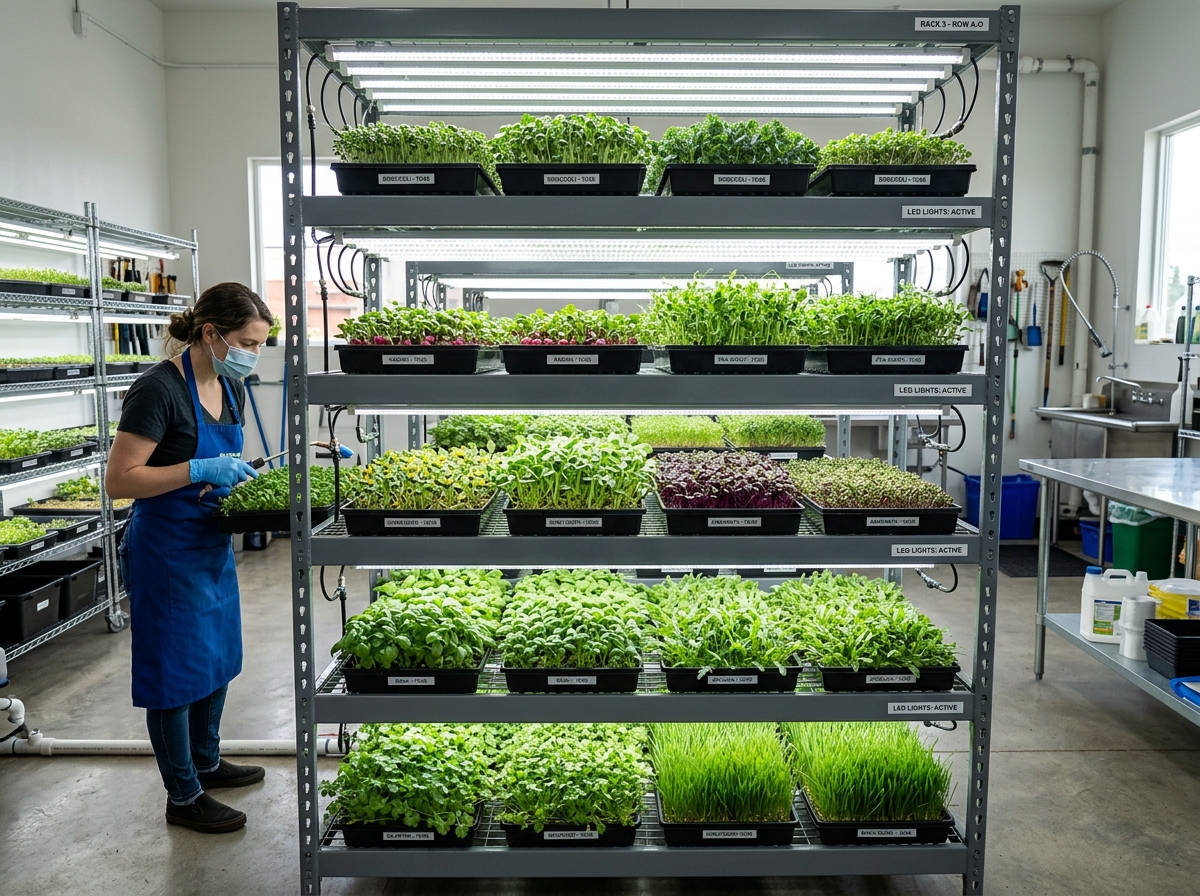
To build a setup that actually produces a reliable harvest, you need to think about drainage. Most professional setups use a “two-tray system”: one tray with drainage holes nestled inside a second tray without holes. This allows for “bottom watering,” which keeps the delicate leaves dry and prevents mold. For a full list of what to buy, our guide on Essential Tools For Indoor Gardening covers the hardware in detail.
One of the first decisions you’ll face is choosing between soil and hydroponics. Here is a quick breakdown to help you decide:
| Feature | Soil-Based (Seedling Mix) | Hydroponic (Mats/Coir) |
|---|---|---|
| Ease of Use | Very forgiving for beginners | Requires more precise watering |
| Flavor Profile | Often richer, more “earthy” | Clean, but sometimes milder |
| Mess Factor | Can be messy indoors | Very clean and “soilless” |
| Nutrition | Minerals from soil help growth | Relies entirely on seed/water |
| Cost | Low (potting mix is cheap) | Medium (mats can be pricey) |
Choosing the Best Containers for Your Indoor Microgreens Growing Setup
You don’t need to spend a fortune on fancy pots. Because microgreens are harvested when they are only 2–4 inches tall, they don’t develop deep root systems. Trays only need to be about 2 inches deep.
We often recommend repurposing food-safe plastic containers, like those clear spinach or arugula clamshells from the grocery store. Just make sure to poke plenty of drainage holes in the bottom! If you’re looking to scale up, investing in heavy-duty, BPA-free trays is a smart move for long-term ROI. You can learn more about Choosing The Best Containers For Your Microgreens or explore how to Ditch The Plastic With These Beginner Microgreens Growing Trays for more sustainable options.
Lighting and Temperature for a Professional Indoor Microgreens Growing Setup
While a south-facing window providing 4–6 hours of direct sun can work, it often leads to “leggy” plants that stretch toward the light. For a truly professional indoor microgreens growing setup, we recommend full-spectrum LED grow lights.
Look for lights with a color temperature around 6500K (which mimics daylight). You don’t need expensive horticultural arrays; simple LED shop lights often do the trick for pennies a day. In fact, running a single tray costs about $0.20 in electricity per cycle. Keep your lights 6–12 inches above the trays and run them for 12–16 hours a day once the seeds have sprouted.
Temperature is the other half of the equation. Most microgreen seeds germinate best at 70–75°F (21–24°C). If your basement or garage is chilly, a waterproof seedling heat mat can be a lifesaver. For more technical details, dive into our resources on LED Grow Lights For Microgreens and Maintaining Optimum Temperatures For Your Microgreens.
Selecting Seeds and Growing Mediums
Not all seeds are created equal. When shopping for your indoor microgreens growing setup, look for seeds specifically labeled for sprouting or microgreens. These are usually untreated and tested for high germination rates.
The Brassicaceae family is the “gold standard” for beginners. This includes:
- Radish: The undisputed king of beginner greens. It germinates in 24 hours and is ready to eat in 6 days.
- Broccoli: Mild flavor and famous for high levels of sulforaphane (a powerful antioxidant).
- Kale and Cabbage: Very similar to broccoli in growth habit and incredibly hardy.
For your medium, we suggest starting with a high-quality Organic Soil For Microgreens. A sterile, peat-based or coconut coir-based seedling mix provides the right balance of moisture retention and aeration. If the idea of dirt in your kitchen makes you twitchy, you can explore Your Guide To Soil Free Microgreens Growing for cleaner alternatives like hemp or silicone mats.
Beginner-Friendly Varieties vs. Nightshade Risks
While most edible vegetables make great microgreens, there is one major “Red Flag” group: the Nightshade family. Never grow tomatoes, peppers, eggplants, or potatoes as microgreens. Their stems and leaves contain toxic alkaloids that can make you very sick.
Stick to the winners:
- Sunflower Shoots: Nutty, crunchy, and a favorite for kids. (Note: these require soaking for 8–12 hours before planting).
- Pea Shoots: Sweet and tender; they can sometimes even give you a second harvest!
- Arugula: Adds a wonderful peppery punch to sandwiches.
For more help picking your first crop, see our Microgreens Planting Guide For The First Time Gardener.
Step-by-Step: From Sowing to Harvest
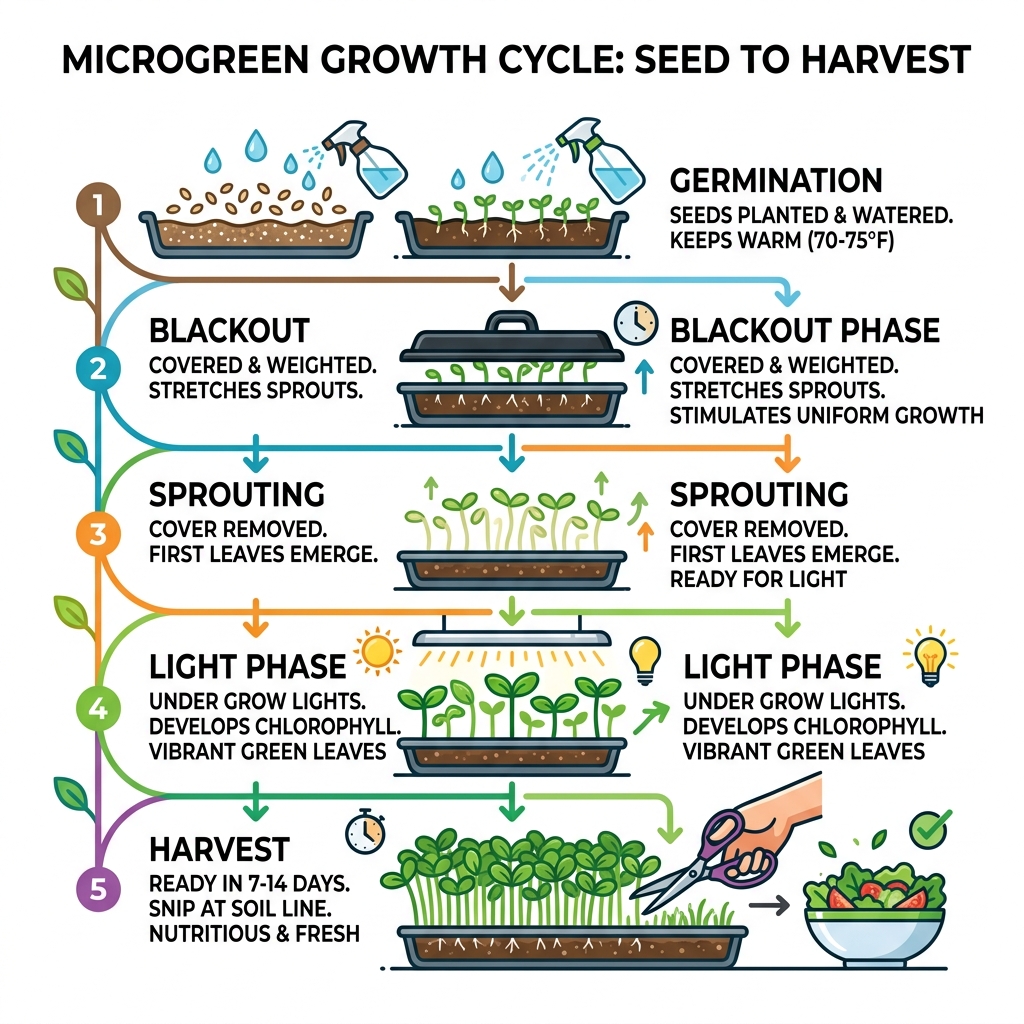
Ready to get your hands dirty? Follow this proven workflow for your indoor microgreens growing setup:
- Prepare the Tray: Fill your tray with 1.5–2 inches of moist soil. Press it down lightly to create a flat, even surface.
- Sow the Seeds: Broadcast your seeds densely across the surface. For small seeds like broccoli, aim for about 1 tablespoon per 1020 tray (roughly 1/4 inch spacing). For larger seeds like peas, you want a single, crowded layer.
- The Blackout Phase: This is the “secret sauce.” Cover your seeds with another tray or a piece of cardboard to keep them in total darkness for 3–5 days.
- Weighting the Trays: Put a 5lb weight (like a brick or a heavy book) on top of the cover tray. This “resistance training” forces the seedlings to develop incredibly strong stems and deep roots.
- Let There Be Light: Once the seedlings are about an inch tall and pushing up the cover, remove the weight and the cover. Move them under your grow lights. They will look yellow at first, but they’ll turn vibrant green within hours.
- Bottom Watering: Instead of spraying from the top, pour about 1/4 inch of water into the bottom (outer) tray. The soil will wick up exactly what it needs. To master this, read our guide to Stop Guessing And Learn Exactly How Often To Water Microgreens.
For a more visual walkthrough, check out How To Grow Microgreens At Home Like A Pro.
Harvesting and Post-Harvest Storage
Most microgreens are ready when they reach 2–4 inches in height and their first “seed leaves” (cotyledons) are fully open. Some growers wait for the first “true leaves” to appear for extra flavor, but don’t wait too long, or the stems can become woody.
The Harvest Process:
- Use sharp, clean scissors or a sharp knife.
- Grasp a small clump of greens and cut about 1/2 inch above the soil line.
- Avoid getting soil into your harvest—it’s a pain to wash out!
Storage Tips: Microgreens are delicate. If you aren’t eating them immediately, store them unwashed in an airtight container or a Ziploc bag in the fridge. Place a dry paper towel inside the container to absorb excess moisture; this can extend their shelf life to 10–12 days.
Troubleshooting and Optimizing Your Yield
Even the best indoor microgreens growing setup can run into hiccups. The most common enemy? Mold.
If you see white, fuzzy patches on the soil surface, it’s often due to overwatering or poor airflow. Don’t confuse root hairs (tiny white fuzz on the roots) with mold! Mold looks like spiderwebs and usually has a musty smell.
Pro-Tips for Success:
- Airflow is Key: Use a small clip-on fan to keep air moving across your trays 24/7. This prevents “damping off” and keeps the canopy dry. Learn How To Use Fans To Grow Healthier Microgreens.
- Sanitize Everything: Wash your trays with a weak bleach solution or food-grade hydrogen peroxide between every single crop.
- Seed Density: If your plants are falling over and rotting, you might be sowing too thickly. Try reducing your seed amount by 20% in the next tray.
For more rescue strategies, see our guide on How To Avoid Mold In Your Microgreen Garden.
Frequently Asked Questions about Indoor Microgreens
Do microgreens regrow after cutting?
For 90% of varieties, the answer is no. Most microgreens are a “one-and-done” crop because you are cutting off the growing point of the plant. Once the stem is cut, the plant doesn’t have the energy to start over. Pea shoots are the exception; if you leave at least one leaf on the stem when you cut, they may give you a second, smaller harvest.
What is the difference between microgreens and sprouts?
This is a common point of confusion!
- Sprouts are grown entirely in water (no soil or light) and you eat the whole thing—seed, root, and stem. Because they are grown in warm, wet conditions, they have a higher risk of bacterial contamination.
- Microgreens are grown in a medium (like soil), require light, and you only eat the stems and leaves. They are generally considered much safer and more flavorful.
How much light do microgreens need daily?
After the blackout phase, your microgreens need a lot of energy to produce those nutrients. We recommend 12–16 hours of LED light daily. If you rely solely on a windowsill, you may notice your plants becoming “leggy” (tall, thin, and pale). If this happens, it’s a sign they need more light or a closer light source.
Conclusion
At FinanceOrbitX, we look at gardening through the lens of a smart investment. An indoor microgreens growing setup offers one of the highest ROIs in home health. For a startup cost of under $100, you can produce hundreds of dollars worth of organic, nutrient-dense produce every year.
By using staggered planting—sowing a new tray every 5–7 days—you can ensure a continuous supply that never runs out. It’s a simple, rewarding habit that pays dividends in flavor and vitality.
Ready to build your own oasis? Start your journey with our premium supplies and join the ranks of home growers who are taking control of their nutrition, one tiny leaf at a time.
