
The Quickest Way to Grow Healthier Microgreens at Home
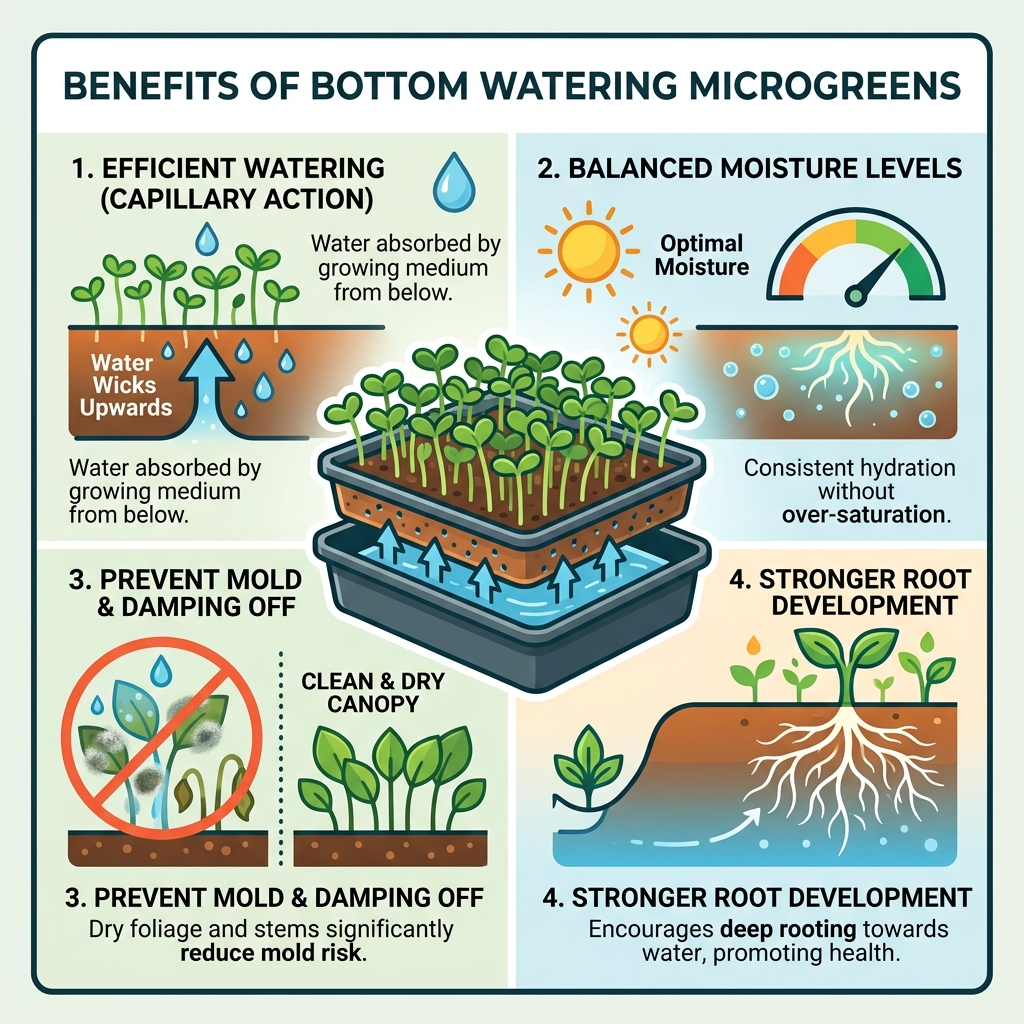
Bottom watering microgreens is the technique of adding water to a tray placed beneath your growing tray, so moisture travels upward through drainage holes directly to the roots — keeping stems and leaves completely dry.
Here’s a quick summary of how it works and why it matters:
- What it is: Water sits in a bottom tray and wicks upward into the growing medium through capillary action.
- When to use it: After germination, once your seeds have sprouted and you remove the blackout cover.
- How much water: About 1 cup for a 1010 tray, 2 cups for a standard 1020 tray.
- How often: Check daily using the weight test — if the tray feels light, it’s time to water.
- Why it works: Dry foliage means far less mold, stronger roots, and healthier harvests.
Getting watering right is one of the hardest parts of growing microgreens — especially for beginners. Too much water and you risk mold, damping off, and root rot. Too little and your greens wilt before they’re ready to harvest.
The good news? Bottom watering takes most of the guesswork out of the equation.
It’s faster, cleaner, and more forgiving than top watering — and once you understand the basics, it becomes second nature.
This guide walks you through everything: the right equipment, exact water amounts, a step-by-step process, and the mistakes to avoid so your first grow is a success.
Why Bottom Watering Microgreens is the Gold Standard
When we first start our journey into indoor gardening, our instinct is usually to grab a watering can and shower our plants from above. While that works for your backyard kale, it’s often a recipe for disaster with microgreens. At FinanceOrbitX, we’ve seen many beginners struggle with “damping off” or fuzzy white mold, and almost every time, the culprit is top watering.
So, why is bottom watering microgreens considered the “Gold Standard”? It all comes down to the delicate nature of the microgreen canopy.
Foliage Protection and Mold Prevention
Microgreens are grown very densely. Because there are thousands of tiny plants packed into a small tray, airflow is naturally restricted. If you get the leaves and stems wet by watering from the top, that moisture gets trapped in the “undergrowth.” This creates a humid microclimate that is a playground for mold and pathogens. By watering from the bottom, the foliage stays bone-dry, which is the single most effective way to how-to-avoid-mold-in-your-microgreen-garden.
Root Health and Strength
When you bottom water, you aren’t just keeping the tops dry; you’re encouraging the roots to do some work. As the water sits in the bottom tray, the roots sense the moisture and grow downward to reach it. This leads to a more robust, healthy root system. In fact, research shows that while yield might be similar between methods, the root development in bottom-watered trays is often superior. You can learn more about the science of hydration in our guide on the-right-way-to-water-your-microgreens.
Increased Shelf Life
Believe it or not, how you water affects how long your greens last in the fridge. Wet microgreens at harvest time have a significantly shorter shelf life. They tend to turn into “mush” much faster. By keeping the canopy dry throughout the growth cycle, you ensure a crisp, clean harvest every time.
| Feature | Top Watering | Bottom Watering |
|---|---|---|
| Mold Risk | High (wet foliage) | Very Low (dry foliage) |
| Root Growth | Surface-level | Deep and robust |
| Ease of Use | Messy/Disturbs seeds | Clean and efficient |
| Harvest Quality | May be damp/wilted | Crisp and dry |
| Time Investment | High (misting takes time) | Low (pour and go) |
When to Switch from Top to Bottom Watering
Timing is everything in gardening, much like in finance. You wouldn’t invest in a long-term bond before you have your savings account set up, right? Similarly, you shouldn’t start bottom watering microgreens until the plants are ready for it.
The Germination Phase
During the first 2–3 days, your seeds are just starting to wake up. At this stage, they don’t have roots long enough to reach the bottom of the tray. During germination, we recommend using a fine mist sprayer to keep the top of the organic-soil-for-microgreens moist. This helps soften the seed hulls and encourages the first tiny “radicle” (the baby root) to emerge.
The Blackout Period
Most microgreens go through a “blackout” period where they are covered to encourage them to stretch. During this time, the humidity dome or cover usually keeps enough moisture in. However, if you notice the edges drying out, a quick mist is all you need.
The Cotyledon Stage: Time to Switch!
Once the seeds have sprouted, developed their first set of leaves (cotyledons), and you have removed the cover to place them under lights, it is time to switch to bottom watering. At this point, the roots have usually reached the bottom of the tray and are ready to drink.
If you’re unsure if it’s too early, you can always check our resource on how to stop-guessing-and-learn-exactly-how-often-to-water-microgreens. Generally, if you see roots poking through the drainage holes at the bottom of your tray, you are officially in the bottom-watering zone!
Essential Equipment for Success
To bottom water microgreens like a pro, you don’t need a massive budget, but you do need the right “infrastructure.” Think of this as your gardening portfolio—quality assets yield better returns.
- Nesting Trays (The 1020 System): This is the most critical piece of equipment. You need two trays of the same size. One tray must have drainage holes (where the plants live), and the other must be solid with no holes (the reservoir). We discuss the best options in our guide on choosing-the-best-containers-for-your-microgreens.
- Growing Medium: Whether you use coconut coir or a peat-based mix, ensure it has good wicking properties. Coconut coir is excellent because it acts like a sponge, pulling water upward very efficiently. Check out our thoughts on organic-soil-for-microgreens-2 for more details.
- Water pH Testing Kit: Microgreens are happiest when their water is slightly acidic, ideally between pH 5.5 and 6.5. If your tap water is too alkaline, your plants might struggle to absorb nutrients.
- Pump Sprayer: While we are focusing on bottom watering, a pump sprayer is still one of the best tools-to-prevent-mold-in-microgreens during that initial germination phase. It’s much easier on your hands than a trigger bottle!
Step-by-Step Guide to Bottom Watering Microgreens
Ready to get your hands dirty (but your leaves dry)? Follow this simple process to ensure your microgreens get exactly what they need.
Step 1: The Weight Test
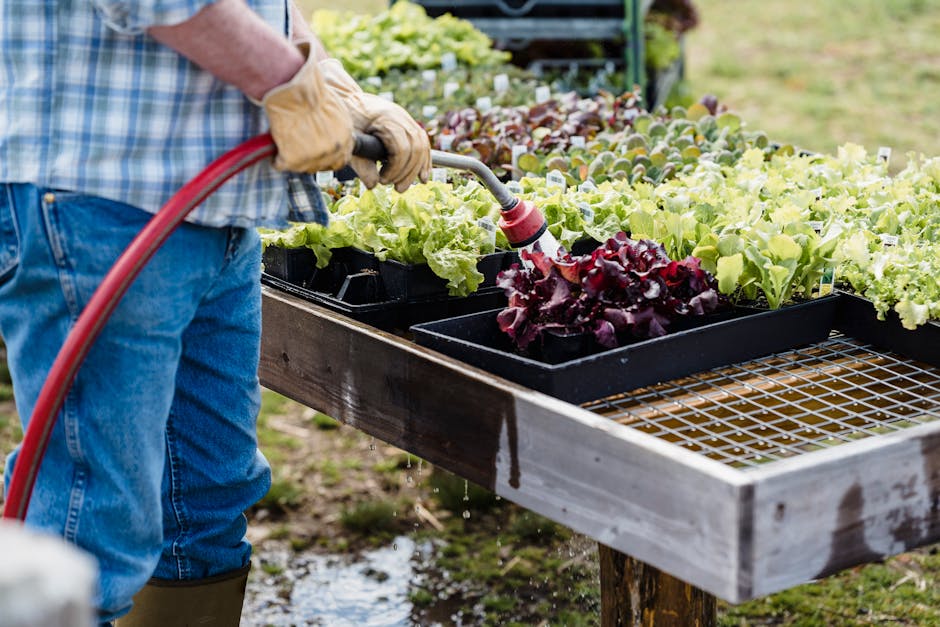
Before you add a single drop of water, pick up your tray. Does it feel light as a feather? If so, your plants are thirsty. If it still feels heavy, wait another day. Learning the “feel” of a dry tray is the best way to prevent overwatering.
Step 2: Prepare Your Water
Use room-temperature water. Cold water can shock the tender roots of your microgreens, slowing down their growth. If you want to be extra precise, test the pH and adjust it with a little lemon juice or vinegar if it’s above 7.0.
Step 3: Add Water to the Reservoir
Lift the corner of your microgreen tray (the one with the holes) and pour the water into the solid bottom tray. For a standard 1020 tray, start with 1.5 to 2 cups of water.
Step 4: The 20-Minute Soak
Lower the microgreen tray back into the reservoir. Through a process called capillary action, the soil will begin to “wick” the water upward. It’s like a paper towel dipping into a spill—the moisture moves against gravity to fill the dry spaces in the soil.
Step 5: Excess Drainage
After about 20 minutes, check the tray. If there is still a significant amount of standing water in the bottom tray, dump it out. You want the soil to be moist, but you don’t want the roots to be “swimming” in stale water for hours. This is vital for preventing root rot.
For more on the differences in growing mediums, see our article on soil-vs-hydroponics-which-is-best-for-microgreens.
Measuring the Right Amount for Bottom Watering Microgreens
Not all trays are created equal. Depending on what you’re using, your “water budget” will vary:
- 1020 Tray (The Standard): 2 cups of water per session.
- 1010 Tray (Half-size): 1 cup of water per session.
- 5×5 Inserts: About 1/2 cup of water.
- Pea Shoots and Sunflowers: These are the “heavy drinkers” of the microgreen world. As they get closer to harvest, they may need up to 2 cups of water twice a day.
- Small Greens (Basil, Broccoli): These usually do fine with 1.5 cups once a day.
Troubleshooting Common Mistakes in Bottom Watering Microgreens
Even pros hit a snag occasionally. Here’s how to fix common issues:
- Standing Water: If you leave water in the bottom tray for days, it becomes stagnant. This invites bacteria and root rot. Always dump the excess after 20–30 minutes.
- Hydrophobic Soil: If your soil gets too dry, it might actually repel water. If you notice the water isn’t wicking up, you may need to lightly mist the top just once to “prime the pump” and get the capillary action started again.
- Uneven Wicking: If one side of your tray is dry and the other is wet, your shelf might not be level! Check your surface with a level tool to ensure even water distribution.
Frequently Asked Questions about Watering
How often should I bottom water my microgreens?
For most varieties, once a day is plenty. However, environmental factors like high heat, low humidity, or strong fans can dry out trays faster. Always rely on the weight test. If the tray is light, water it! As plants get larger and closer to harvest, their water needs will increase significantly.
What is the ideal water pH for microgreens?
We recommend a pH between 5.5 and 6.5. Most tap water is slightly alkaline (above 7.0). While microgreens are hardy and can often grow in standard tap water, you’ll see much more vibrant growth if you balance the pH. You can find more tips on soil and water chemistry in our guide on organic-soil-for-microgreens-3.
Can bottom watering prevent mold and damping off?
Absolutely. Mold thrives in wet, stagnant environments. By keeping the top of the soil and the plant canopy dry, you remove the environment mold needs to grow. Combined with good airflow (like a small oscillating fan), bottom watering microgreens is your best defense. For more advanced tips, check out how-to-avoid-mold-in-your-microgreen-garden-2.
Conclusion
At FinanceOrbitX, we believe that growing your own food should be as rewarding as a well-managed investment. Mastering the art of bottom watering microgreens is a small skill that pays huge dividends in the form of lush, crunchy, and nutrient-dense harvests.
By switching from top misting to bottom soaking at the right time, using the correct equipment, and monitoring your trays daily, you eliminate the most common hurdles beginners face. No more moldy trays, no more wilted greens—just pro-level results from your very own kitchen counter.
Ready to dive deeper into home gardening? Explore our ultimate-guide-to-growing-microgreens-at-home or start from the very beginning with our microgreens-101-a-beginners-guide.
For more tips, tricks, and expert advice, visit our full library of Gardening Resources. Happy growing!
