
Why Every Home Gardener Needs an Indoor Microgreens Growing Guide
An indoor microgreens growing guide is the fastest path to growing your own nutrient-packed greens at home — no yard, no experience, and no green thumb required.
Here’s the quick answer:
- Fill a shallow tray with 1-2 inches of potting mix or coconut coir
- Sow seeds evenly across the surface and press gently
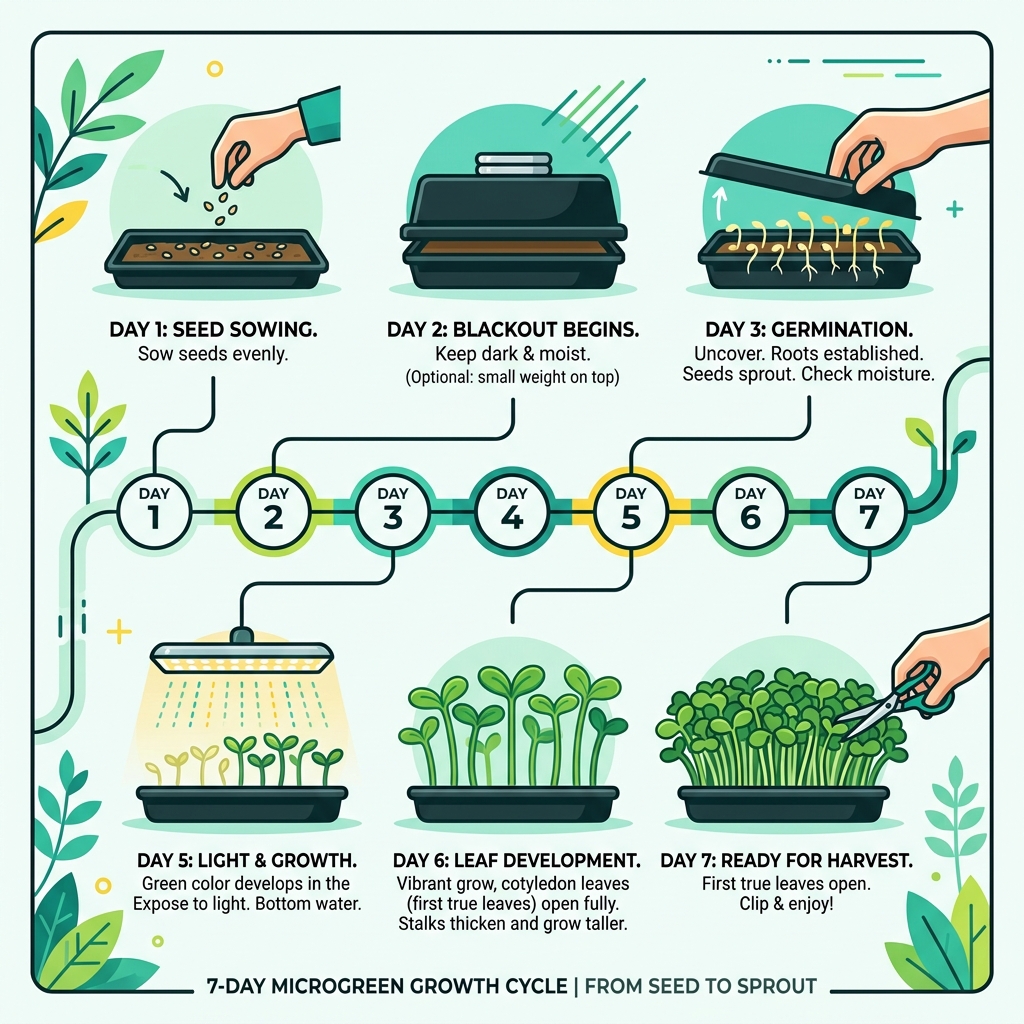
- Cover with a second tray for a 3-5 day blackout period
- Uncover and move under a grow light or sunny window
- Water from the bottom daily to keep roots moist
- Harvest in 7-14 days when the first leaves fully open
That’s the whole process. Most beginners get their first successful tray within two weeks.
So why bother growing your own? A few reasons stand out:
- They’re incredibly nutritious. Research suggests microgreens can contain up to 40 times more vitamins and antioxidants than their fully grown counterparts.
- They’re fast. Some varieties like radish are ready in as little as 5-7 days.
- They’re cheap to grow. Each tray costs roughly $2-4 in supplies — yet the same amount costs $10 or more at a grocery store.
- They fit anywhere. A single 10×20 inch tray on a kitchen counter is all the space you need.
- They grow year-round. No seasons, no weather, no waiting.
The challenge most beginners face isn’t the concept — it’s the details. How dense should you sow seeds? How far should the light be? Why does mold keep appearing?
This guide answers all of that, step by step.
Essential Supplies for Your Indoor Microgreens Growing Guide
Starting your indoor garden doesn’t require a massive investment, but having the right tools makes the difference between a lush harvest and a tray of wilted stems. Think of this as your “startup capital” for a lifetime of fresh greens.

The Growing Trays
The industry standard is the 10×20 tray, but for home use, smaller 5×7 or 10×10 trays are often more manageable. You need two types: one with drainage holes and one without. The tray with holes holds your growing medium, while the solid tray underneath acts as a reservoir for bottom watering. If you are looking for specific recommendations, check out the top hydroponic trays for microgreens to see which durability levels suit your budget. If you prefer to avoid plastic entirely, there are sustainable options available; you can ditch the plastic with these beginner microgreens growing trays to keep your setup eco-friendly.
Growing Media: Soil vs. Soilless
You have choices here. Many beginners start with a high-quality, sterile potting soil or a seed-starting mix. However, many pros prefer “soilless” options like coconut coir or hemp mats because they are cleaner and reduce the risk of soil-borne diseases. For a deep dive into these methods, read your guide to soil-free microgreens growing.
Essential Tools
- Spray Bottle: For misting seeds during the initial germination phase.
- Full-spectrum LED: While a sunny window can work, a dedicated light ensures consistent growth. For the best results, look into the best indoor grow lights for microgreens.
- Kitchen Scale: Essential for measuring seed density so you don’t overcrowd your trays.
- pH Strips: Microgreens prefer water in the 5.5 to 6.5 pH range. If your tap water is too alkaline, your greens might struggle to absorb nutrients.
Choosing the Best Varieties for Beginners
Not all seeds are created equal. Some are “set it and forget it,” while others are divas that require perfect conditions. We recommend starting with the “Big Five”:
- Radish: The undisputed king for beginners. It germinates in 24 hours and is ready to eat in 6 days. It has a spicy, peppery kick.
- Broccoli: Famous for its high sulforaphane content, it’s mild, grows reliably, and is ready in about 10 days.
- Pea Shoots: These are crunchy and taste exactly like snap peas. Kids love them because the seeds are large and easy to handle.
- Sunflower: These require a bit more work (soaking and weighted germination), but the nutty, crunchy reward is worth it.
- Arugula or Kale: Great for adding variety to salads. Arugula offers a sharp bite, while kale provides a hearty, earthy base.
For a more detailed breakdown, our microgreens 101: a beginner’s guide covers everything from seed sourcing to flavor profiles.
| Variety | Germination Time | Flavor Profile | Difficulty |
|---|---|---|---|
| Radish | 1-2 Days | Spicy/Peppery | Very Easy |
| Broccoli | 2-3 Days | Mild/Fresh | Easy |
| Pea Shoots | 2-3 Days | Sweet/Crunchy | Moderate |
| Sunflower | 3-4 Days | Nutty/Buttery | Moderate |
| Arugula | 2-3 Days | Sharp/Nutty | Easy |
Understanding the Cost and Space Requirements
One of the best parts of using an indoor microgreens growing guide is the financial efficiency. You don’t need a greenhouse; a single shelf or a small corner of your kitchen island is plenty. We’ve found that maximizing small spaces: apartment microgreens gardening is entirely possible even in studio apartments.
In terms of cost, the electricity for a small LED setup is negligible — often around $0.20 per tray for the entire growth cycle. Compare that to the $30 we recently spent on three small clamshells at a local farmer’s market, and the ROI (Return on Investment) is clear.
Step-by-Step Process: From Sowing to Germination
Now that you have your gear, it’s time to get your hands dirty (or “coir-y”). Proper sowing is the foundation of a healthy crop.
Preparation and Sowing
Start by filling your tray with about 1.5 inches of your chosen medium. Level it out gently—don’t pack it down like a brick, as the roots need air to breathe.
Pro Tip: For larger seeds like peas, sunflowers, and beets, pre-soak them in a bowl of water for 8-12 hours before planting. This “wakes up” the seed and significantly speeds up germination. For smaller seeds, you can sow them directly. Our microgreens planting guide for the first time gardener suggests using about 1 tablespoon of small seeds (like broccoli) for a 10×10 tray.
Broadcast the seeds evenly across the surface. You want them close, but not overlapping. Once sown, mist them generously with your spray bottle.
The Blackout Period
This is where many beginners go wrong. Most microgreens need a “blackout period” to germinate properly. This mimics the seeds being buried underground. Place an empty tray (or a lid) over your seeds to block out all light.
For the best results, use “weighted germination.” Place a weight (like a brick or a heavy book) on top of the cover tray. This forces the roots to push deeper into the medium and helps the seedlings shed their seed hulls. Keep them in the dark for 3-5 days. You can learn more about building this setup in the ultimate guide to crafting your own DIY microgreen kit.
Once you see the seedlings pushing up against the weighted tray and they look slightly yellow (don’t worry, they’ll turn green soon!), it’s time to introduce them to the world. For a deeper look at this transition, check out how to grow microgreens at home like a pro.
Mastering Light and Water in Your Indoor Microgreens Growing Guide
Once the blackout is over, your greens are hungry for light. Move them under your LEDs or to a very bright south-facing window.
Lighting Specs:
- Duration: 12-16 hours per day. Use a cheap timer to automate this.
- Distance: Keep LED lights 3-5 inches above the plants. If the lights are too far away, the plants will stretch and become “leggy” (weak and thin).
- Photoperiod: Consistency is key. Our experts suggest 17 hours on and 7 hours off for maximum growth, though 12-14 is sufficient for most. Learn more about choosing the right lighting for growing microgreens.
Watering Wisdom: Stop misting from the top once the seeds have sprouted. Excess moisture on the leaves is an invitation for mold. Instead, use bottom watering. Pour water into the bottom (solid) tray and let the medium wick it up. This keeps the stems dry and the roots hydrated. This is one of the most essential tools for indoor gardening success.
Optimizing the Environment and Troubleshooting
Your indoor environment plays a massive role in your success. Microgreens are like Goldilocks—they don’t like it too hot or too cold.
Ideal Conditions:
- Temperature: 65-70°F is the sweet spot.
- Humidity: 40-60%. If it’s too humid, mold will strike. If it’s too dry, your trays will dry out before you get home from work.
- Air Circulation: This is the “secret sauce.” A small oscillating fan pointed near (but not directly at) your trays will prevent stagnant air and drastically reduce mold issues.
For year-round success, especially in harsh winters or humid summers, see our year-round indoor microgreen growing tips.
Troubleshooting Common Issues
Even with a perfect indoor microgreens growing guide, things can go sideways. Here is how to fix the most common problems:
- Mold vs. Root Hairs: Beginners often freak out when they see white fuzz. If it’s only at the base of the stem and looks like tiny hairs, those are root hairs (they’re good!). If it looks like a spiderweb and is spreading across the tops of seeds, that’s mold.
- Fixing Mold: Improve airflow and reduce your seeding density next time. You can also spray a diluted mixture of food-grade hydrogen peroxide and water to kill early mold.
- Leggy Growth: Your plants are “reaching” for light. Move your light source closer or increase the duration.
- Damping Off: This is a fungal disease where stems collapse at the base. It’s usually caused by overwatering or contaminated soil.
For more advanced fixes, refer to the ultimate guide to indoor microgreen mastery or our apartment-friendly tips for growing microgreens.
Harvesting, Storage, and Scaling Your Setup
The finish line is in sight! Harvesting is the most rewarding part of the process.
When and How to Harvest
Most microgreens are ready when they reach the cotyledon stage (the first set of leaves). This is usually when they are 2-3 inches tall. Use sharp, clean scissors or a dedicated harvesting knife. Hold a clump of greens gently with one hand and snip about half an inch above the soil line. Avoid getting soil on your greens, as washing them can reduce their shelf life.
If you want to transition from seed to salad: a beginner guide to indoor microgreens, timing is everything. Harvest in the morning when the plants are most hydrated for the best crunch.
Storage for Longevity
Microgreens can last 10-12 days in the fridge if stored correctly. The enemy of storage is moisture. Place your harvested greens in an airtight container lined with a dry paper towel. The towel will absorb any excess humidity, keeping the greens crisp. For more on the best containers for nurturing indoor microgreens, check our reviews of glass vs. plastic options.
Scaling Up and Creating Custom Salad Mixes
Once you’ve mastered single-variety trays, try succession planting. Start a new tray every 5 days so you have a perpetual harvest.
You can also create “Spicy Mixes” (Radish + Mustard) or “Mild Mixes” (Broccoli + Kale + Cabbage). Just make sure the varieties you mix have similar growth rates. If space is tight, look into vertical microgreens gardening: small space solutions to stack your harvests to the ceiling!
Frequently Asked Questions about Microgreens
Can microgreens regrow after cutting?
For 95% of varieties, the answer is no. Microgreens are a “one and done” crop. Because you are cutting them before they have developed true leaves and a complex root system, they don’t have the energy reserves to bounce back. The exception is pea shoots, which can sometimes give you a smaller second harvest if you cut them above the lowest leaf node. Generally, it’s best to compost your soil and start fresh.
Are microgreens more nutritious than mature vegetables?
Yes! They are considered “living food.” Because they are harvested at the peak of their initial growth spurt, they contain a concentrated dose of the nutrients the plant would eventually spread out across its entire adult body. Broccoli microgreens, for example, are famous for having high levels of sulforaphane, a compound studied for its cancer-preventing properties.
How long does it take to reach harvest size?
It depends entirely on the variety. Radishes and mustards are the sprinters (5-7 days). Sunflowers and peas are the middle-distance runners (10-14 days). Herbs like cilantro, basil, and parsley are the marathon runners, often taking 21 days or more to reach a good harvest size.
Conclusion
At FinanceOrbitX, we believe that self-sufficiency is the ultimate form of financial and personal freedom. By following this indoor microgreens growing guide, you aren’t just growing food; you’re investing in a sustainable lifestyle that pays dividends in health and grocery savings.
Whether you’re starting with a single tray of radishes on your windowsill or building a vertical farm in your spare room, the journey of home horticulture is incredibly rewarding. Ready to get started? Start your journey with the right microgreen supplies and join the thousands of home gardeners who have ditched store-bought lettuce for fresh, living greens. Happy growing!
