
Why Getting Soil Moisture Right Makes or Breaks Your Microgreens
Microgreens soil hydration tips are the single most important thing to get right when growing your first tray at home.
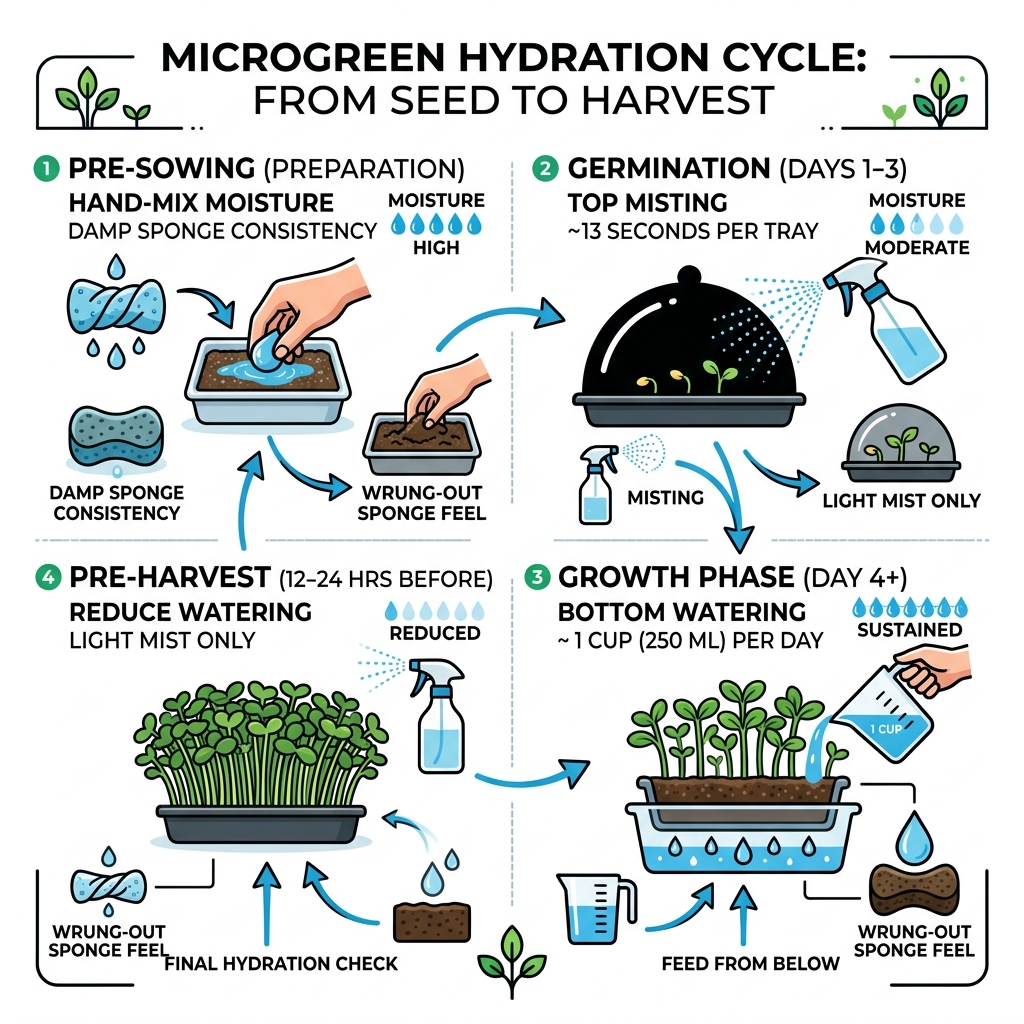
Here’s a quick-reference guide to ideal soil moisture at each stage:
| Growth Stage | Method | Amount |
|---|---|---|
| Pre-sowing | Hand-mix water into medium | Damp sponge consistency |
| Germination (days 1-3) | Top misting with spray bottle | ~13 seconds per tray |
| Growth phase (day 4+) | Bottom watering | ~1 cup (250 ml) per day |
| Pre-harvest (12-24 hrs before) | Light mist only | Reduce watering |
The core rule: soil should feel like a wrung-out sponge — moist, but never soggy or dripping.
Most beginners lose their first crop not from bad seeds or poor light, but from watering mistakes. Too much water invites mold. Too little causes wilting and stunted growth. And unlike most houseplants, microgreens grow so fast — 7 to 14 days from seed to harvest — that a single day of bad hydration can cost you the whole tray.
The good news? Once you understand the two-phase watering approach and a few simple checks, keeping your soil at the right moisture level becomes second nature.
Preparing the Foundation: Pre-Sowing Microgreens Soil Hydration Tips
Before a single seed touches the medium, we have to set the stage. Think of your growing medium as a bank account; if you start with a zero balance, your plants will be “overdrawn” before they even sprout. Proper pre-moistening ensures that seeds have immediate access to the moisture required to crack their hulls.
The Perfect Mix: 10×20 Tray Standards
Most home growers use the industry-standard 10×20 tray. For a shallow 1-inch deep tray, you will typically need about 6 cups of soil or coco coir. If you are using a 2-inch deep tray, that volume doubles to 12 cups.
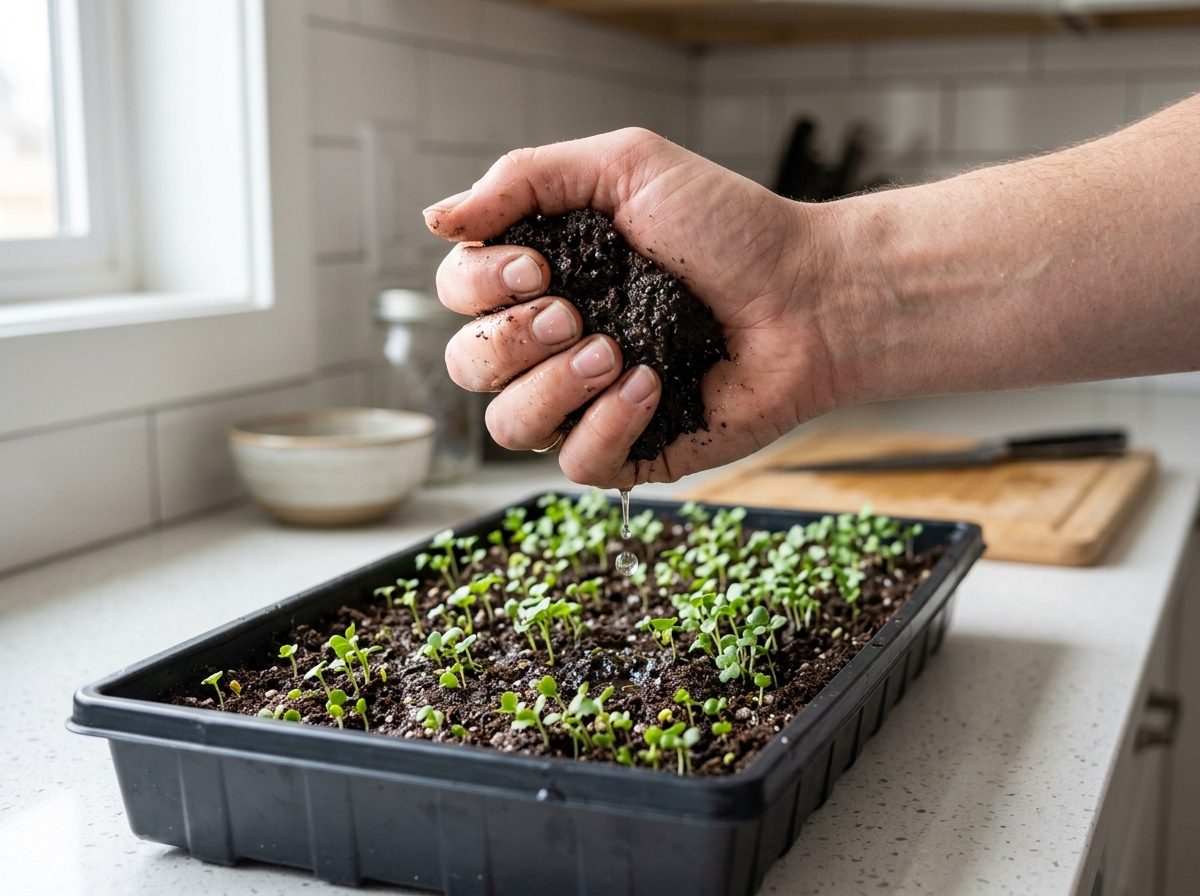
To achieve the ideal moisture level, do not simply dump dry soil into the tray and spray the top. Instead, place your medium in a clean bucket and slowly add water, mixing by hand. You are aiming for a damp sponge consistency. When you squeeze a handful of soil, it should hold its shape and feel cool and wet, but only a drop or two of water should escape. If it’s dripping, it’s too wet; add more dry medium. If it crumbles and falls apart, it’s too dry.
Medium Matters: Soil vs. Coir vs. Mats
The type of medium you choose significantly dictates your microgreens soil hydration tips strategy. Some materials hold onto water like a high-yield savings account, while others “spend” it quickly through evaporation.
| Growing Medium | Water Retention | Hydration Characteristics |
|---|---|---|
| Organic Soil | High | Holds nutrients well; stays moist longer; can be messy. |
| Coco Coir | Excellent | Very beginner-friendly; wicks water evenly; neutral pH. |
| Peat Moss | Moderate | Can become hydrophobic (repel water) if it dries out completely. |
| Reusable Mats | Low | Dries out very fast; requires frequent monitoring (2-3 times/day). |
For more details on choosing the right base, check out our guide on Soil and Growing Medium for Microgreens. Regardless of the medium, ensure your growing tray has drainage holes. Without them, excess water pools at the bottom, leading to “swampy” conditions that rot delicate roots.
The Two-Phase Watering Strategy
Mastering hydration isn’t about a single “set it and forget it” method. We categorize watering into two distinct phases based on the plant’s life cycle. To do this effectively, you’ll need a few basic tools:
- A fine-mist spray bottle (for delicate seeds).
- A garden pump sprayer (for larger setups).
- A measuring cup (to track exactly how much you’re “investing” in your trays).
- A solid bottom tray (without holes) for bottom watering.
Phase 1: Germination Phase Microgreens Soil Hydration Tips
During the first 2 to 4 days, your seeds are in the “blackout” or germination phase. They don’t have roots yet, so they rely entirely on surface moisture.
- Top Misting: Use your spray bottle to mist the seeds immediately after sowing. A good rule of thumb is to spray for about 13 seconds using a hand pump sprayer to ensure the seeds are nestled into the moist medium.
- The Humidity Dome: Covering your tray with another inverted tray or a lid helps lock in moisture. This creates a micro-climate that prevents the soil from drying out under your lights or in a breezy room.
- Seed Hulls: Keeping the surface moist is critical for “softening” the seed hulls. If the environment is too dry, the hulls won’t split, or worse, they’ll get stuck on the leaves of the growing plant (common with sunflowers).
- Weighting: For many crops like peas or radishes, placing a 3-7 lb weight on top of the covering tray during germination improves seed-to-soil contact, which leads to more efficient water uptake.
Phase 2: Growth Phase Microgreens Soil Hydration Tips
Once the seeds have sprouted and you see tiny roots reaching down, it is time to stop misting the tops. Transitioning to bottom watering is perhaps the most important of all microgreens soil hydration tips.
- Why Bottom Water? Spraying the leaves of maturing microgreens is a recipe for disaster. It traps moisture between the dense stems, creating a playground for mold and pathogens. Bottom watering keeps the foliage dry while delivering hydration directly to the roots.
- The 10-15 Minute Rule: Pour about 1 cup (250 ml) of water into your solid bottom tray and place your growing tray (the one with holes) inside it. Let it sit for 10 to 15 minutes. The medium will wick the water upward through capillary action.
- Drain the Excess: If there is still water standing in the bottom tray after 30 minutes, dump it out. Standing water suffocates roots and leads to root rot.
- Evapotranspiration: As your plants grow, they “breathe” out moisture. A tray of radish microgreens can transpire between 1.5 to 2.5 fluid ounces of water daily. As the canopy gets thicker, you may need to increase your daily “deposit” to 2 cups of water.
For a deeper dive into this transition, see our article on The Right Way to Water Your Microgreens.
Environmental Factors and Water Quality
Just as market conditions affect your finances, environmental factors like temperature and humidity dictate how fast your soil loses moisture.
Temperature and Airflow
The ideal temperature for microgreens is between 68-77°F (20-25°C). If your grow room is hotter, the evapotranspiration rate increases, meaning you’ll need to water more frequently. Conversely, high humidity (above 60%) slows down evaporation but increases the risk of mold. We recommend using a small fan to keep air moving, which helps regulate the soil’s surface moisture.
Water Quality: The “Hidden Costs”
Not all water is created equal. For optimal nutrient uptake, your water should have a pH of 5.5 to 6.5.
- Chlorine: Most tap water contains chlorine or chloramines. These can shock delicate microgreen roots. To fix this, let your tap water sit out for 24 hours to allow the chlorine to evaporate, or use a Vitamin C tablet to neutralize chloramines.
- Temperature: Always use room-temperature water. Cold water can shock the plants and stunt their growth, while hot water can literally cook the tender roots.
To help you stay on track, check out our guide to Stop Guessing and Learn Exactly How Often to Water Microgreens.
Frequently Asked Questions about Microgreen Hydration
Should I water microgreens before harvest?
Yes, but with caution. We recommend reducing your watering about 12 to 24 hours before harvest. You want the soil to be slightly drier so the greens are “crisper” and have less surface moisture when cut. This significantly extends their shelf life in the fridge. If you harvest “wet” greens, they will turn to mush much faster.
How do I tell the difference between root hairs and mold?
This is the most common panic point for new growers!
- Root Hairs: These look like tiny, white, fuzzy fibers growing directly off the main root. They usually appear in concentrated patches around the root. If you spray them with water, they will “disappear” or flatten against the root.
- Mold: Mold looks like a messy, spider-web-like structure that crawls across multiple seeds and the soil surface. It does not disappear when sprayed.
- The Fix: If you suspect mold, mix 1-2 teaspoons of food-grade hydrogen peroxide per gallon of water and mist the area lightly to kill the spores without harming the plants.
What are the signs of overwatered vs. underwatered soil?
Monitoring your “liquid assets” requires a keen eye.
- Underwatered: The plants will look pale and begin to wilt or fall over. The tray will feel incredibly light when you lift it.
- Overwatered: You may notice yellowing stems, a musty or “sour” smell from the soil, and the presence of mold. The tray will feel heavy, and you might see “slimy” roots.
- The Lift-and-Feel Technique: Get into the habit of lifting your tray every day. You will quickly learn the difference in weight between a fully hydrated tray and one that is “bankrupt” and needs a refill.
Conclusion
At FinanceOrbitX, we believe that growing your own food is one of the smartest investments you can make for your health and your wallet. Mastering microgreens soil hydration tips is the first step toward a high-yield home garden. By understanding the transition from germination misting to growth-phase bottom watering, and keeping a close eye on your environmental “market conditions,” you’ll ensure a lush, vibrant harvest every time.
Consistency is key. Set a schedule, watch your water pH, and don’t be afraid to get your hands dirty checking that soil moisture. For more expert advice on the gear you need to get started, visit our section for More info about microgreen supplies. Happy growing!
