
The Easiest Seeds for Microgreens (And Why They’re Worth Growing)
Seeds for microgreens are one of the fastest ways to grow fresh, nutrient-packed food at home — even if you’ve never gardened before.
Here are the best beginner-friendly options to start with:
| Seed Variety | Days to Harvest | Flavor Profile | Difficulty |
|---|---|---|---|
| Broccoli | 7-10 days | Mild, earthy | Easy |
| Radish | 7-10 days | Spicy, peppery | Easy |
| Sunflower | 10-14 days | Nutty, crunchy | Easy |
| Pea Shoots | 10-14 days | Sweet, fresh | Easy |
| Kale | 8-12 days | Mild, slightly bitter | Easy |
| Mizuna | 10-15 days | Mild mustard | Easy-Medium |
Most of these are ready to harvest in under two weeks. Some studies suggest microgreens can contain up to 40 times more vitamins and minerals than their fully grown counterparts. That’s a serious nutritional payoff for a very small amount of effort and space.
The catch? A lot of beginners pick the wrong seeds, set up their trays incorrectly, or run into problems like mold and poor germination — and give up before their first harvest.
This guide walks you through exactly which seeds to choose, how to set them up for success, and how to avoid the most common beginner mistakes.
Understanding Microgreens vs. Sprouts
To the uninitiated, microgreens and sprouts might look like the same thing: tiny, expensive greens in plastic clamshells at the grocery store. However, they are fundamentally different “life stages” of a plant, and the way we grow them is quite different too.
Sprouts are the most basic stage. They are grown entirely in water (usually in a jar) without soil or light. When you eat a sprout, you eat the whole thing—the seed, the tiny root, and the pale stem. Because they grow in warm, wet conditions without much airflow, they carry a higher risk of bacterial contamination.
Microgreens, on the other hand, are a step further along. We grow them in a medium like soil or a hemp mat. They require light to develop their true leaves and vibrant colors. Unlike sprouts, we only harvest the stems and leaves by cutting them just above the soil line. We don’t eat the roots. This vertical growth makes them much cleaner and often safer to consume.
When looking for Organic Non-GMO Microgreen Seed, you are essentially looking for seeds that have the vitality to push through that first stage of growth and provide a dense canopy of “true leaves” that are packed with flavor.
Choosing the Best Seeds for Microgreens
Not every seed is destined to be a microgreen. When you’re shopping, you’ll see terms like “Heirloom,” “Non-GMO,” and “Organic.” Here’s what we recommend looking for:
- Germination Rates: You want seeds with a high germination rate (usually 90% or higher). Since we plant microgreens very densely, if half the seeds don’t grow, you end up with “bald spots” in your tray that can invite mold.
- Heirloom and Non-GMO: Many growers prefer Microgreens Seeds | Non-GMO, Organic, & Heirloom Varieties because they haven’t been chemically treated. Since we eat these plants when they are so young, using clean, untreated seeds is a smart health choice.
- Seed Quality: Avoid seeds meant for large-scale “commodity” farming, which might be treated with fungicides. Always buy seeds specifically labeled for sprouting or microgreen use.
Top Beginner-Friendly Seeds for Microgreens
If you are just starting your journey, we suggest sticking to the “Big Five”: Broccoli, Radish, Sunflower, Peas, and Kale. These varieties are the most forgiving and offer the highest success rates for new gardeners.
For a deeper dive into specific recommendations, check out our guide on top-microgreens-seeds-for-home-gardening/.
Easy-to-Grow Individual Varieties
If you want to master one crop at a time, here are the superstars:
- Waltham 29 Broccoli: This is widely considered the “gold standard” for beginners. It germinates in 2-3 days and is ready to eat in about 10. It has a mild flavor and is incredibly nutrient-dense—kale’s cousin, but often with even more concentrated vitamins.
- Rambo Radish: If you like a bit of a “kick,” this is for you. It grows incredibly fast (sometimes ready in 6 days!) and produces beautiful purple and green leaves.
- Black Oil Sunflower: These are crunchy, nutty, and substantial. They feel more like a snack than a garnish. Note: These require a short soak in water before planting.
- Red Russian Kale: A very hardy variety that handles temperature fluctuations well. It has a sweet, mild flavor that is great for those who find mature kale too bitter.
- Mizuna: This is a Japanese mustard green. Mizuna – Organic Microgreen Seed is prized for its feathery, toothed leaves and mild peppery taste. It’s a “fast-grower,” typically reaching harvest in about 12 days.
Popular Mixes and Seeds for Microgreens
Sometimes, you want a “salad in a tray.” Mixes are great because they combine different textures and colors. However, the trick is picking a mix where all the seeds grow at the same speed.
- Snappy Microgreen Seed Mix: This usually contains a blend of cabbage, arugula, and mustard. It’s designed to give you a “snappy” bite and vibrant colors. Snappy Microgreen Seed Mix – Home Microgreens is a great example of a balanced blend.
- Mild Mix Microgreens Seeds: For those who prefer a gentler flavor, look for mixes containing bok choy, kale, and kohlrabi. Mild Mix Microgreens Seeds – Botanical Interests is a fantastic starting point for families with kids who might be sensitive to spicy greens.
- Organic Mighty Microgreen Salad Mix: This is often a powerhouse blend of the most nutrient-dense brassicas. Organic Mighty Microgreen Salad Mix Seed – Home Microgreens is optimized for maximum health benefits per square inch.
Essential Supplies and Environmental Conditions
You don’t need a greenhouse to grow seeds for microgreens. In fact, a sunny kitchen windowsill or a small shelf is often enough.
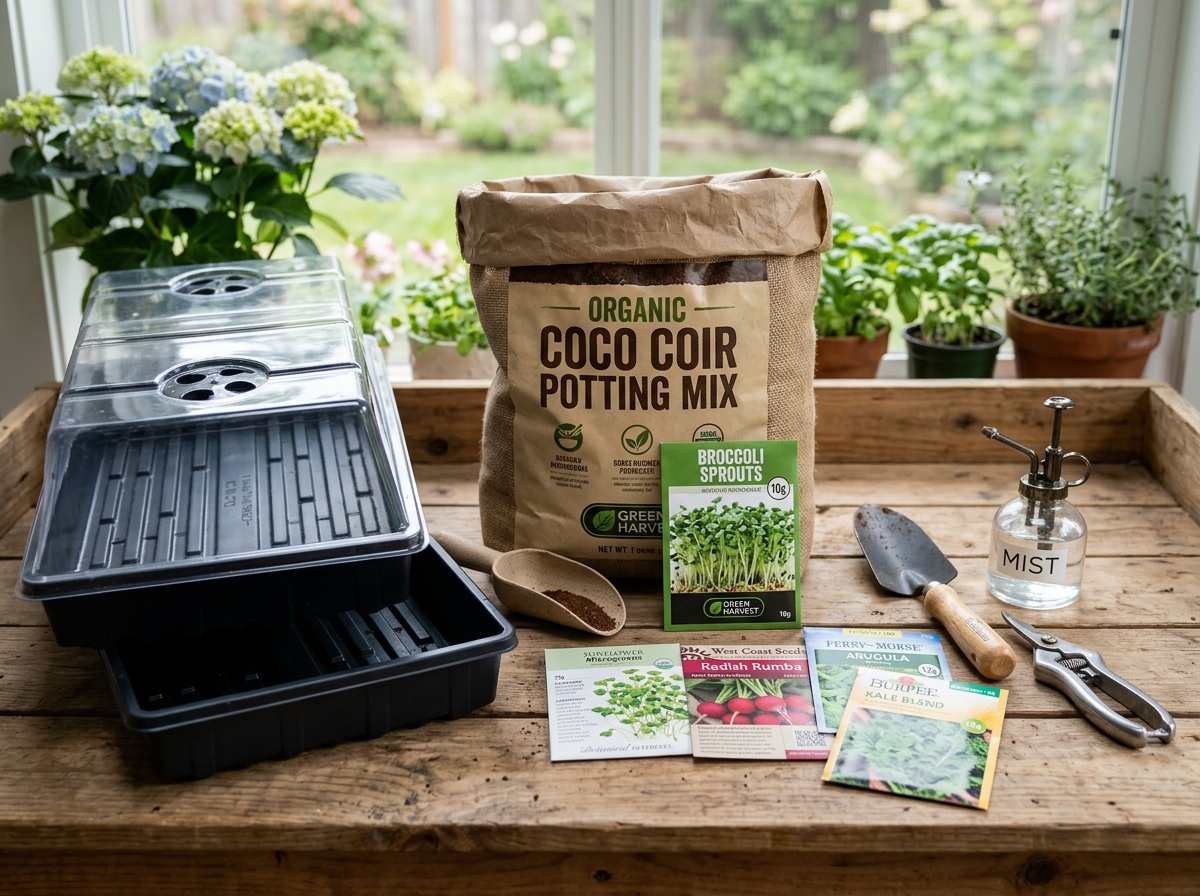
To get started, we recommend looking into microgreens-seed-starter-packs, which usually include the basics. Here is what you’ll need:
- Shallow Trays: You don’t need deep pots because the roots don’t grow very far. Trays that are 1-2 inches deep are perfect. Ensure at least one tray has drainage holes.
- Potting Mix: A fine-grained, seed-starting mix or a coco coir-based medium works best. Avoid heavy garden soil, which can be too dense and contain “hitchhiking” pests.
- Temperature Control: Microgreens are happiest between 65-75°F. If your house is too cold, they will grow very slowly; if it’s too hot (above 80°F), you risk mold growth.
- Air Circulation: This is the “secret sauce” of successful growing. A small fan to keep air moving around your trays can prevent almost all common diseases.
Optimal Watering and Light Techniques
Watering is where most beginners go wrong. If you water from the top, you get the leaves wet, which can lead to damping off (a fungal disease).
- Bottom Watering: Place your growing tray inside a second tray without holes. Pour water into the bottom tray, and let the soil “wick” the moisture up. This keeps the stems dry and the roots happy.
- Misting: During the first 2-3 days (the germination phase), use a spray bottle to gently mist the seeds to keep them moist. Once they have sprouted, switch to bottom watering.
- Supplemental Lighting: While a sunny window works, the sun isn’t always reliable. A simple LED grow light kept 2-4 inches above the plants for 12-14 hours a day will produce much thicker, greener crops. Varieties like the Mild Micro Mix Microgreen Seed perform exceptionally well under consistent light.
From Sowing to Harvest: A Step-by-Step Guide
Ready to plant? Follow these steps for a perfect tray every time:
- Prepare the Tray: Fill your tray with about an inch of moist potting mix. Level it out so there are no lumps.
- Seeding Density: This is crucial. You want the seeds to be close together but not overlapping. Think of it like a “peppered” steak—a thick, even layer. For a standard 10×10 inch tray, you might use 10-15 grams of small seeds (like broccoli) or up to 30 grams of large seeds (like peas).
- Pressing Seeds: Gently press the seeds into the soil with a flat board or your hand. This ensures “seed-to-soil contact,” which tells the seed it’s time to wake up.
- The Blackout Phase: Most seeds for microgreens need a few days of darkness to germinate. Cover your tray with another inverted tray or a piece of cardboard for 2-4 days. This mimics being underground and encourages the stems to stretch upward.
- Let There Be Light: Once you see tiny sprouts (about 1/2 inch tall), remove the cover and move them to the light.
- Harvest: When the plants are 2-3 inches tall and have their first set of leaves, they are ready! Use sharp scissors to cut them just above the soil.
For a beautiful variety of colors in one go, try a Microgreen Seeds – Microgreen Rainbow Blend , which can be harvested in stages over 7 to 21 days.
Managing Challenges with Seeds for Microgreens
Even experts run into trouble occasionally. Here’s how to handle the “drama” of the microgreen world:
- Mucilaginous Seeds: Some seeds, like Chia, Flax, and Basil, develop a jelly-like coating when wet. These are a “trick of nature” designed to store water. Don’t panic! They shouldn’t be soaked; just plant them directly on moist soil.
- Mold vs. Root Hairs: Beginners often see white fuzzy stuff and think it’s mold. Usually, these are just “root hairs”—tiny microscopic roots searching for water. If the fuzz disappears when you mist it, it’s root hairs. If it stays and looks like a spiderweb, it’s mold.
- Damping Off: If your tiny plants suddenly fall over and die, it’s likely “damping off” caused by too much water or poor air circulation. Use clean media, don’t overwater, and keep that fan running!
- Seed Soaking: Large seeds like peas, sunflower, and beets benefit from an 8-12 hour soak in water before planting. This softens the hard outer shell and speeds up growth. Small seeds (broccoli, radish) do not need soaking. You can find more tips on this at Microgreens – Sproutpeople .
Frequently Asked Questions about Microgreen Seeds
How long does it take for microgreens to grow?
Most varieties are ready in 7 to 14 days. Fast-growers like radish can be ready in 6 days, while slower herbs like cilantro might take 21 days.
Do I need to soak my seeds before planting?
Only the big ones! Soak peas, sunflowers, and beets. Small seeds like broccoli, kale, and radish should be sown dry onto moist soil.
Can I grow microgreens without soil?
Yes! You can use hemp mats, bamboo mats, or even wet paper towels (though paper towels are tricky for beginners). However, we find that a high-quality potting mix provides the best flavor and easiest water management for first-timers.
Conclusion
At FinanceOrbitx, we believe that self-sufficiency is a form of wealth. Growing your own seeds for microgreens isn’t just a fun hobby; it’s a way to “invest” in your health with very little capital.
These tiny greens are incredibly versatile. You can toss a handful into your morning smoothie (you won’t even taste the broccoli!), use them as a crunchy base for a salad, or pile them onto a sandwich for an instant gourmet upgrade. They also make a stunning garnish for soups and steaks, making your home cooking look like it came from a Michelin-star kitchen.
By starting with easy varieties like broccoli and radish, you’ll gain the confidence to explore more complex flavors and mixes. The goal isn’t perfection—it’s fresh, homegrown nutrition that you can harvest in your pajamas.
Ready to start your own mini-farm? Start your indoor garden today with FinanceOrbitx and discover how simple it is to grow “tiny but mighty” food right on your counter.
