
Why Your Beginner Microgreens Light Setup Makes or Breaks Your First Harvest
A beginner microgreens light setup doesn’t need to be complicated or expensive. Here’s the quick answer:
Quick-Start Lighting Guide for Beginner Microgreens:
- Light type: Daylight LED shop lights (5,000-6,500K color temperature)
- Wattage: 20W per tray minimum; 3 x 20W lights per shelf for full coverage
- Height: Position lights 6-12 inches above your trays
- Daily schedule: 16-17 hours on, 7-8 hours off (use a timer)
- Cost: Under $50 to get started; roughly $3-4/month in electricity per shelf
You picked up a tiny pack of microgreens at the grocery store. Maybe $4 or $5 for a small clamshell. You put it back.
The good news? You can grow that same amount at home for pennies – and the only thing standing between you and a steady supply of fresh, nutrient-packed greens is getting your lighting right.
Microgreens are one of the easiest crops to grow indoors. They’re ready in 7-14 days, require very little space, and research shows they can contain up to 40 times more vitamins and antioxidants than their fully-grown counterparts. But poor lighting is the number one reason beginners get disappointing results – pale, weak, leggy plants instead of vibrant, flavorful greens.
The great news: you don’t need special or expensive grow lights. A basic LED shop light from a hardware store, positioned correctly and run on a timer, is all most beginners need to get excellent results.
This guide walks you through exactly how to set it up.

If you are just getting started, these beginner-friendly resources can help you build the rest of your setup:
Understanding the Basics of a Beginner Microgreens Light Setup
When we talk about a beginner microgreens light setup, we are essentially trying to mimic the sun’s best qualities within the four walls of our home. While a south-facing windowsill can work for a hobbyist, it often lacks the consistency needed for a high-yield “dividend” of greens.
The Science of Light: Photosynthesis and Spectrum
Plants don’t “see” light the way we do. They care about the spectrum and the intensity. For microgreens, we focus on the “Daylight” spectrum. This is measured in Kelvins (K).
- 5000K to 6500K: This is the sweet spot. Lights in this range mimic natural daylight. They provide plenty of blue-spectrum light, which is crucial for keeping plants compact and preventing them from “stretching” (becoming leggy).
- Chlorophyll Production: High-quality light triggers the production of chlorophyll and antioxidants. Research indicates that microgreens grown under 5500-6500K LEDs have superior fresh weight and higher concentrations of vitamins compared to those grown under specialized red/blue “blurple” lights.
Comparison: Natural Sunlight vs. LED Shop Lights vs. Specialized Grow Lights
| Feature | Natural Sunlight | LED Shop Lights | Specialized Grow Lights |
|---|---|---|---|
| Cost | Free | Low ($15-$25) | High ($50-$200+) |
| Consistency | Low (Weather dependent) | High | High |
| Ease of Use | High | High | Moderate (Complex settings) |
| Yield Potential | Moderate | High | High |
| Best For | Casual hobbyists | Beginners on a budget | Commercial growers |
As you can see, for a beginner microgreens light setup, the LED shop light offers the best “return on investment.” It provides the intensity needed without the high upfront capital of professional horticultural gear. For a deeper dive into these requirements, check out our guide on shining a light on optimal microgreen requirements.
Step-by-Step: Building Your Budget-Friendly Lighting System
Building your system is like setting up a small production line. We want efficiency, low overhead, and high output.
1. Choose Your Rack
A standard wire shelving unit (often called a “baker’s rack”) is the gold standard. They are sturdy, adjustable, and allow for excellent airflow, which prevents mold.
2. Select Your Bulbs
We recommend T5 or T8 LED shop lights.
- T5 tubes are thinner and often more efficient.
- T8 tubes are the standard size you see in most garages. Look for lights that produce at least 2,000 lumens per 4-foot fixture. If you are using standard 10×20 trays, we suggest mounting three 20W LED strips per shelf to ensure even coverage across the entire tray surface.
3. Mounting for Success
One of the biggest mistakes we see is hanging lights too high.
- Initial Height: Position your lights 10-12 inches above the empty trays.
- Growth Phase: As the plants grow, the distance will naturally decrease to about 6 inches. This “close-quarters” lighting prevents the plants from wasting energy reaching upward, resulting in thicker stems and more biomass.
4. Daisy-Chaining
Most modern LED shop lights allow you to “daisy-chain” them. This means you plug one light into the next, so the entire rack only requires one wall outlet. It keeps your workspace clean and reduces the risk of tripping over cords—a classic “operational risk” in home gardening!
For more tips on choosing these components, see our article on affordable grow lights for microgreens.
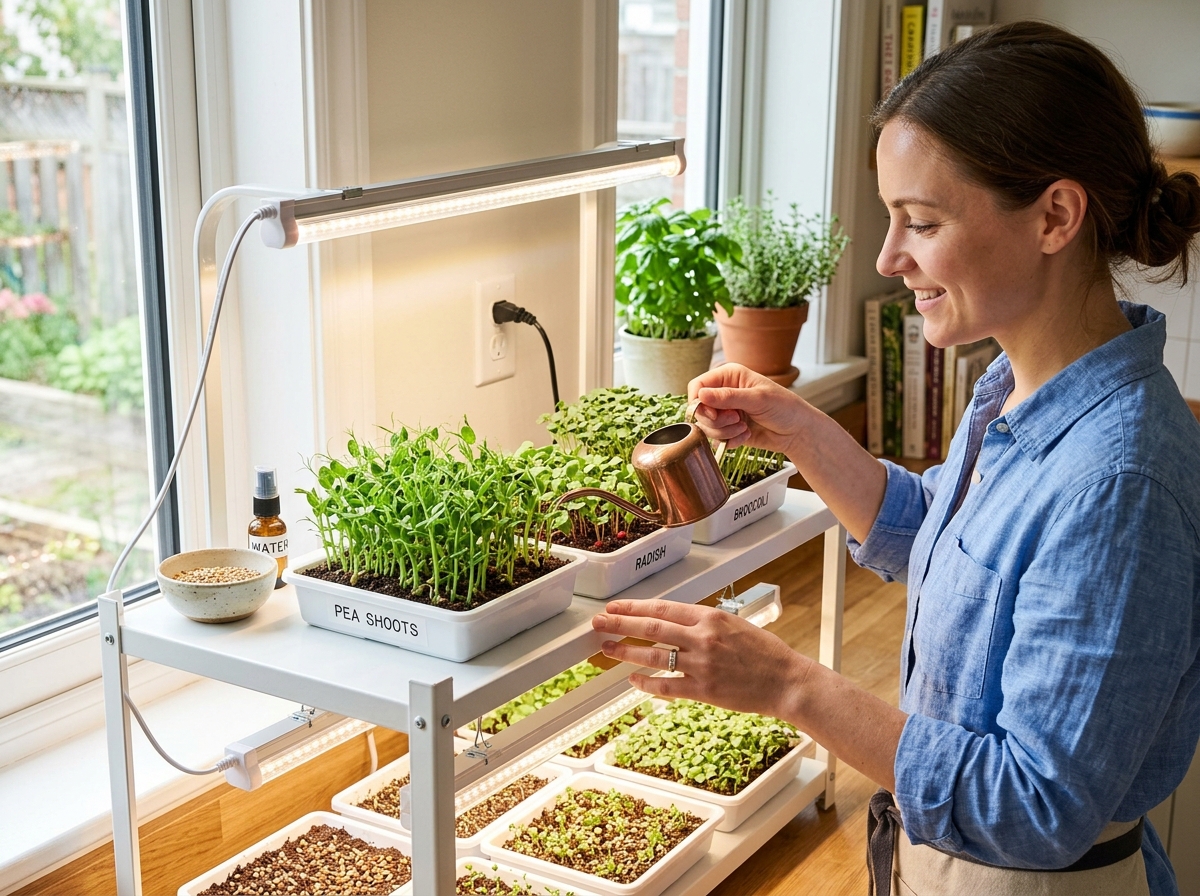
Optimizing Your Beginner Microgreens Light Setup for Maximum Yield
Once the hardware is in place, it’s time to optimize the “software”—your lighting schedule and intensity.
The Power of the Photoperiod
Microgreens aren’t like teenagers; they don’t need to sleep for 12 hours. In fact, they thrive on long days.
- 17 Hours On / 7 Hours Off: This is the “sweet spot” we’ve found through testing.
- The Stats: A 16 to 17-hour photoperiod can increase phenolic compounds (the healthy stuff!) by 32% and antioxidant capacity by 25% compared to a standard 12-hour cycle.
Intensity (PPFD)
While you don’t need a PhD in physics, understanding PPFD (Photosynthetic Photon Flux Density) helps. For microgreens, you want an intensity of 200-400 µmol/m²/s.
- Too Low (<100): You’ll get low yields and fewer nutrients.
- Too High (>600): You risk “bleaching” the delicate leaves or drying out the soil too fast.
Automation: The Digital Timer
Don’t try to be the timer yourself. You will forget, and consistency is king. A simple $10 digital timer is the best employee you’ll ever hire. Set it to turn on at 6:00 AM and off at 11:00 PM. This ensures your plants get their “work hours” in every single day without fail. To learn more about selecting the right specs, visit choosing the right lighting for growing microgreens.
Troubleshooting Common Lighting Issues for New Growers
Even with the best beginner microgreens light setup, you might run into a few “market fluctuations” in your growth. Here is how to handle them.
Identifying Problems
- Pale Leaves: Usually a sign of insufficient light intensity or the wrong spectrum. Check your Kelvin rating.
- Light Bleaching: If the tops of your greens look white or crispy, the lights are too close or too intense. Raise them by 2 inches.
- Uneven Growth: This happens if the lights don’t span the full width of the tray. This is why we recommend three light strips per shelf instead of just one.
For more detailed troubleshooting, read our guide on led grow lights for microgreens.
Fixing Leggy Growth in Your Beginner Microgreens Light Setup
“Leggy” is the term for plants that are tall, thin, and prone to falling over. This is a sign of “light hunger.”
- Proximity: Lower your lights. If they are 12 inches away, move them to 6-8 inches.
- Duration: Ensure your timer is actually hitting that 16-17 hour mark.
- Spectrum: Ensure you aren’t using “Warm White” bulbs (2700K-3000K), which encourage stretching. Stick to the 5000K+ range.
By adjusting these variables, you can ensure your plants stay “short and stout,” which makes for a much easier harvest. Don’t waste money on expensive fixes; learn more about how to stop overpaying for your microgreens grow lights.
Managing Light Intensity for Different Varieties
Not all microgreens are created equal. Some are “high-maintenance” while others are very forgiving.
- Radish: The ultimate beginner crop. They grow fast and aren’t very picky about light, but they love the 6500K spectrum to stay crisp.
- Pea Shoots: These are robust. They can handle slightly higher intensity and will reward you with thick, sweet tendrils.
- Sunflower: These need strong light to help them shed their seed hulls. Without enough light, the hulls tend to get stuck.
- Amaranth: This “diva” of the microgreen world needs consistent, bright light to develop its signature vibrant red color.
For variety-specific advice, check out enlightening indoor microgreens: a guide to lighting.
Frequently Asked Questions about Microgreen Lighting
Can I use regular household bulbs for my beginner microgreens light setup?
Technically, yes, but it’s not efficient. A standard household LED bulb is designed to light a room, not grow a plant. They often have “spectrum gaps” and lack the necessary lumens to cover a whole tray. You would need dozens of them to match the output of a single $20 shop light. For the best results, stick to the fixtures mentioned in our best indoor grow lights for microgreens guide.
How much does it cost to run grow lights monthly?
This is where the “Finance” in FinanceOrbitX shines! LED lights are incredibly energy-efficient.
- The Math: If you run three 20W lights (60W total) for 17 hours a day, you are using about 1.02 kWh per day.
- The Monthly Total: At an average rate of $0.12 per kWh, it costs roughly $3.67 per month to run one full shelf. When you consider that one shelf can produce $50 worth of greens, that’s a profit margin any investor would love. See more in our lighting guide.
Do microgreens need light during the germination phase?
No! This is a common “rookie mistake.” Most microgreens need a blackout period of 3 to 5 days.
- The Process: After sowing, cover the trays with another tray or a towel.
- The Benefit: This encourages the seeds to develop strong roots and uniform stems. Once you see the “sprouts” reaching about an inch high, then you introduce them to your beginner microgreens light setup.
Conclusion
Building a beginner microgreens light setup is one of the smartest investments you can make for your health and your wallet. By choosing affordable LED shop lights, maintaining a consistent 17-hour schedule, and keeping your fixtures close to your crops, you can harvest nutrient-dense greens year-round.
You don’t need a backyard or a massive budget to be a successful indoor gardener. You just need the right light. Ready to start your first tray? Shop for microgreen supplies and join the movement of home harvesters today.
By mastering these simple lighting techniques, you are setting yourself up for a high-yield, low-cost hobby that pays dividends in nutrition. Keep experimenting with different varieties and heights to find the perfect balance for your home environment.
Happy growing, and may your harvests always be “in the green!”
