
Understanding How Often to Water Microgreens by Growth Stage
Growing microgreens is a journey, often taking only 7 to 21 days from seed to plate. Because they grow so quickly, their hydration needs shift rapidly. We can’t treat a tray of newly sown seeds the same way we treat a forest of two-inch-tall pea shoots.
To master how often water microgreens, we first need to break the life cycle down into distinct phases. Each phase requires a different technique to ensure the roots get what they need without drowning the delicate stems. If you are just starting out, check out the right way to water your microgreens to get a solid foundation on the mechanics.

Sowing and Germination: The Misting Phase
The journey begins with the “Sowing Phase.” Before the seeds even touch the medium, we recommend hydrating the soil. A common mistake is soaking the entire tray of soil until it’s a muddy mess. Instead, we only water the upper one-third of the soil profile. The seeds live at the surface, and excess water at the bottom of the tray just sits there, potentially leading to sour soil and rot before the roots even reach it.
Once the seeds are spread, they need a “humidity “hug.” During the germination or blackout phase (typically days 1–4), your goal is to keep the seeds damp so their hulls can soften and split.
- Frequency: Mist the seeds and the inside of your humidity dome or cover tray every 12 hours.
- The Goal: You aren’t trying to “water” the plant yet; you are maintaining a humid microclimate.
- Media Choice: Whether you use soil or mats matters here. You can learn more about picking the best substrate in our guide on soil and growing medium for microgreens.
Post-Blackout: Transitioning to Bottom Watering
Once the seeds have germinated and you see those first tiny leaves (cotyledons) stretching upward, it’s time to remove the cover and “turn on the lights.” This is the most critical transition in the watering cycle.
As soon as the plants are exposed to light and airflow, they begin to transpire (essentially sweating water out of their leaves). This pulls water up through the roots. At this stage, we stop misting from the top entirely. Why? Because wet leaves and stems in a dense canopy are an open invitation for mold and damping-off disease.
Instead, we move to the bottom-watering technique. This involves pouring water into a solid outer tray and letting the inner planting tray (which must have drainage holes) wick the moisture up. This keeps the foliage bone-dry while giving the roots exactly what they need.
The Tray-Weight Method: Your Secret Weapon for Success
If you take only one tip away from this guide, let it be this: Throw away your calendar.
Watering on a strict schedule (like “every Monday and Thursday”) is a recipe for disaster. Environmental conditions like humidity and temperature change daily, meaning your plants’ thirst changes too. Instead, we use the “Weight Test.”

How Often Water Microgreens Using the Weight Test
The weight test is the gold standard for professional and home growers alike. It relies on your sense of touch rather than a clock.
- Establish a Baseline: When you first pull your trays out of the blackout phase, feel how light they are. This is your “dry weight.”
- The Saturation Feel: After you water the tray for the first time, lift it again. Notice how heavy and substantial it feels. This is your “saturated weight.”
- The Daily Check: Every morning, give the corner of your tray a little lift. If it feels heavy, walk away. If it feels light—similar to that baseline weight from the end of blackout—it’s time to water.
By using this method, you stop guessing. You are responding to the actual physical state of the growing medium. For a deeper dive into this sensory approach, see our article on how to stop guessing and learn exactly how often to water microgreens.
Volume Guide by Tray Size
While the “when” is determined by weight, the “how much” depends on the size of your footprint. You want to provide enough water to cover the bottom of the tray so the medium can wick it up via capillary action, but not so much that the roots are still sitting in a pool an hour later.
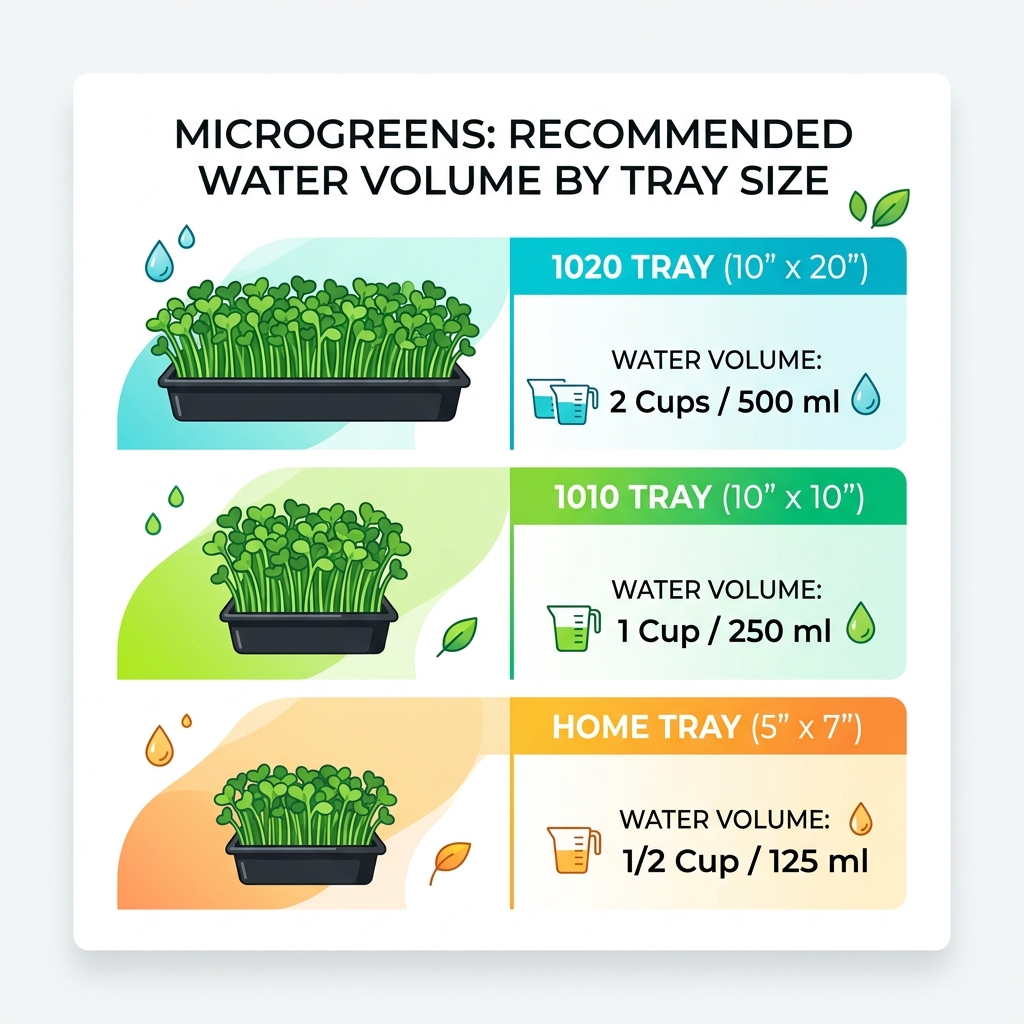
| Tray Size | Dimensions (Approx.) | Recommended Water Volume |
|---|---|---|
| 1020 Tray | 10″ x 20″ | 2 Cups (500 ml) |
| 1010 Tray | 10″ x 10″ | 1 Cup (250 ml) |
| Home Tray | 5″ x 7″ | 1/2 Cup (125 ml) |
Pro Tip: After pouring the water into the bottom tray, wait about 15–20 minutes. If there is still standing water in the tray after that time, pour it out. Your microgreens need to breathe, and stagnant water kills roots.
Environmental Factors and Variety-Specific Needs
Not all microgreens are created equal. A tray of delicate Amaranth has very different hydration needs than a tray of robust, leafy Pea Shoots. Furthermore, the “climate” of your kitchen or grow room plays a massive role in how often water microgreens.
How Often Water Microgreens Based on Variety and Climate
Environmental factors like temperature, humidity, and airflow act as a “straw,” pulling water out of the tray.
- Humidity: If your room humidity is below 60%, you may find yourself watering every single day. If it’s a humid summer and levels are high, you might only water every 2 or 3 days.
- Airflow: Using fans is great for preventing mold, but it also increases evaporation. Trays positioned directly in front of a fan will dry out much faster than those in the back.
- Variety Differences:
- The Thirsty Giants: Peas and Sunflowers have massive root systems and large leaves. Near harvest, these “heavy drinkers” might need a full 2 cups of water twice a day!
- The Sensitive Greens: Basil, Mustard, and Brassicas are more prone to overwatering. They have thinner stems and can collapse if the soil stays too soggy. For more on managing these specific types, check out our common beginner microgreens troubleshooting tips.
Growing Mediums and Water Retention
The “sponge” you choose to grow in dictates your watering frequency.
- Coconut Coir: This is our favorite for beginners. It wicks water beautifully and is very difficult to over-saturate. It also re-wets easily if it happens to dry out.
- Peat Moss: While effective, peat moss has a “hydrophobic” quality. If it gets bone-dry, water will just bead up on top of it rather than soaking in. This can lead to “dry spots” in your tray where the plants wilt even though you just watered.
- Hydroponic Mats: Hemp or felt pads have very little “buffer.” They dry out extremely fast, often requiring twice-daily checks to ensure they haven’t turned into crispy crackers.
To keep your environment balanced and prevent moisture-related issues, using the right tools to prevent mold in microgreens is essential.
Troubleshooting: Overwatering vs. Underwatering
In microgreens, water is both the elixir of life and a potential poison. Learning to spot the early warning signs of hydration issues can save a tray from the compost bin.
Signs of Dehydration
Underwatering is usually the easier problem to fix, provided you catch it early.
- The “Flop”: If your greens look like they’ve fainted, they are likely thirsty.
- Soil Shrinkage: Look at the edges of the tray. If the soil has pulled away from the plastic walls, it is dangerously dry.
- Recovery: Most hardy varieties like Radish or Sunflower will “pop” back up within an hour of bottom-watering. However, smaller, more delicate greens may suffer permanent stem damage if they wilt too hard.
Dangers of Excess Moisture
Overwatering is the “silent killer.” By the time you see the symptoms, it might be too late.
- Yellowing Stems: This is often a sign of root stress or lack of oxygen (the roots are drowning).
- Musty Smells: If your tray smells like a damp basement, bacteria are thriving in stagnant water.
- Mold: Fuzzy white growth (not to be confused with root hairs!) often starts because the surface of the soil is too wet or the air is too stagnant.
If you’re struggling with fuzzy invaders, our guide on how to avoid mold in your microgreen garden is a must-read. Avoiding these common microgreen growing mistakes will keep your harvests crisp and clean.
Frequently Asked Questions about Watering Microgreens
Can I use tap water for my microgreens?
Yes, in most cases, fresh tap water is perfectly fine. Microgreens are only in the soil for a short time, so they aren’t as sensitive to minerals as long-term houseplants. However, if your water is heavily chlorinated (you can smell it), let the water sit in an open container overnight to allow the chlorine to dissipate. Aim for a pH between 6.0 and 6.5 if you want to be precise, but for most home growers, “room temperature tap” works great. Avoid using softened water, as the salt content can stunt growth.
Should I water microgreens on the day of harvest?
Timing your final drink is a pro-level move. We recommend watering about 8 to 12 hours before you plan to cut. This allows the plants to “plump up,” making them crisp and juicy. However, you want the surface of the plants to be completely dry when you harvest. If you water right before cutting, you’ll end up with wet greens that rot quickly in the fridge. “Dry to the touch, but hydrated at the root” is the goal for a long shelf life.
How long should I leave water in the bottom tray?
The “15-minute rule” is your best friend. After you pour your 1 or 2 cups into the bottom tray, set a timer. The growing medium will act like a straw, pulling up what it needs. After 15 minutes, lift the planting tray. If there is still a pool of water in the bottom, dump it out. Leaving roots submerged for hours deprives them of oxygen and leads to root rot.
Conclusion
At FinanceOrbitX, we believe that growing your own food should be as calculated and rewarding as a well-managed portfolio. Mastering how often water microgreens isn’t about following a rigid set of rules; it’s about developing a relationship with your plants.
By using the tray-weight method, transitioning to bottom-watering at the right time, and staying mindful of your room’s environment, you eliminate the “guesswork” that leads to failed harvests. Remember the golden rule: it is almost always better to underwater slightly than to overwater.
Ready to put these skills to the test? Stop guessing and learn exactly how often to water microgreens by starting your next tray today. Happy growing!
