
What Are Microgreens? Your Quick-Start Guide to Tiny Greens With Big Benefits
What are microgreens is one of the most searched gardening questions right now — and for good reason. Here’s the short answer:
Microgreens are the young seedlings of edible vegetables and herbs, harvested just 7 to 21 days after germination, when they are 1 to 3 inches tall. They are older than sprouts but younger than baby greens, and they pack a serious nutritional punch.
Key facts at a glance:
- What they are: Tiny seedlings of vegetables, herbs, and some edible flowers
- When harvested: 7 to 21 days after germination
- How tall: 1 to 3 inches (2.5 to 7.6 cm)
- What you eat: The stem and cotyledon leaves (first leaves), sometimes the first true leaf
- Why people love them: Up to 40 times more nutrients than their mature counterparts
- How many varieties: 50 to 60+ types, from radish to sunflower to broccoli
Think of microgreens as the concentrated version of a full-grown vegetable. All the nutrients a plant would normally spread across its entire life cycle are packed into those first tiny leaves.
They started appearing on fine dining plates in San Francisco in the 1980s. Today, you can grow them on your kitchen counter in less than a square foot of space — with as little as one to five minutes of daily attention.
Whether you want to boost your nutrition, save money on expensive store-bought trays, or simply start your gardening journey without a backyard, microgreens are one of the most beginner-friendly options available.
This guide covers everything you need to know — from what microgreens actually are, to how to grow, harvest, store, and eat them.
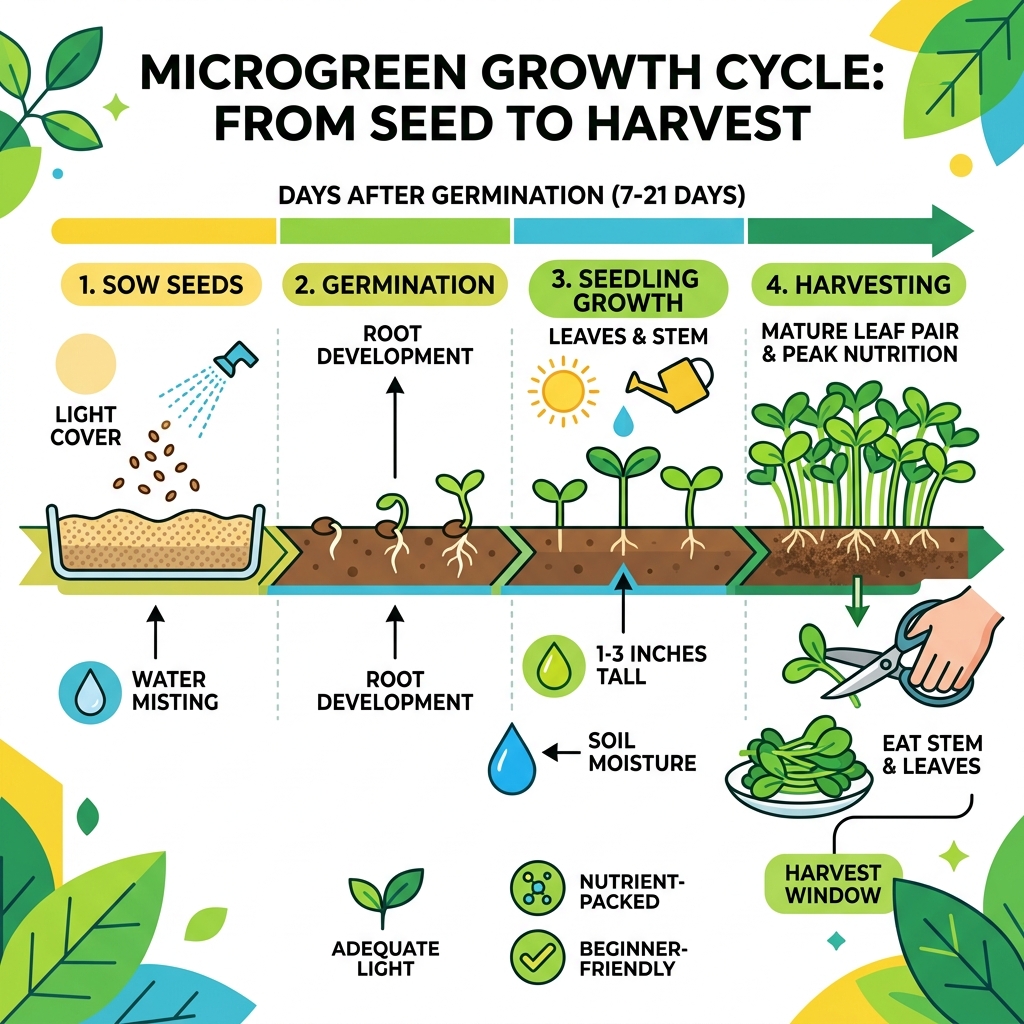
What Are Microgreens? Defining the Superfood Trend
When we talk about What are microgreens, we aren’t just talking about a specific species of plant. Instead, “microgreen” is a marketing and culinary term used to describe a specific growth stage. They fall right in the sweet spot of a plant’s development—after the seed has popped open and stretched its legs, but before it becomes a teenager (baby green) or an adult (mature vegetable).
Physically, these plants typically range in size from 1 to 3 inches (2.5 to 7.6 cm) tall. At this stage, they consist of a central stem, two fully developed “cotyledon” leaves (the initial embryonic leaves), and often the very first pair of “true leaves.” These true leaves look more like the adult version of the plant and signal that the microgreen is reaching its peak harvest window.
According to The ABCs of Microgreens, microgreens are harvested by cutting the stem just above the soil line. This is a key distinction from other types of young greens. If you are looking for a deep dive into the basics, our microgreens-101-a-beginners-guide is a great place to start.
How microgreens differ from sprouts and baby greens
It is incredibly common for people to confuse microgreens with sprouts or baby greens, but they are actually quite different in how they grow and what parts you eat. We like to think of them as the “middle children” of the vegetable world.
- Sprouts: These are the youngest stage. They are seeds that have just germinated (usually in 2 to 7 days). Sprouts are grown in water and high humidity without soil or much light. When you eat a sprout, you eat the whole thing—seed, root, and stem.
- Microgreens: These are grown in soil or a soil-like medium and require plenty of light and good airflow. We only eat the stems and leaves, not the roots. They take longer to grow (7 to 21 days) and have much more intense flavors and textures than sprouts.
- Baby Greens: These are the “teenagers.” They are harvested after the microgreen stage but before full maturity. Think of the baby spinach or baby arugula you buy in plastic clamshells at the grocery store.
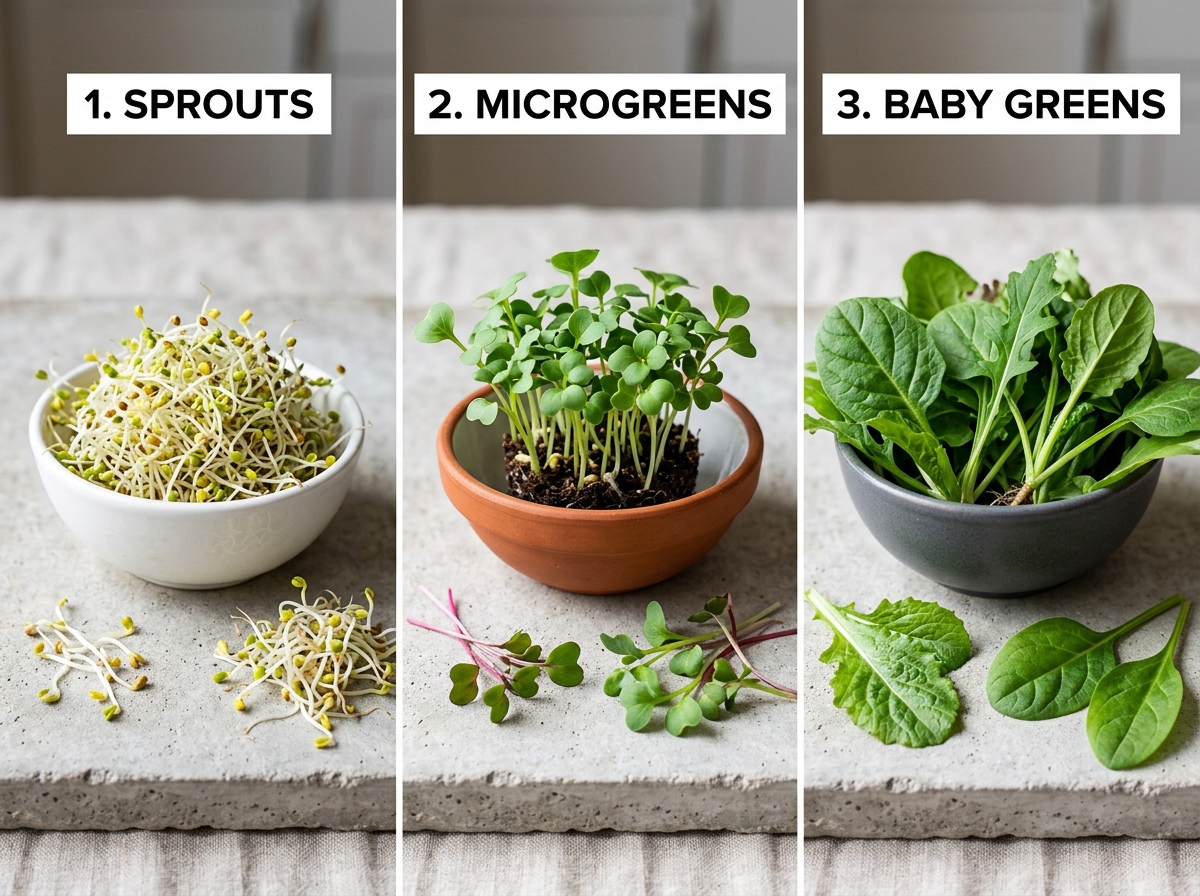
| Feature | Sprouts | Microgreens | Baby Greens |
|---|---|---|---|
| Growth Cycle | 2–7 days | 7–21 days | 21–40 days |
| Growing Medium | Water/Humidity | Soil/Coco Coir/Mats | Soil |
| Light Required | Low to None | High Light | High Light |
| Parts Eaten | Seed, Root, Stem | Stem, Leaves | Leaves, Stem |
| Flavor | Mild/Watery | Intense/Complex | Moderate |
Understanding the growth timeline: What are microgreens’ harvest windows?
One of the most exciting parts of growing these tiny plants is the speed. If you are someone who lacks patience (we’ve all been there!), microgreens are the ultimate “fast food.”
The harvest window depends largely on the variety you choose:
- The Sprinters: Some varieties, like radishes and certain brassicas (broccoli, kale), can be ready to harvest in as little as five to six days.
- The Average Joes: Most common varieties take about 10 to 14 days from seeding to harvest.
- The Marathoners: Slower-growing herbs like cilantro, basil, or beets might take up to three weeks to reach that 1-to-3-inch height.
Knowing What are microgreens harvest signs is simple: look for the “true leaves.” Once those appear after the initial cotyledons, your nutrient density is at its peak, and it’s time to get the scissors ready!
The Nutritional Powerhouse: Why Size Doesn’t Matter
Don’t let their tiny stature fool you. Microgreens are essentially “nature’s multivitamins.” When a seed begins to grow, it uses all the energy and nutrients stored inside to launch its life. When we harvest the plant at the microgreen stage, we are capturing all that concentrated goodness before it gets diluted into a large, mature plant.
Research, including studies highlighted in 6 Health Benefits of Microgreens, shows that microgreens contain considerably higher levels of vitamins and carotenoids—about five times greater—than their mature plant counterparts. Some studies have even shown that microgreens can be up to 40 times more potent in phytochemicals.
For a specific breakdown of which varieties offer which nutrients, check out our guide on vitamins-in-popular-microgreens and see how-microgreens-improve-nutrition in your daily diet.
Concentrated vitamins: What are microgreens’ potency levels?
When we ask What are microgreens capable of nutritionally, the numbers are staggering. In a famous 2012 study by the Journal of Agricultural and Food Chemistry, researchers looked at 25 different varieties and found that nearly all of them outperformed mature vegetables.
- Red Cabbage: These microgreens had 40 times more Vitamin E and six times more Vitamin C than a mature head of red cabbage.
- Cilantro: These tiny leaves contained three times more beta-carotene than the full-grown herb.
- Garnet Amaranth: This variety is exceptionally high in Vitamin K, which is essential for bone health and blood clotting.
- Green Daikon Radish: A powerhouse for Vitamin E and various antioxidants.
Our microgreens-health-benefits-guide explains that because you only need a small handful to get a massive dose of nutrients, they are perfect for people who struggle to eat enough “big” vegetables.
Specific health advantages of popular varieties
Beyond just general vitamins, specific microgreens carry unique compounds that target various health concerns. This is why they are often labeled as a “superfood.”
- Broccoli Microgreens: These are famous for containing high levels of sulforaphane. This compound has been studied for its potential to fight cancer, improve insulin resistance in type 2 diabetes, and support heart health.
- Red Cabbage: As mentioned, the high Vitamin C and E content helps lower LDL (bad) cholesterol and reduce inflammation.
- Fenugreek: In lab studies, fenugreek microgreens were shown to enhance cellular sugar uptake by 25% to 44%, making them a potential ally for managing blood sugar.
- Vision Protection: Varieties like spinach, broccoli, and cress are rich in lutein, which helps protect your eyes from age-related damage.
To learn more about how these tiny plants can change your health, read superfood-microgreens-for-health.
Growing Microgreens at Home: Pros, Cons, and Costs
At FinanceOrbitX, we love a good deal. If you’ve ever walked through a high-end grocery store or a trendy farmers’ market, you might have noticed the price tag on those tiny plastic containers of microgreens. They are notoriously expensive! However, the “secret” is that they are incredibly cheap to grow yourself.
Growing at home allows you to take control of your food supply and save a significant amount of money. If you’re ready to dive in, our ultimate-guide-to-growing-microgreens-at-home covers the nitty-gritty details.
Why microgreens are expensive to buy but cheap to grow
Why is there such a massive price gap? At farmers’ markets, a single small tray can cost $5, $8, or even $10. Some large flats sell for up to $30!
The high cost in stores is due to:
- Short Shelf Life: They only last about 10-12 days once cut, meaning stores lose money on unsold stock.
- Labor: Harvesting tiny plants by hand is time-consuming for commercial growers.
- Space and Care: They require climate-controlled environments and daily attention.
The FinanceOrbitX Cost Breakdown: When you grow them at home, your main costs are seeds, a little bit of soil (or coco coir), and reusable trays. You can buy seeds in bulk—for example, a pound of broccoli seeds might cost $20 and provide you with dozens of harvests. Instead of paying $10 for a tiny container, you might spend $0.50 to $1.00 per tray at home. That is a massive return on investment!
The pros and cons of the home harvest
While we are big fans of home growing, we want to give you the full picture. Here is our honest take on the experience:
The Pros:
- Freshness: You harvest seconds before you eat, ensuring the highest nutrient density.
- Year-Round Gardening: You can grow them indoors during the coldest winters or the hottest summers.
- Minimal Space: You don’t need a backyard. A windowsill or a small shelf is plenty.
- Speed: You get results in days, which builds gardening confidence for beginners.
The Cons:
- Initial Setup: You need to buy trays and potentially a small grow light if you don’t have a sunny window.
- Daily Attention: They need 1-5 minutes of care every single day. If you forget to water them, they can wilt and die quickly.
- Single Harvest: Most microgreens do not regrow. Once you cut them, you have to compost the soil and start a new batch.
- Mold Risk: Without good airflow, the high density of seeds can lead to mold or “damping off” (rot).
For more tips on mastering the environment, see the-ultimate-guide-to-indoor-microgreen-mastery.
Step-by-Step: How to Grow Microgreens Indoors and Out
Ready to get your hands dirty? Growing microgreens is a straightforward process, but precision matters. Unlike traditional gardening where you might plant one seed every few inches, microgreen growing is all about seed density.
The optimal seed density ranges from 2 seeds per square inch for larger seeds (like peas or sunflowers) up to 12 seeds per square inch for smaller seeds (like broccoli or arugula).
The Basic Steps:
- Prepare the Tray: Use a shallow tray with drainage holes. Fill it with about 1-2 inches of organic potting mix or coco coir.
- Sow the Seeds: Scatter your seeds evenly across the surface. Don’t bury them! Just press them gently into the soil.
- Mist and Cover: Use a spray bottle to mist the seeds until damp. Cover the tray with a lid or another tray to keep them in the dark for the first 2-3 days (this is the “blackout phase” which encourages them to stretch).
- Light and Air: Once they sprout, remove the cover and place them in a sunny window or under a grow light.
- Water Daily: Check them every day. We recommend “bottom watering”—placing your tray inside another tray with water so the roots soak it up without getting the leaves wet.
For a foolproof walkthrough, follow the-ultimate-step-by-step-guide-to-growing-microgreens-without-killing-them.
Best plant varieties for beginners
If you are just starting, we recommend varieties that are fast, hardy, and delicious. The Brassicaceae family is the gold standard for beginners.
- Radish: These are the “Usain Bolt” of microgreens. They grow incredibly fast (5-6 days) and have a wonderful spicy kick.
- Broccoli: Very easy to grow, mild flavor, and arguably the healthiest option.
- Arugula: If you like zesty, peppery flavors, arugula is a winner.
- Pea Shoots: These are fun because they are crunchy and taste exactly like sugar snap peas. They are larger and easier for kids to handle.
- Sunflower: These have a nutty, hearty flavor and are great for salads.
To learn more about the science of sprouting, check out demystifying-the-sprouting-process-for-microgreens.
Toxic varieties: Which plants should be avoided?
This is a critical safety point: Not every vegetable can be eaten as a microgreen.
You must avoid plants in the Nightshade family. These plants contain toxic alkaloids (like solanine) in their stems and leaves that can make you very sick.
- Do NOT grow: Tomatoes, Eggplants, Peppers, or Potatoes as microgreens.
Stick to seeds specifically labeled for microgreens or sprouts to be safe. Also, be cautious with wild species unless you are an expert in plant identification.
Harvesting, Storage, and Culinary Inspiration
When your microgreens are 1 to 3 inches tall and have their first true leaves, it’s time to harvest!
How to Harvest: Grab a sharp pair of kitchen scissors. Hold a clump of the greens gently in one hand and snip the stems just above the soil line. Try to avoid getting any soil on the leaves, as washing them can cause them to bruise and wilt faster.
How to Store: If you aren’t eating them immediately, store them dry in a sealed container or a Ziploc bag with a paper towel to absorb excess moisture. When stored properly in the fridge, they can last about 10 to 12 days, with some hardy varieties lasting over two weeks.
Easy ways to use microgreens in daily meals
The best way to eat microgreens is raw. Cooking them can destroy many of those delicate enzymes and vitamins we worked so hard to grow. Luckily, their intense flavors make them a perfect addition to almost anything.
- Garnishes: Sprinkle them over soups, pizzas, or omelets just before serving.
- Smoothies: Toss a handful of broccoli or kale microgreens into your morning smoothie. You won’t even taste them, but you’ll get a massive nutrient boost.
- Salads: Use them as the base of a salad or mix them with larger greens for texture.
- Sandwiches and Wraps: Replace boring iceberg lettuce with crunchy pea shoots or spicy radish microgreens.
- Main Dishes: Top a grilled piece of fish or steak with a “nest” of microgreens for a restaurant-quality look.
For more inspiration, see from-seed-to-salad-a-beginner-guide-to-indoor-microgreens.
Frequently Asked Questions about Microgreens
Can microgreens regrow after harvesting?
Generally, no. Most microgreens are a “one and done” crop. Because you are cutting the plant below its lowest leaves, you are essentially removing its ability to photosynthesize and grow. While a few varieties (like peas) might give you a small second growth if you leave the bottom nodes intact, the quality is usually lower. It is best to compost the old roots and soil and start a fresh batch.
Can microgreens grow into full plants?
Yes! Microgreens are grown from the exact same seeds as mature vegetables. If you were to take a broccoli microgreen and transplant it into a large pot with deep soil and plenty of space, it would eventually grow into a full head of broccoli. However, the way we plant them for microgreens (very close together in shallow soil) is designed to prevent them from becoming adults.
How often do microgreens need water?
They need daily attention. Because they are grown in shallow soil, they can dry out quickly. We recommend checking them every morning. The soil should feel like a wrung-out sponge—damp but not soaking wet. Using a misting bottle for the first few days and then switching to bottom watering is the best way to keep them hydrated without causing mold.
Conclusion
At FinanceOrbitX, we believe that gardening shouldn’t be complicated or expensive. Understanding What are microgreens is the first step toward building a sustainable, healthy habit that fits into even the busiest lifestyle.
By growing these tiny powerhouses at home, you aren’t just saving money—you are taking control of your nutrition and building gardening confidence. Whether you start with a simple tray of radishes on your windowsill or build out a full indoor shelf system, the rewards are well worth the five minutes of daily care.
Ready to explore even more varieties? Dive into The Gourmet Guide to Different Types of Micro-Herbs and start your journey to becoming a microgreen master today!
