
What Happens If You Let Microgreens Grow? (The Short Answer)
What happens if you let microgreens grow past their harvest window is something every beginner gardener wonders at some point. It seems almost wasteful to cut those tiny shoots so early — so what if you just… didn’t?
Here’s the quick answer:
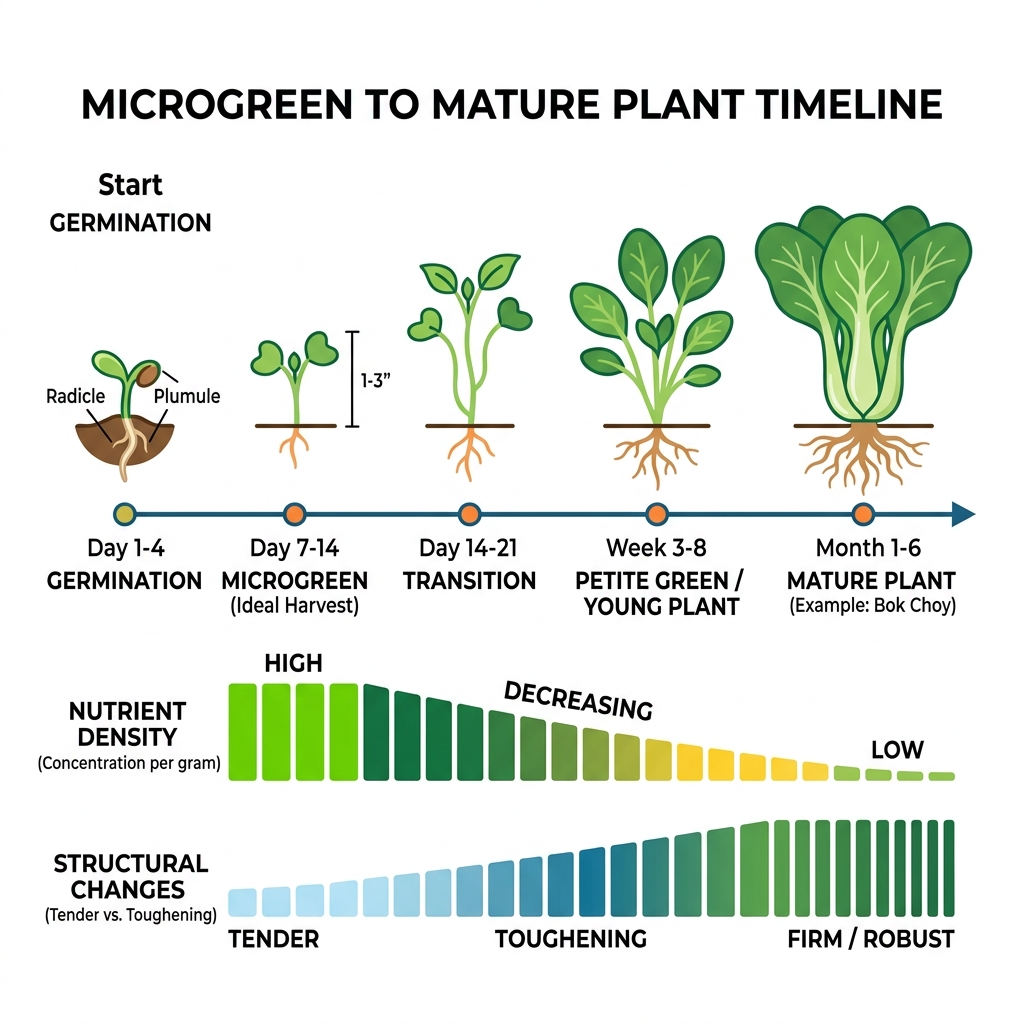
- Days 1–14: Microgreens reach their ideal harvest stage — 1 to 3 inches tall, tender, and packed with nutrients
- Days 14–21: Stems elongate and toughen, true leaves develop, flavor intensifies, and the texture becomes less delicate
- Weeks 3–8: Plants transition into “petite greens” or young vegetables, with lower nutrient density per gram but larger overall biomass
- Months 1–6: Given the right conditions (transplanting, space, soil depth), some varieties can reach full maturity — but most will simply die in their trays from crowding, nutrient depletion, or disease
The core trade-off is simple: the longer you wait, the less nutrient-dense your greens become per bite — but you may end up with a full-grown vegetable or herb if conditions are right.
Microgreens contain roughly five times more vitamins and carotenoids per gram than their mature counterparts. That concentration drops as the plant grows bigger.
Most microgreens grown in standard shallow trays won’t make it to full maturity anyway. The dense planting, shallow soil, and tangled roots create stress that eventually kills the plants — harvested or not.
But some varieties, like radish, bok choy, pea shoots, and onions, can be transplanted and grown to full size. The key word is transplanted — the original tray is rarely enough.
What Happens If You Let Microgreens Grow?
When we decide to skip the harvest and see what happens if you let microgreens grow, we are essentially asking the plant to move from its “infant” stage into “adolescence.” In the industry, these are often referred to as “petite greens.” This stage occurs right after the cotyledons (the first seed leaves) have done their job and the first set of “true leaves” appears.
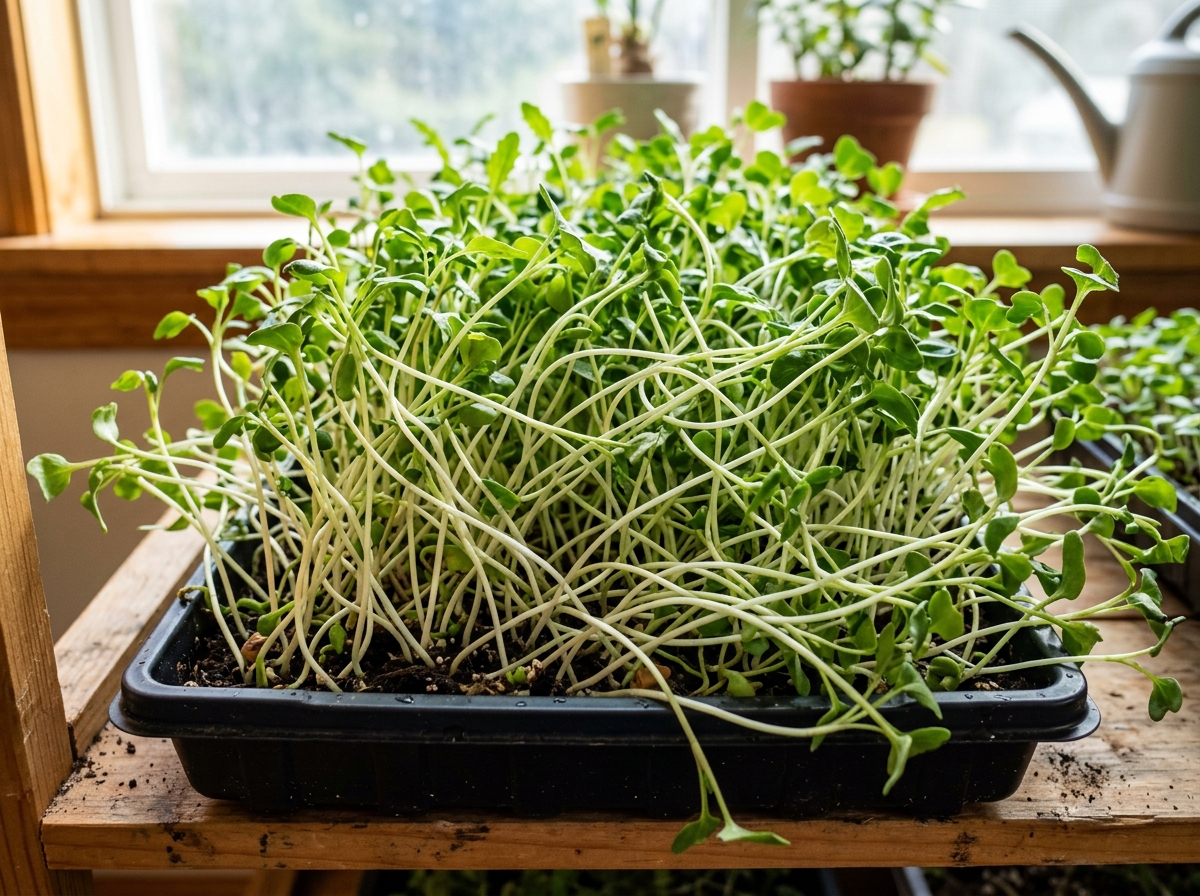
As the plant pushes past the 14-day mark, it begins to stretch. This is called stem elongation. While a tall plant might look impressive, in microgreens, it often leads to a “leggy” appearance. The stems become woody, the vibrant colors of the stems (like the bright pink of a radish or the purple of a cabbage) may start to fade or turn a duller green, and the overall texture loses that signature crunch, becoming much tougher to chew.
To ensure you don’t miss the peak window, we recommend Knowing Exactly When Your Microgreens Are Ready to balance flavor and nutrition perfectly.
Structural Changes: What Happens If You Let Microgreens Grow Past the Typical Harvest Window?
Biologically, a lot is happening under the surface. The plant is moving its energy from the seed’s stored starches to its apical meristem—the growing tip of the plant.
- Lignification: This is the process where the plant develops lignin, a complex organic polymer that makes the stems rigid. While great for a full-sized broccoli head standing in a field, it makes a microgreen taste like a piece of straw.
- Root Expansion: In a standard tray, roots have nowhere to go but sideways and down into a thin mat. As the plant grows taller, it demands more stability and nutrients, which a one-inch layer of soil simply cannot provide.
- Leaf Complexity: You will notice the leaves changing shape. A kale microgreen starts with heart-shaped cotyledons, but as it matures, it develops the ruffled, complex “true leaves” we recognize in the grocery store. According to Microgreen biological definitions, once these true leaves are fully expanded, the plant has officially graduated from the microgreen stage.
Nutritional Density: What Happens If You Let Microgreens Grow to Full Maturity?
At FinanceOrbitX, we like to think of microgreens as high-yield “nutrient stocks.” When they are tiny, their “market cap” of vitamins is concentrated in a very small “share” (the seedling). As the plant grows into a full-sized vegetable, that same amount of initial nutrient investment is spread across a much larger biomass.
Research shows that microgreens generally contain considerably higher levels of vitamins and carotenoids—about five times greater—than their mature plant counterparts. For example, red cabbage microgreens are famous for having exceptionally high vitamin C levels.
If you let them grow to full maturity, the total amount of vitamins in the whole plant might increase, but the density per gram decreases significantly. You would have to eat a giant bowl of mature kale to get the same nutrient punch found in a small handful of kale microgreens. If you want to capture that peak value, you should Master the Art of the Microgreen Harvest Today before the dilution begins.
The Challenges of Maturing in a Microgreen Tray
One of the biggest hurdles we face when letting microgreens grow is the environment they started in. Most microgreens are sown at an incredibly high density—hundreds or even thousands of seeds in a single 10×20 tray.
As these plants grow, they enter a “resource war.”
- Seed Energy Depletion: Initially, the plant lives off the energy stored in the seed. Once that’s gone (usually around day 10-14), it needs external nutrients.
- Crowding Stress: Imagine 500 people trying to live in a studio apartment. The plants compete for light, water, and the very limited nutrients in that thin layer of soil.
- Root Entanglement: The roots become so twisted and knotted together that they can’t effectively absorb water or oxygen. This leads to stunting, where the plant just stops growing entirely.
To avoid these pitfalls, it’s vital to Avoid These Common Microgreen Growing Mistakes like over-seeding if you plan on experimenting with longer growth cycles. Furthermore, dense trays are a breeding ground for pathogens. High humidity and low airflow between crowded stems often lead to “damping off” or mold. We always suggest using specific Tools to Prevent Mold in Microgreens to keep your crop healthy if you’re pushing past the two-week mark.
Why Most Microgreens Fail to Reach Maturity in Trays
The simple truth is that a microgreen tray is a “nursery,” not a “forever home.”
- Shallow Soil: Most trays use only 1 inch of medium. A full-grown radish needs 4-6 inches, and a kale plant needs even more.
- Fungal Risks: As the canopy thickens, air cannot circulate. This is when the white fuzzy mold usually strikes.
- The “One-and-Done” Nature: Many people ask, “Can you regrow microgreens after cutting?” For most varieties like radish, broccoli, and sunflower, the answer is no. Once you snip the stem, you’ve removed the growing point (the apical meristem), and the plant cannot recover.
Pros and Cons of Letting Your Microgreens Mature
Is it worth the wait? Let’s look at the “portfolio” of benefits and drawbacks.
| Feature | Microgreen Stage (1-3 Weeks) | Mature Stage (2-4 Months) |
|---|---|---|
| Nutrient Density | Extremely High | Moderate |
| Flavor | Intense, Spicy, or Sweet | Traditional Vegetable Taste |
| Texture | Tender and Crisp | Fibrous and Hearty |
| Space Needed | A Windowsill | Garden Bed or Large Pot |
| Maintenance | Low (Daily Watering) | High (Feeding, Pest Control) |
| Yield per Seed | Low (One tiny shoot) | High (One full vegetable) |
The Benefits of Full Maturity
If you decide to transplant your microgreens into a proper garden bed, there are some unique “dividends” to be earned:
- Seed Saving: If you let a radish or mustard plant grow to full size, it will eventually “bolt” and produce flowers, then seeds. You can harvest these seeds for your next round of microgreens!
- Edible Flowers: Many microgreen varieties, like nasturtiums or arugula, produce beautiful, spicy edible flowers once they mature.
- Larger Harvests: A single pea microgreen is a snack; a mature pea plant provides pods for weeks.
- Continuous Harvest: Some herbs, once mature, allow for a “cut-and-come-again” approach. While you’re at it, you can also learn How to Successfully Grow a Second Microgreen Crop to keep your kitchen stocked while your garden matures.
The Drawbacks of Delayed Harvesting
However, there are “hidden costs” to letting them grow:
- Space Requirements: One tray of microgreens can provide a salad for four people. If those same plants were grown to maturity, they would require an entire backyard garden plot.
- Pest Susceptibility: Microgreens grow so fast that pests usually don’t have time to find them. Mature plants have to deal with aphids, caterpillars, and slugs.
- Bitter Flavors: Some plants, like lettuce or cilantro, become very bitter once they start to mature or bolt in the heat.
- Time Investment: You’re moving from a 10-day “ROI” to a 90-day commitment.
How to Successfully Transition Microgreens to Maturity
If you want to see what happens if you let microgreens grow into full-sized plants, you can’t just leave them in the tray. You have to facilitate a “corporate merger” between the plant and a larger soil base.
Step-by-Step Transition:
- Thinning: You must remove about 90% of the plants in the tray. If you don’t, they will choke each other out.
- Root Separation: Gently tease the roots apart. If they are too tangled, it’s better to cut the soil into “plugs” and plant the whole plug.
- Transplanting: Move the strongest seedlings into a deep pot or a garden bed with at least 6-8 inches of high-quality potting soil.
- Nutrient Supplementation: Unlike microgreens, mature plants need fertilizer. Use a balanced organic liquid fertilizer to help them overcome the “transplant shock.”
- Light Adjustment: While microgreens can grow on a windowsill, mature plants usually need 6-8 hours of direct sunlight or high-intensity grow lights.
Best Varieties for Full Growth
Not all microgreens are created equal when it comes to “career advancement.”
- Radish & Bok Choy: These are the “fast-track” stars. If transplanted, they can produce full-size vegetables in just 4-6 weeks.
- Onions: These are a unique exception. Their roots don’t tangle as badly as brassicas, making them very easy to transplant into the garden.
- Pea Shoots: Peas are determined climbers. If you give them a trellis, they will happily grow several feet tall.
- Kale & Mustard Greens: These are incredibly hardy and can survive the transition well, providing leaves for months.
- Sunflower: If you transplant a sunflower microgreen, be prepared—it wants to be 6 feet tall!
Frequently Asked Questions about Microgreen Growth
Are there any microgreen varieties that should not be grown to maturity?
Yes! This is a critical safety point. You should never grow plants from the Nightshade family (Solanaceae) as microgreens, nor should you let them mature if you accidentally started them. This includes:
- Tomatoes
- Peppers
- Eggplants
- Potatoes
These plants contain toxic alkaloids like solanine in their stems and leaves. While we eat the fruit of a tomato, the greens themselves can make you very sick. Stick to brassicas, grains, and legumes.
Can microgreens regrow after the first harvest?
For the vast majority, the answer is a firm “no.” When you harvest, you usually cut below the lowest leaves, which removes the plant’s ability to photosynthesize and its “brain” (the apical meristem).
However, there are two famous exceptions:
- Pea Shoots: If you cut them high—leaving at least one “node” or a set of small leaves at the bottom—they will often grow a second, albeit slightly weaker, shoot.
- Wheatgrass: You can usually get 2 or even 3 “flushes” of wheatgrass, though the nutrient density drops with each harvest.
Is it worth the effort to let microgreens grow into full plants?
From a “financial” perspective in your home garden, it depends on your goals.
- If you want speed and nutrition: Stick to the 10-14 day harvest. It’s the most efficient use of space and time.
- If you want a traditional garden: It is actually cheaper and more effective to buy a packet of seeds and sow them at the correct spacing (e.g., one seed every 3 inches) rather than trying to “save” crowded microgreens.
Most experienced growers at FinanceOrbitX use microgreens for their quick “cash flow” of nutrients and separate garden beds for their “long-term investments” in mature vegetables.
Conclusion
Understanding what happens if you let microgreens grow is a rite of passage for every indoor gardener. While the allure of “infinite growth” is tempting, the microgreen lifecycle is specialized for speed, intensity, and high-density nutrition.
By letting them grow too long in a tray, you risk losing the very benefits—tenderness and concentrated vitamins—that make microgreens so special. However, for the curious gardener, transplanting a few hardy radishes or pea shoots can be a rewarding experiment in lifecycle mastery.
Whether you’re looking for a quick harvest or a long-term garden project, FinanceOrbitX is here to help you manage your botanical assets. Ready to diversify your indoor garden? Start your indoor garden journey today and discover the perfect balance between tiny shoots and big roots.
